
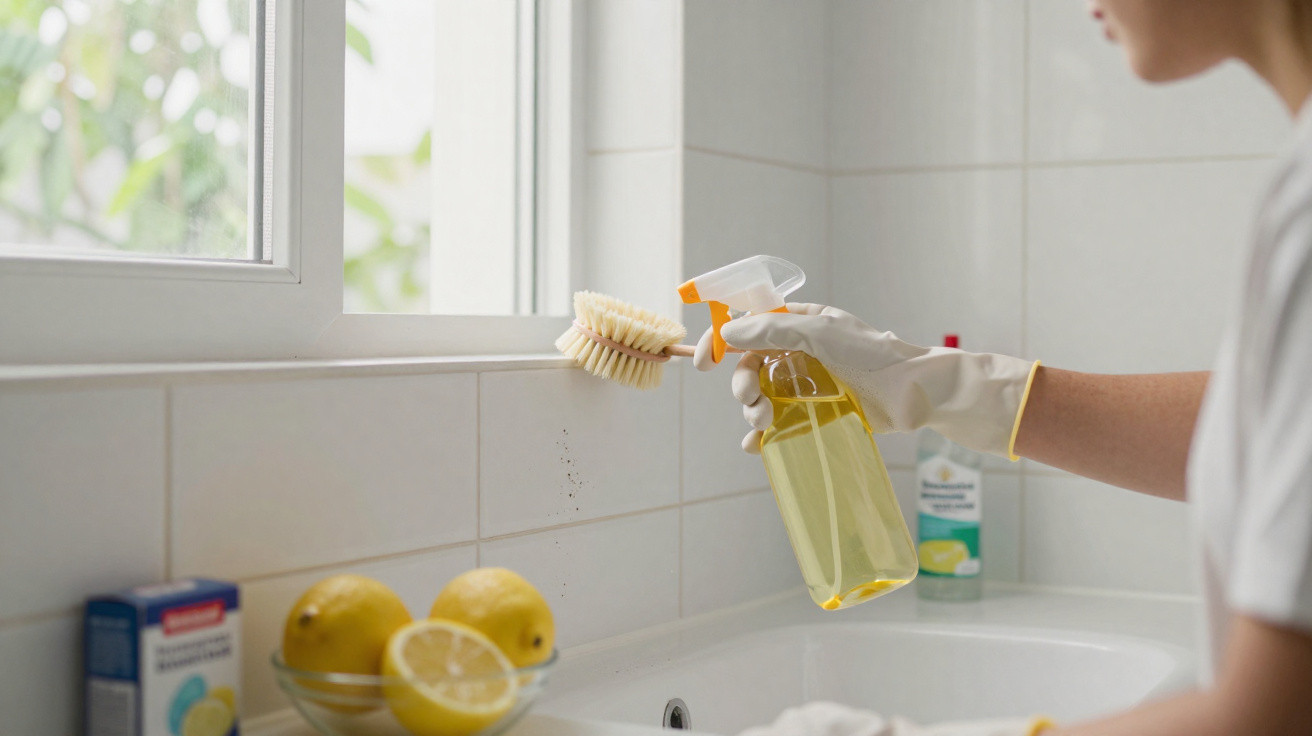
The bottle was in her hand already when she stopped.
Before she had even twisted off the lid, the heavy, biting smell of bleach caught at the back of her throat. Early sunlight stretched over the bathroom tiles, drawing attention to the usual black flecks in the grout, like little scorch marks. She had scrubbed them the previous month. And the month before that. It always went the same way: burning eyes, a short cough, stepping away to open the window, then hoping it had worked.
But this time, it did not seem right. The mould in the corner had spread rather than reduced. The silicone around the bath edge looked worn and ragged, as if one winter had added a decade to it. She found herself thinking: “How is this still here? I used the strongest stuff.”
Then came the thought people rarely admit: what if bleach is not helping at all?
Bleach, mould and your bathroom: what really happens
At first glance, bleach seems like a magic solution. Spray it on, watch the black marks disappear and leave the room smelling like a swimming pool. Yet the unseen problem is different. Bathroom mould does not simply rest on tile surfaces. It works its way into grout lines, pores, tiny fractures and behind silicone. Bleach largely acts on the surface and the mould's colour, rather than its roots.
The result is a bathroom that appears cleaner. Dark grey grout turns a pleasant pale cream, while the silicone looks brighter. Your mind settles: “Sorted, at least for now.” Meanwhile, however, the surviving spores are quietly rebuilding themselves in warm, damp gaps. A week or two later, the same black specks return with the same stubbornness. It is not so much cleaning as concealment.
There is a further complication. Over time, chlorine bleach can damage porous surfaces. That grout or silicone which is already worn? Every harsh application of bleach can leave it more brittle and absorbent. Not only might you fail to destroy the mould, but you could also be providing newer, softer material for it to colonise. It is like cutting the grass and feeding it fertiliser on the same afternoon.
Once you consider the figures, it no longer seems like a small irritation. Across the UK, damp and mould issues are reported in roughly one in five homes, particularly in bathrooms and kitchens. These are not necessarily neglected properties. Many are homes of people who clean routinely, keep purchasing more powerful sprays and regard bleach as the “proper” answer. A housing charity worker in London told me she can almost tell which tenants rely heavily on bleach simply from the scent in the corridor.
There is a personal cost as well. A young couple in Manchester I spoke to had been bleaching their shower every week throughout winter. Mould formed in the familiar pattern on the ceiling above the showerhead, with a trail of black dots around the window frame. They scrubbed until their fingers ached, opened the window and used the extractor fan. The mould still returned. The partner with mild asthma began coughing more after cleaning day than after running on a cold morning.
They believed they were “being strong” and “doing it properly”. Actually, they were exposing both their lungs and bathroom surfaces to a product that did not address the underlying cause: moisture and spores embedded in porous materials. Once they changed their approach - and used less bleach - the bathroom did more than look improved. Its smell changed, as did the air in the neighbouring bedroom.
Bleach has its reputation because it disinfects hard, non-porous surfaces such as stainless steel and glazed tiles. The situation is different with living mould in a bathroom that remains damp. Bleach is water-based, and a significant amount of that water can enter porous grout. Its chlorine content soon evaporates or breaks down, whereas the added moisture may encourage mould to grow further within the material. This is why black specks often return in precisely the pattern you had scrubbed away.
With silicone, the danger is slightly different. Strong bleach may weaken the seal, create pitting and form tiny openings through which moisture can get behind the bath or shower tray. Once water is trapped there, mould has its ideal setting: dark, still and difficult to access. You spray, the marks fade and the surface looks acceptable, while out of sight the issue gradually gets worse.
Your body matters too. When bleach comes into contact with organic material - mould, dust or even residue from other cleaning products - it can produce more irritating gases. A tight throat, stinging eyes or a dull headache an hour afterwards are not merely the “smell of clean”. They are your airways reacting. For people with asthma, children, pets or anyone with sensitive lungs, that trade-off can look particularly bleak.
What to do instead when mould appears in your bathroom
Begin by changing the question. Rather than asking, “How do I blast this with something stronger?”, ask, “How do I stop this from having a home here?”. The first step is not a product but air. Fully open the window after every shower, rather than leaving it just slightly ajar. Keep the extractor fan running for at least 20 minutes after you finish. If the fan sounds like a tractor yet can barely hold a tissue against its grille, it needs cleaning or replacing.
Next, deal with the mould itself carefully and locally. On ceramic tiles and grout, a specialist hydrogen peroxide-based mould remover usually performs much better than standard bleach sprays. Apply it, allow time for it to penetrate, lightly scrub with an old toothbrush, then rinse. When silicone is heavily stained or breaking down, the most effective form of “cleaning” is often to cut it away and apply a new bead of anti-mould silicone. It may feel extreme, but once it is done, those stubborn black lines frequently stop coming back.
Gentle, focused tools are better than harsh, broad attacks. Microfibre cloths trap spores rather than merely spreading them around. A small squeegee kept in the shower can remove 30 seconds' worth of moisture every day. Let us be honest: hardly anyone actually does that daily. Still, doing it several times a week is far kinder to both your bathroom and lungs than soaking everything in bleach each Sunday.
The main trap is waiting until mould becomes a “big job”. During a busy weekday, it is easy to notice one small black dot in a corner and think, “I’ll deal with that when I scrub the whole bathroom.” Then weeks go by. The dot turns into a streak. In a hurry, you reach for the bleach. You cover a large area, inhale the fumes, scrub furiously and finish exhausted and frustrated. In the meantime, the mould has had weeks to establish itself.
A simpler routine is this: as soon as you see one patch, tackle only that spot within a day or two. If the affected area is larger than your hand, wear a mask, open the window and use a non-bleach mould remover or diluted hydrogen peroxide solution. Wipe carefully rather than angrily. Afterwards, dry the area using a separate cloth, so it is not left wet. Small, calm actions are more effective than huge “deep clean” battles in which nobody wins.
People also overlook the bathroom's concealed routines. A bathmat that stays wet, a shower curtain that never dries completely and bottles packed onto a window ledge, each holding little pools of moisture, all give mould more space to occupy. Choosing a quick-drying synthetic mat, hanging towels separately so they can dry and leaving a small gap between bottles and walls removes three of mould's preferred hiding places without purchasing any additional product. Sometimes the cleverest cleaning trick is simply rearranging the scene.
“Bleach makes bathrooms look cleaner, not necessarily healthier,” says one building surveyor I spoke to. “If the room is still damp, the mold isn’t gone. It’s just regrouping where you can’t see it.”
- Ventilate for at least 20 minutes after showers, even during winter.
- Use mould-specific, non-bleach cleaners on grout and tiles.
- Replace badly stained or damaged silicone instead of scrubbing it indefinitely.
- Keep surfaces as dry and free from clutter as everyday life permits.
- Pay attention to your body: if a product makes you cough or wheeze, it is not “just the smell”.
Rethinking “clean”: less drama, more breathing space
Once you begin looking closely, bathrooms reveal small stories. Paint peeling above the shower. One black mark in a window corner that somehow becomes a constellation. The patch hidden behind a shampoo bottle you never move. We have all stood there holding a spray bottle, partly irritated by the mould and partly by ourselves, wondering why it has to be such a struggle.
That is why the bleach myth has such staying power. It offers immediate control: spray, sting, wipe, forget. Yet healthy walls and clean air are not created through drama. They come from unremarkable, almost invisible routines - opening a window, running a quiet extractor fan that works properly, wiping up a splash before it turns into a stain. It is less “battle against dirt”, and more “don’t give it a battlefield”.
When you mention this to friends or family, another pattern becomes clear: almost everybody has a bleach-and-mould story. A coughing fit. A damaged towel. A bathroom that smelled like a public pool for hours. Moving away from bleach as the main weapon does not mean “doing less”. It means taking the right steps, more slowly and with less damage. Perhaps that is the quiet change our steamy, overworked bathrooms have been waiting for.
| Key point | Detail | Why it matters to the reader |
|---|---|---|
| Bleach conceals rather than solves bathroom mould | It often removes only surface staining, leaving spores and roots in grout and silicone | Helps explain why mould repeatedly returns in the same places |
| Moisture control is more effective than harsh chemicals | Ventilation, working fans and dry surfaces limit mould's ability to grow | Provides practical steps that protect both health and home |
| Safer alternatives and repairs are more effective in the long term | Hydrogen peroxide cleaners and re-sealing silicone prevent recurring outbreaks | Sets out a clear, realistic way to change habits without extra drama |
FAQ:
- Does bleach ever work on bathroom mould? On hard, non-porous surfaces it can lighten stains and kill some spores, but in grout and silicone it often fails to reach the roots and may worsen the problem over time.
- What should I use instead of bleach on mouldy grout? Use a hydrogen peroxide–based mould remover or a diluted 3% hydrogen peroxide solution, let it sit to penetrate, then gently scrub and rinse while keeping the room well ventilated.
- Is bathroom mould dangerous for my health? Long-term exposure, especially in small, unventilated bathrooms, can irritate airways and worsen asthma, allergies, and some respiratory conditions, particularly in children and older people.
- When do I need to replace silicone rather than clean it? If the silicone is cracked, badly stained deep through, or coming away from the surface, cleaning is usually a temporary fix and re-sealing is the more effective long-term solution.
- How can I stop mould from coming back after I’ve cleaned it? Reduce moisture by improving ventilation, drying surfaces after showers, using a decent extractor fan, and avoiding clutter that traps damp air around walls and window frames.



Comments
No comments yet. Be the first to comment!
Leave a Comment