
You pull open the kitchen drawer and stop short. Towels are wedged at the back in a tangle: some are slipping open at their folded edges, while others have been rolled into uneven sausage shapes that still seem to consume far too much room. All you wanted was one to dry a mug, yet suddenly your arm is buried in a cotton mess. The drawer will not shut properly, one corner catches, you press harder, and another pile topples into disorder.
You close it quickly, as though you have stumbled across something you were never meant to see.
Yet one straightforward folding technique can quietly transform the entire situation.
The kitchen drawer issue everyone has, but nobody mentions
We buy attractive kitchen towels as though they are miniature decorative pieces: stripes, checks, linen, waffle-weave cotton and cheerful patterns chosen on impulse in the supermarket. But eventually they are all crammed into one overloaded drawer, where the newest towels disappear beneath stained old favourites from three flats ago. The drawer appears packed, but the towel you actually need is somehow impossible to find.
That is the oddity of kitchen storage. It seems insignificant, until it starts quietly costing you time and energy every day.
One home organiser I spoke with called opening a client’s towel drawer “peeling back layers of someone’s kitchen history”. On top were two or three respectable folded stacks. Below sat another twenty towels, including faded festive logos and souvenir designs from a long-forgotten holiday. In most homes, she explained, towels occupy twice the space they need purely because they have been folded the wrong way.
We all know the moment: you pull out one towel and three more come with it, like unwilling flatmates refusing to let go.
There is a reason this mess develops. Most of us still rely on the familiar horizontal pile: rectangular towels folded in half, then into thirds, and stacked on top of one another. It stays presentable for perhaps half a day. Then everyday life intervenes. You reach for one in the middle, cook in a hurry, or deal with a spill that needs washing. The entire stack falls apart.
Your towels are not the issue, nor is the drawer. The problem is their direction. Horizontal piles topple; vertical rows hold.
The vertical fold that makes a kitchen towel drawer work like a filing cabinet
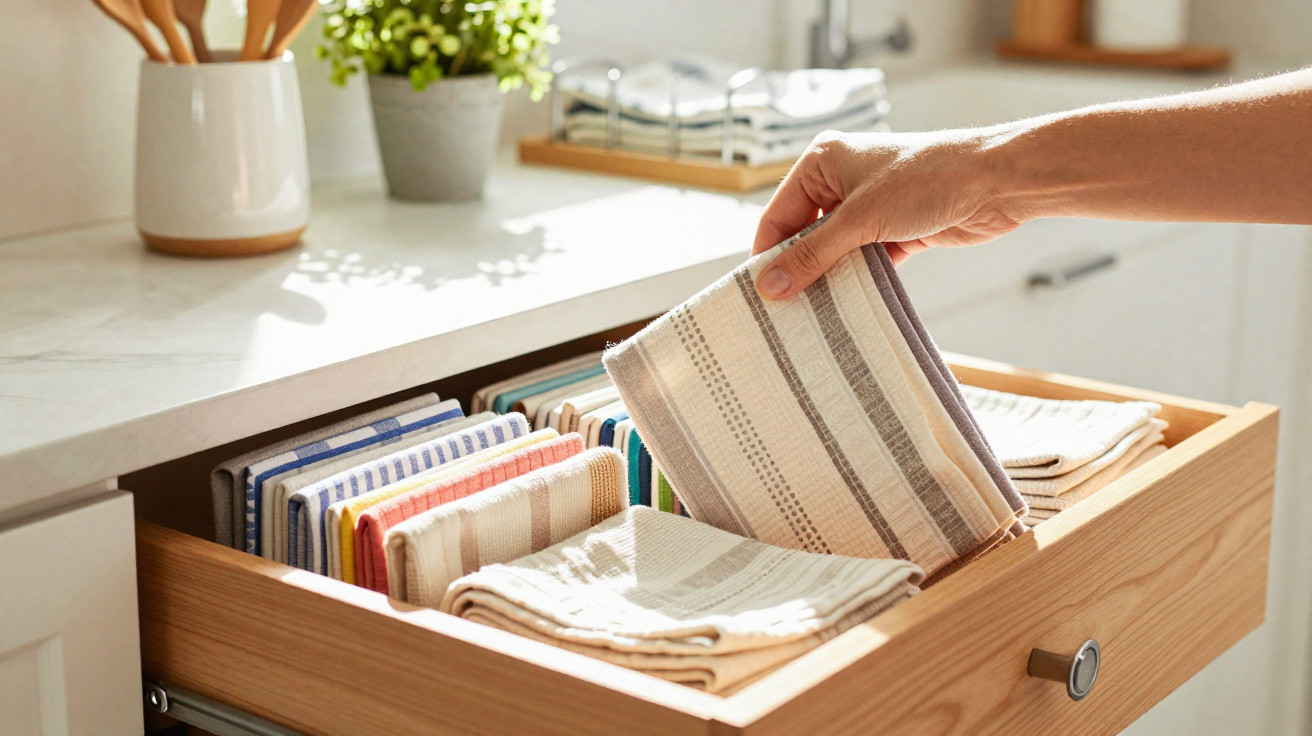
The technique that discreetly creates more drawer space is the upright, or “file”, fold. Spread the towel flat and quickly smooth it with your hands. Fold it in half lengthways, then fold it into thirds along its length again, creating a long, tidy strip. Next, fold that strip across into thirds or quarters until it becomes a compact rectangle able to stand on its edge unaided.
Rather than building a stack, you are creating a line of upright files: a small towel library.
The essential point never changes: each towel must support itself. If it flops over, open it out once and refold it using slightly smaller sections to make the fabric firmer and more compact. Where eight flat-lying towels once fitted, you can suddenly place twelve to fifteen upright, with every one visible immediately. The drawer shifts from an untidy heap to a peaceful, colourful row.
Realistically, nobody follows this routine every single day. However, if you do it once after washing day, the result lasts longer than you might think.
What catches most people off guard is not the added space, but the relief of opening the drawer and locating exactly what they need within two seconds.
“Before, I used to yank the whole pile just to get the blue towel at the bottom,” says Nora, a mother of three who tried the vertical fold after a Sunday laundry marathon. “Now the kids can grab their own without destroying everything. I didn’t buy a single organizer. I just changed the fold.”
- Begin by folding lengthways, then adjust the final dimensions so the towel stands upright.
- Sort towels according to purpose: drying dishes, drying hands and heavy-duty cleaning.
- Keep the towels you use most often at the very front of the row.
- Leave 2–3 older cloths at the back for emergencies or particularly dirty tasks.
- Check the fold: if a towel falls, alter it once until it “clicks.”
One small action with a calm effect across the kitchen
When the towels stand in the drawer like files, another benefit emerges: you stop buying too many. You can clearly see what you already have. Stained towels become immediately noticeable, while the faded souvenir cloth from that 2012 road trip suddenly seems misplaced. As they fold, many people naturally begin sorting, making one orderly row for their best towels, another for “backups”, and a small corner for cleaning rags. The drawer becomes a tiny place for making decisions, where everyday life feels a little easier.
Open, choose, close. No struggle and no avalanche.
| Key point | Detail | Value for the reader |
|---|---|---|
| Vertical “file” folding | Towels remain upright rather than lying flat | Frees up space immediately and keeps drawers stable |
| Visual overview | Every towel can be seen at a glance | Quicker selection and less frustration in busy moments |
| Natural decluttering | Worn or damaged towels become clearly visible | Makes it simpler to part with items that no longer help |
FAQ:
- Question 1 What if my drawer is very shallow and the towels can’t stand upright?
- Answer 1 Apply the same file-fold approach, but make slightly flatter rectangles. Position them diagonally, or place a low box or cut-down shoe box in the drawer so the towels can lean rather than stand completely straight.
- Question 2 Does this method work with thick, fluffy kitchen towels?
- Answer 2 Yes, although you should use fewer folds. Fold them lengthways once, then into thirds, and check whether they stand. If they remain too bulky, keep thicker towels at the back and lighter ones at the front.
- Question 3 How many towels should I realistically keep in the drawer?
- Answer 3 Most households manage well with 8–12 everyday towels within easy reach. Store additional seasonal or spare towels in a higher cupboard to keep the drawer straightforward.
- Question 4 Will the towels get more wrinkled folded like this?
- Answer 4 No. The folds are compact and uniform, and towels often appear smoother because they are no longer crushed beneath a heavy pile whenever you open the drawer.
- Question 5 How do I keep the system from falling apart over time?
- Answer 5 Link it to your laundry routine. As clean towels come in, fold them upright and slide them into the row. Every few weeks, remove one or two older towels and reassign them as cleaning rags or send them for recycling.





Comments
No comments yet. Be the first to comment!
Leave a Comment