
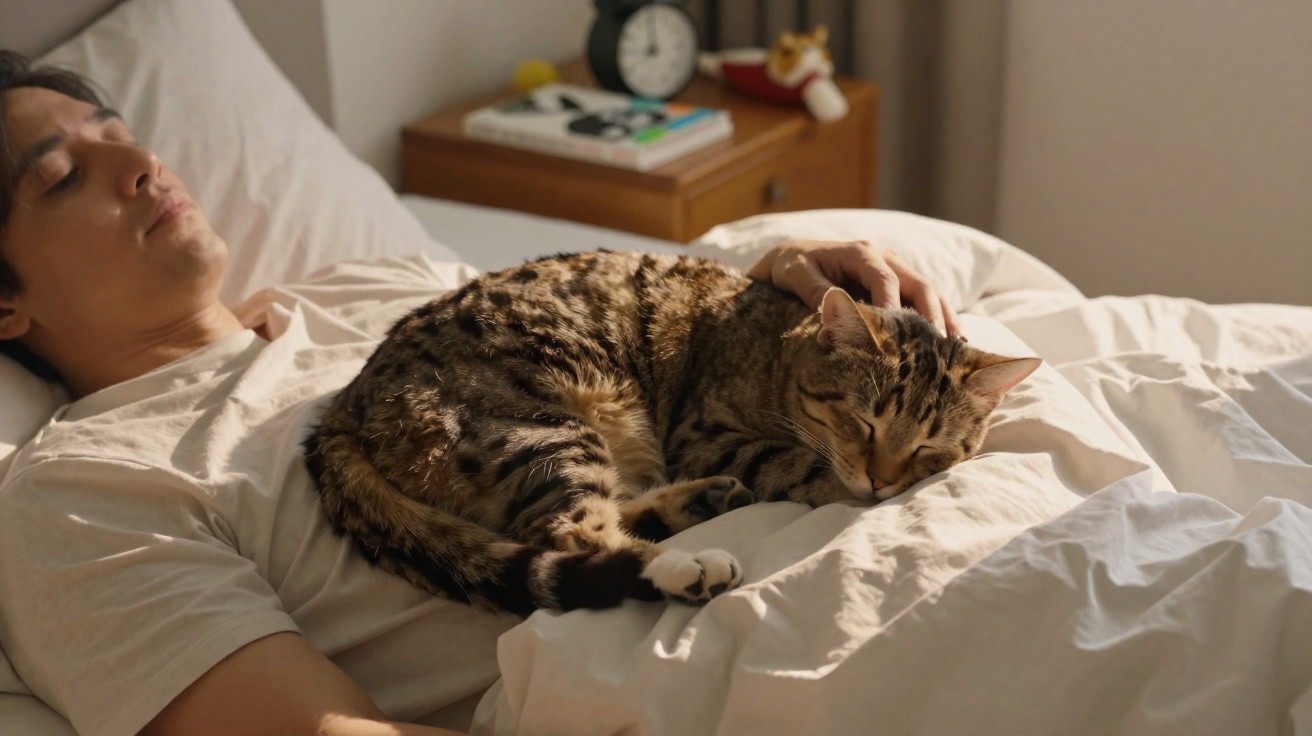
Many cat owners witness the same drowsy routine each day without noticing what it subtly says about the relationship they have with their pet.
Your cat’s preferred place to sleep can seem arbitrary, or even a little irritating, but behaviourists say it carries an unmistakable message. It is much less about physical comfort than about the degree of safety your cat associates with you.
Why your cat sleeps on you (and not the expensive bed)
Every cat owner knows the scenario: you purchase a luxurious bed, a window hammock and perhaps a heated mat, only for your cat to ignore every option and sleep on your chest, lap or beside your head at 3 a.m. Behaviourists say this does not mean your cat is being difficult. Instead, it is selecting what it considers the safest spot in the home.
Although domestic cats live indoors, their survival instincts are still present. Sleeping leaves them exposed. They look for warmth, protection and a means of escaping quickly. Experts say that when a cat repeatedly chooses the same place on, or close to, your body, it is unlikely to be coincidental.
According to pet behaviourists, a cat that regularly naps on your chest or curls behind your knees usually signals deep trust, not dominance or neediness.
Owners frequently misunderstand this behaviour. Some believe their cat is attempting to “claim” them as property, while others fear their pet is insecure or overly attached. Behavioural science offers another explanation: cats generally sleep wherever they feel most protected, and that place is often their owner.
The one spot that screams trust: your chest or upper body
Of all the places cats choose to sleep, behaviourists identify the chest or upper torso as particularly significant. When a cat settles there, several factors come together.
The sound of your heartbeat and breath
Your chest creates a gentle, regular background of breathing, heartbeat and slight movement. For a cat, this rhythm can echo the reassurance of resting beside its mother or littermates. Many kittens sleep together in warm heaps during early life, and that remembered feeling appears to endure.
Behaviourists say adult cats that actively seek your chest generally feel safe enough to enter deep sleep, rather than the light, “half-alert” nap they reserve for unfamiliar settings.
When a cat sleeps so deeply on your chest that its body goes limp, it often shows that the animal sees you as a safe shelter, not just a food source.
Heat, scent and shared territory
Your upper body gives off steady warmth, while your skin and clothing hold a familiar smell. Both are important. Cats interpret much of the world through scent, and your smell forms part of the territory they regard as secure. Sleeping directly against it reinforces that security.
This does not indicate that your cat wants to possess you in a territorial sense. Behaviourists describe it another way: the cat includes you in its idea of home. You become more than a provider of resources and instead form part of its “social group”, including in a one-cat household.
How most owners misinterpret this sleepy signal
As cats are seen as independent animals, many people interpret close physical contact as neediness or manipulation. Behaviour consultations often begin with concerns such as “He’s so clingy, he won’t get off my chest at night.”
Experts highlight three frequent misconceptions:
- “He’s trying to dominate me.” A cat’s choice of sleeping place seldom indicates social dominance. It is normally about warmth and security.
- “She’s anxious without me.” A worried cat is more likely to pace, hide or over-groom than to fall asleep on someone.
- “He only wants heat.” Radiators and laptops also provide warmth, but many cats still choose a human who is breathing.
When a cat places its full body weight on your chest, shows its stomach or sleeps with its back towards you, behaviourists consider this evidence of confidence. A frightened cat stays prepared to react. A calm cat accepts the vulnerability of dropping its guard.
Other high-trust sleeping spots you might overlook
The chest is not the sole sleeping location that conveys trust. Behaviourists identify several regular favourites that communicate much the same thing.
| Sleeping spot | What behaviourists read from it |
|---|---|
| Behind your knees | The cat treats your body as a warm barrier and feels secure enough to confine itself in a corner. |
| On your pillow, near your head | The cat seeks closeness to your scent and breath, while putting slightly less weight on you. |
| Across your lap | During quiet periods, the cat picks your company over any available nearby surface. |
| Next to you with back turned | The cat is sufficiently secure to face away from you and leave its spine exposed. |
The location itself remains relevant. A cat that sleeps exclusively on high shelving or in concealed corners may be more wary. One that alternates between your body, the sofa and a windowsill is likely comfortable at home and simply changing places for comfort.
When your cat’s sleep habit signals a problem instead
A change in sleeping behaviour does not always represent affection. Behaviourists encourage owners to consider the wider pattern, as a sudden difference may indicate illness, pain or stress.
Red flags to watch for
Each of the following changes warrants closer attention:
- Your cat abruptly ceases sleeping on or near you after doing so for months or years.
- Following a house move, a new pet or a baby, your cat begins clinging to you and sleeping on your chest.
- You notice louder snoring, difficult breathing or trouble jumping onto the bed.
- Sleep becomes highly interrupted, accompanied by pacing or loud night-time meowing.
Sudden changes in where and how a cat sleeps can signal pain, breathing issues or emotional stress, not a shift in affection.
Behaviourists commonly work with vets. Discomfort caused by arthritis, dental disease or heart problems may lead a cat to seek new positions or warmer places. If a previously trusted routine suddenly disappears, it deserves medical assessment before anyone attributes it to “attitude.”
How to respond when your cat chooses you as a bed
For light sleepers, a 4 kg “fur blanket” on the chest may feel far from romantic. However, roughly forcing a cat away can undermine its trust. Behaviourists recommend considerate compromises that protect both the cat’s attachment and your comfort.
Setting kind boundaries
When your cat obstructs your breathing or disrupts your sleep, calmly reposition it rather than pushing it off. Put a soft blanket beside your pillow, or position a warm bed close to you at chest height. Move the cat there while using the same phrase on every occasion.
Within days or weeks, many cats understand the new boundary while continuing to sleep within arm’s reach. You have more room and your cat retains closeness. For an anxious or recently adopted cat, this arrangement can help the bond develop more quickly without spoiling your sleep.
What science says about cat–human attachment
Studies from several universities now indicate that many cats develop attachment patterns towards people which are unexpectedly similar to those observed in dogs and human infants. Some demonstrate secure attachment: they are relaxed when their owner is there and manage reasonably well when left alone.
Others display more anxious or avoidant tendencies. Sleeping choices can offer hints. A securely attached cat may nap on your chest one day and in a patch of sunshine the next, feeling equally at ease in both places. A more anxious cat may remain constantly close to you or hide when its routines alter.
Where a cat sleeps, and how deeply it relaxes in that spot, often reveals more about its emotional security than daytime play does.
Behaviourists are increasingly assessing sleep routines during consultations. They ask owners where a cat sleeps in the daytime, where it stays overnight, and what it does when its owner moves or leaves the room. This unobtrusive information can reveal much about trust, stress and tension in the household.
Turning a sleepy habit into a healthier routine
When your cat already sleeps on your chest or nestles against you, the routine can support better general welfare. Take advantage of this peaceful time to carry out a brief body check using gentle strokes, feeling for lumps, matted fur, tender areas or unexpected flinching. Keep these checks short and calm so the cat continues to regard the place as safe.
You can also build other pleasant bedtime associations, including a brief grooming session or a short play period before the lights go out. Cats that use up energy immediately before bedtime often sleep more deeply and create fewer 4 a.m. wake-up calls.
In homes with children, a much-loved sleeping place provides a useful lesson. Explain to children that a cat selects particular people and positions only when it feels safe. Help them understand that quiet behaviour, gentle voices and dependable routines build this level of trust. A child who knows why a cat chooses one lap rather than another will often treat the animal more respectfully.
More deeply, the straightforward nightly decision of a cat settling on your chest rather than a cushion reflects thousands of years of shared human-feline history. An animal that was once a solitary hunter now sleeps in time with a human heartbeat. Behaviourists see this as understated proof that the relationship is working, even when you wake to a whisker across your face.






Comments
No comments yet. Be the first to comment!
Leave a Comment