
The first sign is often audible.
It is the faint hiss of sprinklers running in the middle of the day, water gathering on leaves that never needed a daily soaking, and puddles appearing in places where little ever grows. From the window, coffee in hand, you watch the lawn consume more water than the household, while the beds still look exhausted by August. The water bill rises. The soil splits. The plants sulk.
You begin to wonder whether the weather is not the real issue.
It is the design.
Something about the way the garden was planned is steadily draining your water supply.
You are far from alone in thinking that.
Your garden drinks like a leaky bathtub
Walk along almost any suburban street in high summer and water waste is easy to spot. There are lawns mown as short as golf greens, borders planted with thirsty annuals, and narrow strips of turf trapped between a drive and the pavement that nobody genuinely uses. Everything runs on one timer and receives the same extended watering, regardless of the plant or soil type.
The plants reveal the truth only once the heat arrives: brown areas, wilted flowers and mildew in spots where sprayed water never properly dries.
One landscape architect I spoke to described a typical job: a 200-square-metre garden in a semi-arid city. Before its redesign, the household used roughly 1,000 litres a day for irrigation at the height of summer. It had a level green lawn, several roses and boxwood spheres pushed up against the fence. It looked attractive in photographs, but was desperately thirsty in reality.
When the layout was reconsidered with shade trees, deeply mulched beds and fewer water-hungry plants, use fell by almost half. The plot was unchanged. So were the climate and the family. The design approach was different.
The principle is almost frustratingly straightforward. A garden planned as a showroom rather than an ecosystem ends up battling its own climate. Shallow-rooted plants are placed in exposed positions. Lawns are extended into blazing sun where gravel or groundcover could flourish. Beds are raised where water drains away too quickly, or compacted where it cannot soak in at all.
You then make up for it with extra watering, longer programmes and additional sprinklers. What appears to be a “thirsty garden” is often simply a layout that overlooks the way water travels through roots, shade and soil.
Redesigning the garden so water does the work
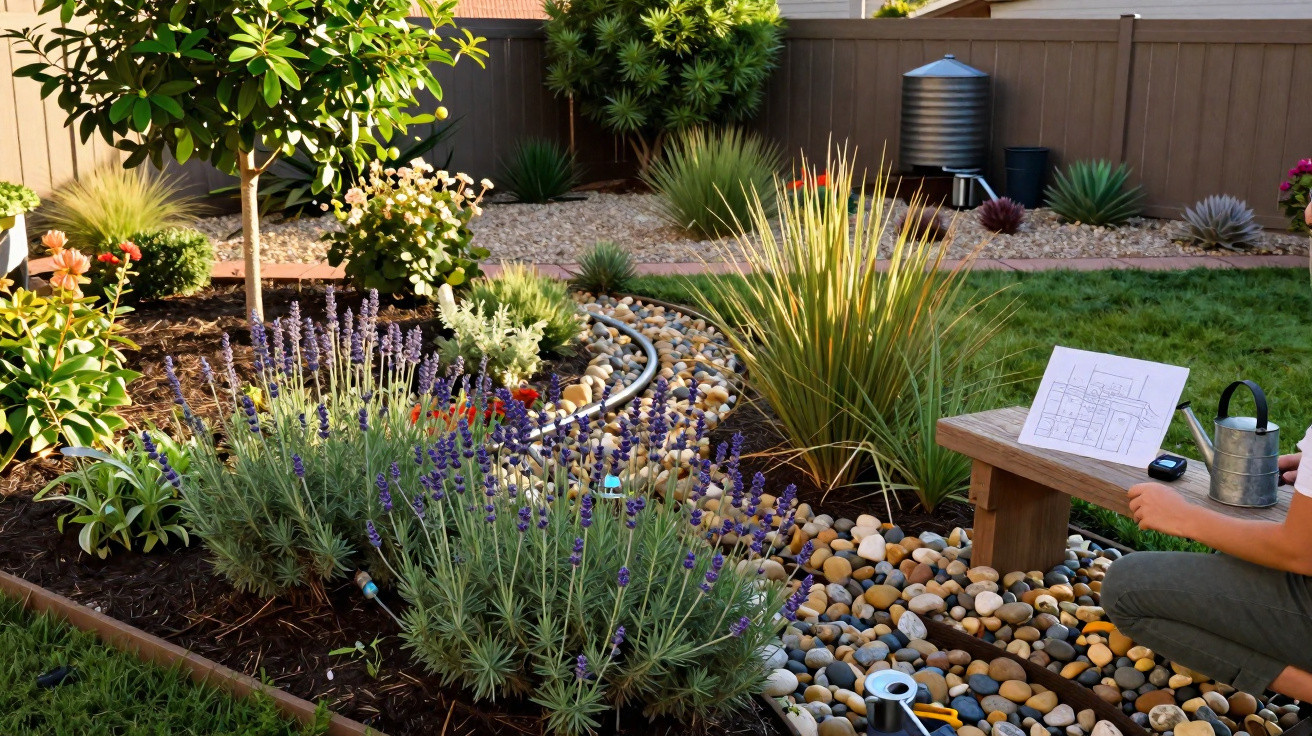
The most effective water-saving step seldom begins with a hose. Start instead with a basic sketch. On a blank sheet, roughly outline your garden and identify three things: areas of full sun, naturally shaded areas and places where water gathers after heavy rain. Do not labour over it; this should be a five-minute map rather than a technical plan.
Once those areas are visible, you can begin relocating the thirstiest plants, at least on paper, to shadier or wetter positions. Keep the hottest areas for durable, drought-tolerant plants or hard landscaping.
A reader near Madrid offered a small example. Her south-facing front garden looked picture-perfect, with an emerald lawn, hydrangeas and a line of lavender. It also consumed almost as much water as her kitchen and bathroom put together. By July, the hydrangeas were scorching, so she watered still more.
A designer friend proposed a major change: halve the lawn, remove the hydrangeas and enlarge a gravel bed planted with Mediterranean perennials that genuinely tolerate heat. The footprint stayed the same, but the zoning became far clearer. A year later, the lawn remains green, the replacement plants are flourishing, and the irrigation programme is largely on “set and forget”.
This approach to zoning succeeds because each plant is essentially a small water strategy on legs. Some species are made for dry conditions, with waxy foliage and deep roots. Others, including hydrangeas or roses growing in full sun, are drama queens. If the design puts them all under one watering routine, something will inevitably suffer.
The real answer is therefore not cleverer equipment but better grouping: deep-rooted trees together, sun-resistant perennials together and shade-loving plants in cooler corners. Your hose should follow the logic of your planting map, not the other way round.
The small, almost invisible habits that save thousands of litres
After the overall layout begins to make sense, the next stage is remarkably practical: soil, mulch and roots. Think of soil as a sponge. A bare, compacted sponge sheds water; a loose sponge rich in organic matter retains it and releases it gradually to roots. One very simple approach, then, is to nourish that sponge.
Apply compost in a thin layer once or twice annually, then cover it with 5–8 cm of organic mulch: shredded bark, leaves, wood chips or even chopped prunings.
Many gardeners miss this step because it can seem untidy or “unfinished” beside bare, immaculate soil. We have all had that feeling after an afternoon of weeding, when everything needs to look perfectly orderly. In truth, nobody maintains that every single day.
Bare earth is rather like leaving the fridge door open in August. It gives up moisture, bakes hard and makes plants root near the surface. Mulch cools the soil, reduces evaporation and encourages roots to grow downwards, allowing them to cope with longer intervals between watering without going on strike.
“Think of mulch as your garden’s shade cloth,” says one sustainable landscaper I interviewed. “You wouldn’t sit in full sun at noon without a hat, but we expect our soil to do exactly that.”
- Mulch depth
Use 5–8 cm around most plants, while leaving a small space clear around trunks and stems. - Watering rhythm
Less frequent but deeper watering encourages roots to grow down rather than remain at the surface. - Plant choices
Choose species suited to the local climate, particularly native plants that developed alongside your usual rainfall. - Smart irrigation
Drip lines beneath mulch lose less water to wind and evaporation than overhead sprinklers. - Hardscape swaps
Exchange small, impractical grass strips for permeable gravel or low-water groundcovers.
A garden that sips, not gulps
Eventually, the question changes from “How much should I water?” to “What sort of garden am I expecting this climate to sustain?” Sustainable design does not require sacrificing beauty or creating a desert of stones. It means matching the look of the garden to what your weather, soil and available time can realistically provide.
There is a subtle elegance in a border that performs well in both dry and wet years, filled with plants selected because they suit the site rather than because they happened to be discounted in spring.
You begin noticing other details: how a tree canopy reduces evaporation, how rain settles in a shallow swale before gradually filtering into the soil, and how native grasses move in the breeze without demanding a daily drink. The more fully you embrace this kind of design, the less guilt you feel whenever you turn on the tap.
Perhaps your garden will no longer resemble your neighbour’s. Perhaps that is exactly the point.
| Key point | Detail | Value for the reader |
|---|---|---|
| Design by water zones | Arrange plants according to their sun, shade and water requirements instead of mixing them together | Cuts wasted irrigation and helps more plants stay healthy |
| Improve soil & mulch | Compost and a 5–8 cm mulch layer make soil a more effective water sponge | Reduces watering frequency and shields roots during heatwaves |
| Swap thirsty areas | Replace some lawn or high-demand beds with climate-adapted plants or permeable hardscape | Lowers water bills while retaining an appealing, usable garden |
FAQ:
- Question 1 How can I tell whether my garden design is wasting water?
- Question 2 Is it still possible to keep a lawn in a water-wise garden?
- Question 3 Are native plants invariably the best option for conserving water?
- Question 4 Does drip irrigation genuinely perform better than sprinklers?
- Question 5 What is one change I could make this weekend to reduce watering?





Comments
No comments yet. Be the first to comment!
Leave a Comment