
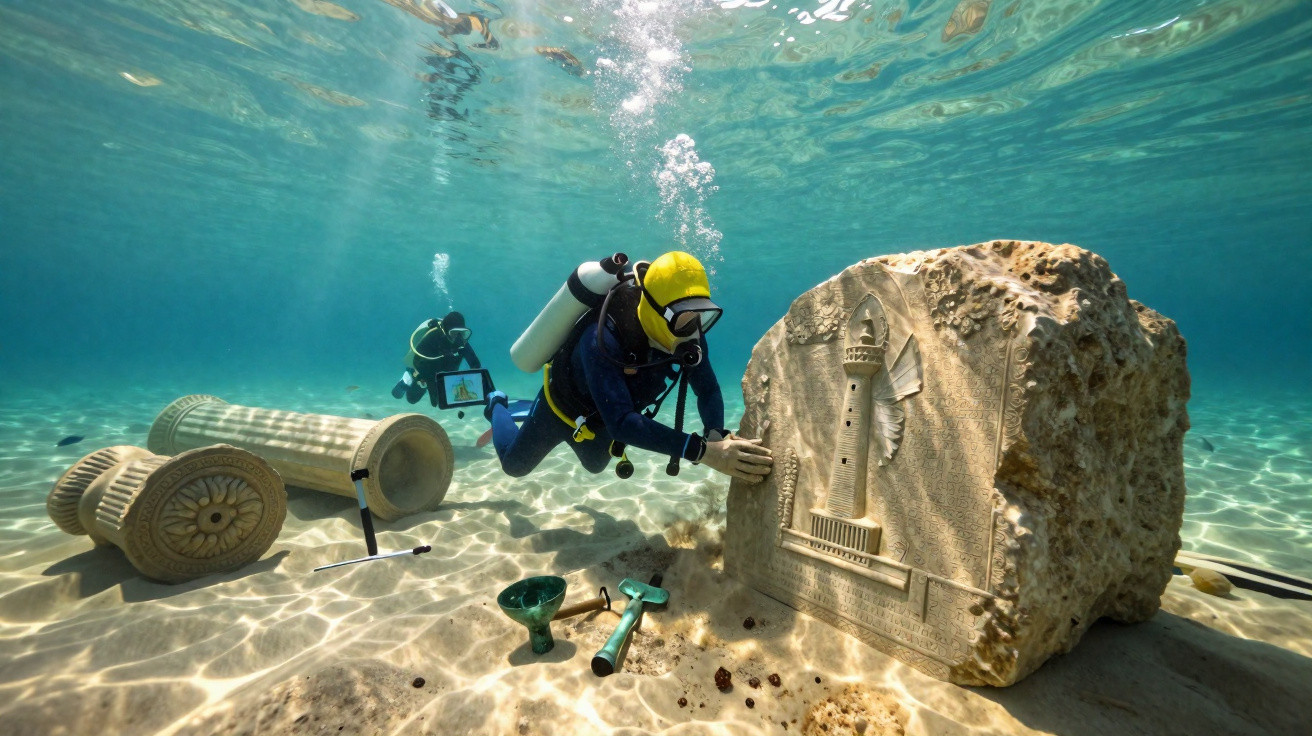
Off the coast of Alexandria, archaeologists have recovered enormous stone blocks from the seabed, belonging to one of the ancient world's best-known structures. The discoveries come from the legendary Lighthouse of Alexandria, one of the traditional ‘Seven Wonders of the World’, which sank beneath the sea more than 1,600 years ago. These latest finds give researchers an unusual opportunity to reconstruct the monument more faithfully and retell its history.
Heavy-lift recovery in Alexandria harbour
In Alexandria harbour, a specialist crane raises a stone block several metres long from the water. Divers carefully guide the load, boats secure the area, and archaeologists and engineers are already waiting on shore. It resembles a scene from an adventure film, but the work is firmly rooted in science.
So far, researchers have recovered 22 enormous architectural elements from the seabed around the ancient harbour. They have conclusively linked the stones to the celebrated Lighthouse of Alexandria. Some individual pieces are so large that even modern floating cranes are pushed close to their limits.
Particularly spectacular are fragments from a monumental gateway, estimated to weigh as much as 80 tonnes per piece, together with a massive pillar that probably formed one of the principal supporting or entrance elements.
The blocks remained embedded in sediment for more than 1,600 years. Saltwater, currents and earlier earthquakes have all left their marks, yet a remarkable number of details survive. Delicate tool marks, joints and fixing points for metal clamps provide evidence of the structure’s construction method and stability.
Why the Lighthouse of Alexandria became so famous
The lighthouse was built around 280 BC during the rule of Ptolemy II. At that time, Alexandria ranked among the Mediterranean’s leading trading centres, and its harbour was exceptionally busy. Vessels from Greece, Asia Minor, North Africa and, later, Rome arrived there.
To improve the safety of navigation while also displaying the city’s power, the Ptolemaic ruling dynasty commissioned a lighthouse on a scale never seen before. It is now estimated to have stood more than 100 metres tall, placing it among the tallest man-made structures of its era.
Its design was sophisticated and highly advanced for the period:
- a substantial rectangular base serving as the foundation
- a multi-storey octagonal central section above it
- a cylindrical upper structure with a platform for the fire
Ancient accounts state that an open fire burned at the summit, intensified by mirrors or reflective metal surfaces. Mariners were supposedly able to see its light from dozens of kilometres away, making it both a navigational aid and a symbol of authority.
Earthquakes, collapse and submersion beneath the sea
For centuries, the lighthouse endured political upheaval, wars and changing rulers. Its decisive threat did not come from people, however, but from below: earthquakes repeatedly struck the Egyptian coast. Each tremor further weakened the masonry.
Medieval written sources describe severe damage to the structure. At first, only isolated sections probably collapsed, followed by increasingly large parts. By the beginning of the 15th century at the latest, the tower was regarded as largely destroyed, and some of its rubble was later used to build a fortress.
As geological conditions changed, the remaining material slipped into the sea and disappeared beneath sand, silt and harbour structures until 1995. That year, a French team identified numerous submerged building stones as remnants of the lighthouse. The blocks recovered now directly continue that work, adding important pieces to the known puzzle.
‘Pharos’ 3D project: how researchers are virtually rebuilding the Lighthouse of Alexandria
At first glance, the stone blocks appear to be random debris. To the researchers involved, they are components of a vast 3D puzzle. The reconstruction project is led by an architect and specialist in historic building research known for work on ancient architecture. Its core is a digital model called ‘Pharos’.
The method is straightforward: every recovered component is measured in high resolution and recorded using laser scanning. Millions of measurement points create a precise 3D model of each stone. Specialists then add information on:
- material and rock type
- dimensions, proportions and tool marks
- evidence concerning location and original purpose
Using a computer, the components can then be assembled into different architectural versions, much as they would be in construction software. This allows the teams to test which structural systems are plausible, how loads were distributed and what form the upper section may have taken.
With the virtual reconstruction, the researchers aim to establish how the tower withstood wind, waves and earthquakes – and why it ultimately collapsed nevertheless.
Historical texts, old nautical charts and earlier underwater photographs are also being incorporated into the model. The intended outcome is not simply an attractive 3D animation, but a scientifically robust reconstruction of the monument.
What the project could mean for visitors
In the longer term, those responsible intend to make the virtual model available to the public. Potential uses include museum applications, VR experiences and interactive installations in Alexandria itself. Visitors could then fly over the ancient harbour wearing a VR headset or “stand” at the foot of the lighthouse to experience its scale directly.
This offers a major opportunity for Egypt in particular, as the country relies heavily on cultural tourism. Many legendary structures survive only in fragments, but can be presented with striking clarity through digital means.
Underwater archaeology: opportunities and risks
Underwater archaeology is considerably more complex than excavation on land. Currents, poor visibility, limited diving time and technical hazards make every recovery operation difficult. At the same time, the sea preserves much that would long since have been destroyed on land.
| Aspect | Challenge | Benefit |
|---|---|---|
| Preservation | Saltwater attacks stone and metal | Sediment can protect surfaces for centuries |
| Research | Demanding dives and expensive equipment | Original contexts often remain undisturbed |
| Presentation | Recovering large objects is difficult | Virtual models make hidden sites visible |
Before any block is brought to the surface, specialists assess its stability, cracking and the surrounding sediment. A careless lifting operation could break the artefact apart. Conservation work begins once it has been recovered: desalination, drying and stabilising the surfaces, a process that can take months or even years.
What the finds mean for our view of antiquity
The Lighthouse of Alexandria appears in countless schoolbooks and travel guides, but depictions of it have often depended on assumptions and later accounts. Every newly recovered component makes the picture more specific. Architects can determine proportions more accurately, while historians can place the building’s role in trade and seafaring in clearer context.
The finds also offer a compelling insight into ancient engineering. How did builders, without modern cranes, raise blocks weighing many tonnes to heights of more than 100 metres? What methods did they use to protect the coastal foundation from wave action? The new discoveries provide data that can help answer these questions in a more practical way.
Perhaps the most appealing prospect is this: the Lighthouse of Alexandria no longer seems merely a semi-mythical symbol, but a real building, created by people using highly specific technical solutions. The better researchers understand its remains, the closer they come to the everyday reality of that age, with all its dangers, ambitions and inventive responses to the forces of Mediterranean nature.






Comments
No comments yet. Be the first to comment!
Leave a Comment