
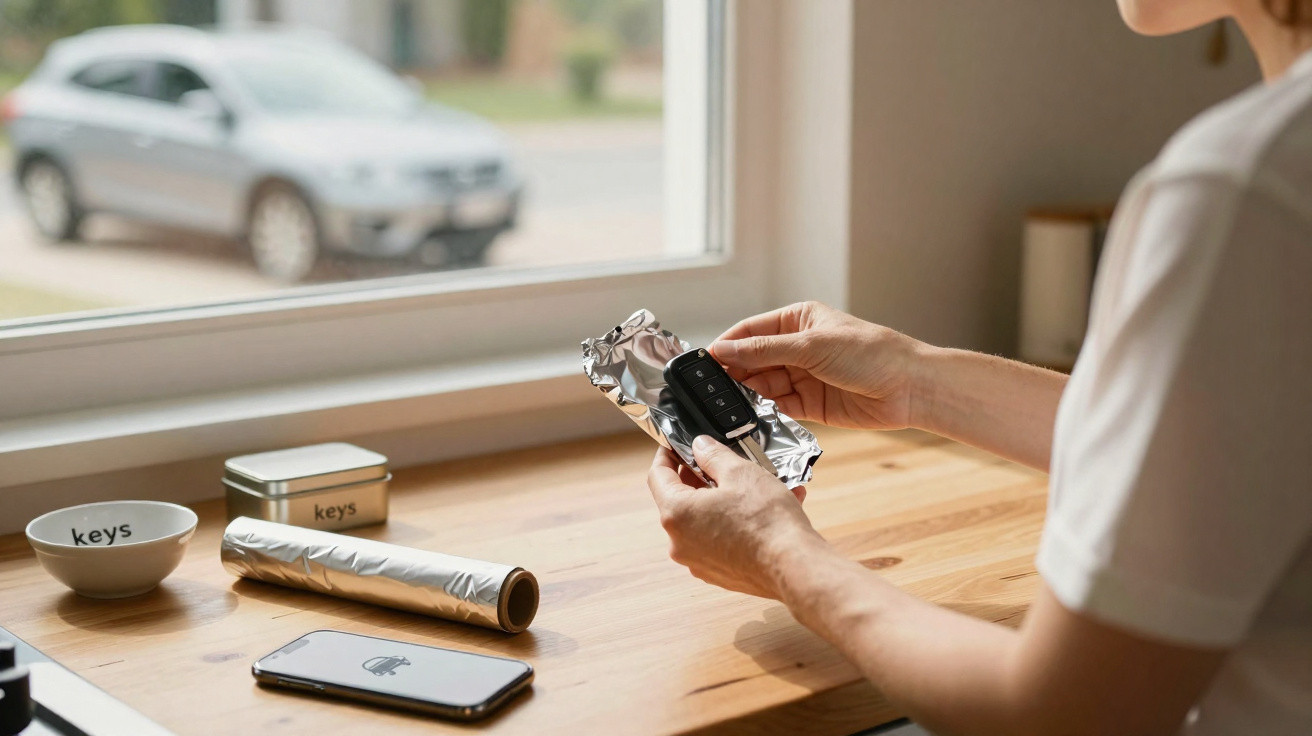
From London to Los Angeles, an understated security tactic is appearing on driveways: everyday car keys covered in crinkled kitchen foil.
It may seem like advice lifted from a conspiracy forum, but the method is based on sound physics and a distinctly modern form of crime. With car theft becoming ever more wireless, motorists are using one of the least expensive household items as a defence.
Keyless entry: convenience that thieves have learned to exploit
Keyless entry was marketed as the ultimate convenience. Approach the car, touch its handle and the doors open. Hit a button and the engine begins. There is no need to fumble for keys in the rain or search through a bag.
That convenience depends on a continual radio exchange. The key fob transmits signals at particular frequencies, commonly around 315 MHz or 433 MHz, and the car listens for them. Once it identifies the correct encrypted code, it unlocks and permits the engine to start.
That invisible signal, designed for comfort, has become one of the easiest openings for modern car thieves.
Relay attacks: stealing your car from your hallway
The technique seen most often is called a relay attack. It generally requires two people and a compact electronic device available online.
One offender stands near the house, often by a front door or window, with equipment that “captures” the faint radio signal emitted by a key fob left on a shelf or in a coat pocket. Another stands beside the vehicle with a second device, which relays and boosts the signal to the car.
From the car's perspective, the key appears to be immediately beside it. The doors unlock, the immobiliser is disengaged and the engine starts. This can all occur without the keys ever leaving the hallway table.
Police forces in the UK, the US and throughout Europe have repeatedly cautioned that keyless vehicles are disproportionately represented in theft figures. Plenty of owners discover the vulnerability only when they step outside in the morning to find an empty driveway, with no smashed glass anywhere.
Signal grabbers and cloning devices
Relay attacks are not the only threat; signal grabbers, also called “code grabbers”, are another. These devices try to record radio transmissions between the car and its key, before replaying or imitating them later.
Certain newer systems use rolling codes and stronger encryption, which makes complete cloning more difficult, though not impossible. As electronics get cheaper and online tutorials spread, advanced equipment is reaching criminals with fewer technical skills.
Car theft has shifted from screwdrivers and crowbars to laptops and discreet antennae.
Why aluminium foil actually works
Although it can appear to be a social-media joke, covering a key with aluminium foil is a rudimentary form of an important scientific device: a Faraday cage.
A Faraday cage is an enclosed conductive shell that prevents external electric fields and radio waves from entering. The principle dates to the 19th century, but remains fundamental to applications ranging from secure military installations to an aircraft's metal body.
Aluminium conducts electricity well. When radio waves strike foil, they create electrical currents across the metal's surface. These currents effectively cancel the field within the enclosure, so little, if any, of the signal passes through.
Wrapped properly, a foil-covered key fob can’t send or receive the radio signals thieves rely on.
How to wrap your keys so the shield actually works
Ordinary kitchen foil-the same kind used to cover leftovers-can block the frequencies used by most key fobs when applied properly. Getting the details right is important.
- Cover the complete key fob, leaving no plastic exposed.
- Apply at least two or three foil layers to improve shielding.
- Press down and fold the edges securely, eliminating gaps through which signals may escape.
- Check it by standing beside the car and attempting to unlock it with the wrapped key.
- Renew or rewrap the foil regularly, as everyday use causes it to tear and crease.
The method applies to every brand. Whether your vehicle is a Ford, Tesla, BMW or Toyota, the principle is unchanged: stop the radio waves and you stop the attack.
Commercial RFID-blocking pouches and boxes rely on comparable conductive materials, but provide them in a more hard-wearing format. They tend to cost more than a piece of foil, but are tidier for everyday use and frequently last longer.
Where you keep your keys makes a difference
Where keys are stored continues to matter, even if you use foil or a blocking pouch, particularly when criminals have high-gain amplification equipment.
Keeping keys on a hook near the front door, a windowsill or a letterbox leaves them close to the pavement, reducing the distance that thieves' devices must cover. This makes their task substantially easier.
Security specialists commonly advise a two-part approach:
| Step | What to do | Why it helps |
|---|---|---|
| Shield | Wrap keys in foil or use an RFID-blocking pouch | Reduces or eliminates the radio signal |
| Relocate | Store keys in a metal tin or drawer away from exterior walls | Makes any remaining signal far harder to detect |
In households with multiple drivers, the least secure habit usually determines the overall danger. A teenager who leaves a key in a jacket by the front door can undo everyone else's precautions.
Layered protection: foil is just the first line
Covering your key is a smart first measure, but most car-crime specialists advise combining it with further barriers. Thieves favour fast, effortless opportunities. The more hurdles in their way, the more likely they are to look elsewhere.
Old-school tools that still work
Obvious physical security devices remain effective. Steering-wheel locks, pedal locks and wheel clamps may seem basic alongside digital technology, but they delay thieves and make detection more likely.
Alarm decals and flashing LEDs can help as well. Even where an alarm is factory-fitted, a clear warning that the vehicle could make noise may steer opportunistic criminals towards simpler targets.
Parking location is important too. Cars left on well-lit roads, close to front windows or beneath CCTV are less appealing than those hidden in dark, secluded spots.
Using the tech you already have
Many newer cars are fitted with security features that owners rarely consider after buying them, including immobilisers, interior sensors, tilt sensors and GPS trackers.
Such systems require periodic checks. An immobiliser problem may have no impact on normal driving and can therefore remain unnoticed until somebody manages to bypass it. A brief inspection at a routine service, or a scan by a security specialist, can identify faults early.
Some motorists also opt to turn off “passive” keyless entry through the vehicle settings menu, where that feature is available. You may still unlock the doors by pressing a button on the key in this mode, but the car no longer continually listens for a hands-free signal. That adjustment alone disrupts the central process behind relay attacks.
Foil vs professional products: what makes sense for you
Risk is not identical for every motorist. An owner of an older non-keyless vehicle in a peaceful rural village faces different dangers from an urban commuter with a new SUV parked on a street corner.
For many, foil offers an inexpensive way to reduce risk promptly or assess just how exposed a key is. If the car can be unlocked from outside the home while the key remains indoors, it is a clear indication that action is needed.
People who drive regularly, use company cars or share vehicles may favour a sturdier choice, such as:
- Rigid metal key boxes for the hallway
- RFID-blocking pouches fitted to keyrings
- Aftermarket immobilisers requiring a PIN-code sequence entered through dashboard buttons
Every option introduces an extra step into daily life, so the right choice is the one you will use reliably. An ideal system left in a drawer is less valuable than a straightforward routine followed every day.
Understanding the broader risks of wireless convenience
Keyless car theft forms part of a wider development: an increasing number of everyday items now communicate wirelessly. From smart doorbells to contactless bank cards, one essential question arises repeatedly: who else can receive this signal?
For vehicle owners, this requires thinking beyond the car itself. If criminals can stand near your front door and detect a key fob, they are close enough to observe routines too: which lights are on and when, when parcels are delivered, and when the house appears unoccupied.
Some security specialists advise considering the entire entrance area of a home as sensitive. This could involve improved motion-sensitive lighting, more thoughtful camera positioning, or simply changing where valuables and electronics are kept overnight.
Seen in this context, a roll of foil is not a magical defence, but one element of a broader collection of small, repeatable habits that make life harder for anyone targeting your street. Spending a few minutes crumpling metal around a key fob can discreetly defeat one of the most effective methods in a modern thief's repertoire.






Comments
No comments yet. Be the first to comment!
Leave a Comment