
The washing machine was on the move again.
Not in an entertaining way, but with that slow, infuriating clatter that travels through the floorboards and lodges itself in your head. It is the sort of sound you feel rather than simply hear. Crockery in the cupboard quivered, the bathroom mirror droned, and a framed picture in the hall shook against the wall like an irritated bee.
Barefoot on the chilly tiles, I stood watching the machine as though it owed me an apology. As the spin cycle gathered pace, so did the racket, while the shelf above began trembling along with it. From the kitchen, a friend half-jokingly called: “Just throw a towel up there!”
So I did. Instantly, the house seemed… calmer.
It sounds like a ridiculous little move. Yet it works.
Why a simple towel can make a room quieter
Once vibration noise catches your attention, you cannot “un-hear” it. The deep drone from a washer, a light rattle from a boiler shelf, or the buzz of a fridge pressed against a timber panel can all become an unwanted household soundtrack.
The particularly annoying part is that nothing appears to be broken. The appliance still washes, the pipes still function and the shelves still support their contents. But every spin cycle or compressor start makes the surrounding furniture tremble as if it is on edge.
This is where the towel trick helps. It is not a miracle solution, but a small physical intervention that redirects the noise elsewhere.
Consider a typical utility-room arrangement: a washing machine squeezed into a narrow recess, with a wooden or metal shelf above holding detergent, baskets and perhaps an existing pile of towels. Whenever the drum reaches full speed, the shelf effectively becomes a drum skin.
One reader described a laundry room sharing a wall with their baby’s bedroom. The washing machine was not especially noisy by itself, but its thin overhead shelf vibrated in response, transforming a mild movement into a piercing, repetitive hum. At precisely 1,200 rpm, the baby would wake as though on cue.
They shut doors, tried soundproof curtains and even put washes on earlier. Then, one evening in frustration, they folded a thick bath towel and spread it across the shelf. During the following wash, there was hardly any buzzing. The baby stayed asleep.
There is nothing magical about it. It is simply physics made softer.
A bare shelf, particularly a thin or hollow one, is highly prone to resonance. Vibration from the machine passes into the wall, through the brackets and into the shelf. The shelf then acts like a low-cost speaker cone, magnifying the sound you are attempting to block out.
A folded towel alters that response. Its thickness and fibres absorb some of the movement. Rather than allowing the shelf to shake freely, the towel provides cushioning and damping. Sharp rattles become muted, barely noticeable tremors, meaning less resonance and less sound reflected around the room.
On a modest scale, this mirrors what sound engineers do in studios: interrupt hard, flat, vibrating surfaces with a soft, uneven material.
How to position a towel to reduce vibration noise
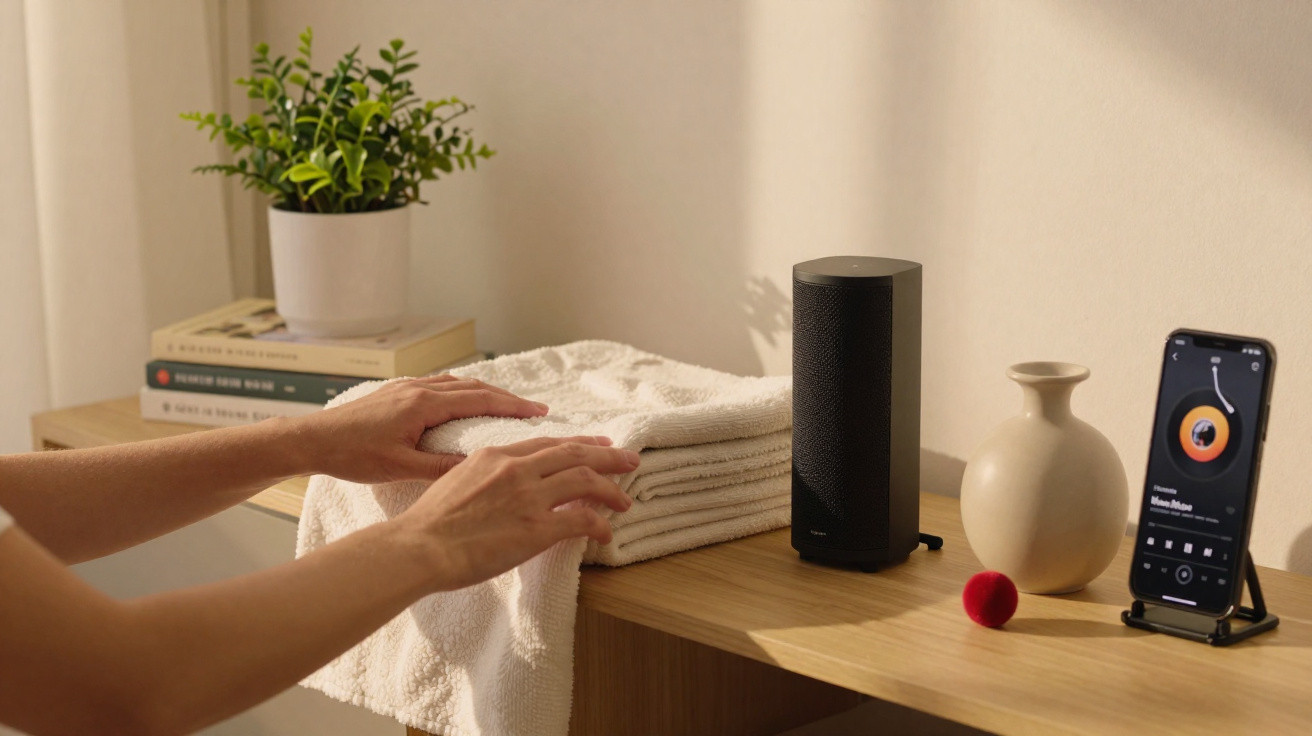
The approach is almost embarrassingly easy, although placement makes a difference. Choose a thick bath towel rather than a thin hand towel. Fold it in half, then fold it again, creating a dense, padded layer.
Lay it flat on the shelf immediately above the source of vibration, whether that is a washing machine, tumble dryer or even a noisy fridge. Contact is crucial: the towel should cover the part where items usually rattle or where the shelf bends most.
Start a cycle, or allow the appliance to power up. If the noise has reduced but remains noticeable, fold the towel into a thicker pad or place another towel over it. Several centimetres of fabric can have a greater effect than a costly “anti-vibration gadget” bought at 2 a.m.
There are a few familiar mistakes people make, and they are entirely understandable. You place a towel on the shelf, listen for a moment and, if the sound is “a bit better but not perfect”, dismiss the idea as ineffective.
Noise is deceptive. It can come from several surfaces at once: the shelf, the containers sitting on it, or even a loose bracket screw. Remove everything from the shelf, run the appliance, then return objects one at a time on top of the towel. Sometimes the true culprit turns out to be one plastic bottle knocking against the wall.
And, realistically, no one folds towels like a sound engineer every day. That does not matter. Go for improvement rather than a Pinterest-ready utility room. Even a slightly rumpled, thick towel can reduce the irritating resonance that leaves you feeling tense.
One acoustic specialist I spoke to put it this way:
“We focus on the loud machine, but the worst noise often comes from what’s around it. Soft materials between hard surfaces are your best, cheapest allies.”
Treat the towel as a starting point. After seeing the difference it makes on a shelf, you can discreetly apply the same principle elsewhere without making your home resemble a recording studio.
- Place a folded towel or cloth beneath an unsteady microwave that makes the worktop hum.
- Put a small fabric pad behind a picture frame that buzzes when a neighbour’s bass kicks in.
- Set a folded tea towel beneath a metal tray or basket that vibrates on top of the fridge.
- Try a towel beneath a tumble dryer’s feet if you cannot fit proper anti-vibration pads yet.
- Use an old towel as a temporary buffer between two items of furniture that knock together.
The subtle impact of small, nearly invisible fixes
The most compelling aspect of this towel-on-a-shelf idea is not the towel itself. It is the sense of relief that moves through a home when a persistent, low-level irritation finally disappears. Vibration noise is like a dripping tap for the nervous system: you may stop registering it consciously, but your body still does.
Putting down a towel can feel far too minor for the comfort it produces. But once the shelf no longer buzzes, the room sounds different. Laundry becomes a background murmur rather than an argument between metal and wood. People say they begin doing washes later in the evening again, or no longer creep around while the machine spins.
We tend to overlook these small adjustments. A more peaceful home does not always require major renovation work. Sometimes, it begins with a spare towel and ten seconds of curiosity.
| Key point | Detail | Benefit for the reader |
|---|---|---|
| Towel as a damper | A thick towel absorbs and disrupts shelf vibrations above noisy appliances | Provides a quick, almost cost-free way to reduce rattling without tools or DIY knowledge |
| Correct placement | Position the folded towel flat on the shelf so that it covers the area with the strongest vibration | Delivers the greatest noise reduction with little effort or trial and error |
| Wider household use | The same principle works beneath small appliances, behind frames and between hard surfaces | Makes it easier to create a noticeably quieter home with things already at hand |
FAQ:
- Does putting a towel on the shelf really reduce washing machine noise? Yes, it can lessen rattling and resonance produced by the shelf itself. It will not silence the motor, but it often reduces the sharp, irritating buzz that spreads through the room.
- Is it safe to place a towel near my appliances? It is generally safe provided the towel stays on the shelf and does not obstruct vents, cables or airflow. Keep it clear of hot surfaces and never cover ventilation grilles.
- What kind of towel works best for vibration noise? A thick bath towel, or a dense hand towel folded several times, is more effective than a thin cloth. Greater mass and softness allow it to absorb more vibration.
- Can I use this trick for other noises in the house? Yes. Try it beneath small appliances, behind vibrating frames, under metal trays or between furniture that knocks together when something shakes.
- What if the towel doesn’t change anything? The primary source may be elsewhere, such as loose machine feet, an uneven load or a shelf poorly secured to the wall. A towel is a quick diagnostic measure, rather than a miracle fix for every issue.





Comments
No comments yet. Be the first to comment!
Leave a Comment