
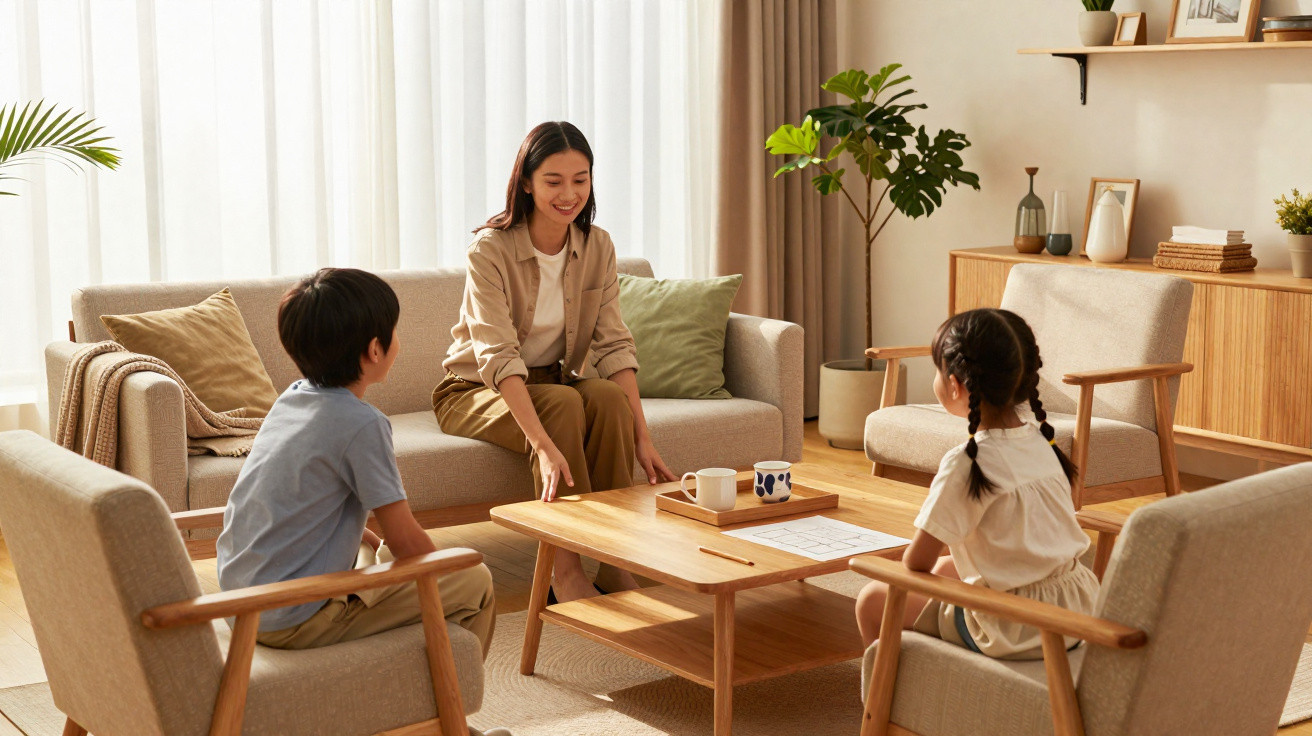
The television was playing, yet no one was properly paying attention.
At one end of the sofa, the teenager was almost swallowed by a hoodie, endlessly scrolling. On the floor, the youngest child was constructing a Lego fortress. Each parent occupied an armchair, positioned far enough apart that every remark became a call across the coffee table.
It was the same space, the same family and the same exhausted “How was your day?” that fizzled out after just three words.
Then, one weekend, they decided on a whim to rearrange the furniture. The TV went to one side. The sofa was turned around. Two chairs were brought nearer together, creating something like a café nook. When they sat down that night, a little breathless from the effort, something unexpected occurred.
The room began to answer them.
Why your living room quietly shapes your conversations
Spend enough time watching a living room and you will see an odd kind of choreography. People settle where the furniture directs them. Their gaze follows its orientation. They speak when the spacing feels comfortable, and fall silent when it does not.
A sofa positioned opposite a huge TV creates an unseen stage: the screen takes the leading role and everyone else becomes an extra. Two armchairs turned towards one another become a secluded theatre box. A long, isolated sofa pressed against a wall can leave even an energetic family feeling as though they are sitting at a bus stop.
A room instructs us how to act. Usually, we follow those instructions without realising it.
In a UK survey conducted by a major furniture retailer, more than half of those questioned said they tend to sit in precisely the same place every evening. The habit of having “my place” can be reassuring, but it can also trap conversations in small, familiar patterns.
Consider your own evenings. Whoever sits nearest the kitchen receives the practical conversations. The person beside the TV has the remote control and makes brief remarks about programmes. At the distant end of the sofa, people vanish behind their phones. The arrangement does not merely contain furniture; it assigns roles.
A family I met in Lyon discovered this for themselves. Their large corner sofa faced the television, with everyone sitting in a straight row. They said their 14-year-old “never talks at night”. One Sunday, they divided the large sofa into two sections and arranged them in an L-shape around a lower table. It was the same teenager, the same parents and the same Netflix choices.
That evening, their son did not retreat to his bedroom. He remained in the room. He made comments about the film. He even asked his mum about her work. No one had lectured him about “screen time”. They had simply changed the room so that speaking no longer felt like a performance.
The reasoning is straightforward. Conversation depends on three things: closeness, eye contact and a shared point of focus. Furniture can either support or stifle each of them.
When seats are too widely spaced, voices become louder and more abrupt. Put people too close together and they can feel cornered. If everybody faces one direction, quiet side remarks disappear. When faces are turned slightly towards one another, silence has somewhere to settle.
Interior designers refer to this as a “conversation zone”. You do not need a design qualification to make one. You need roughly twenty minutes, some experimentation and the willingness to recognise that your current layout may be working against you.
How three furniture moves can transform the whole atmosphere
Begin with one straightforward aim: make a small area in which people see one another more often than they see the screen. This is not a complete refurbishment, only a subtle change in the room’s centre of gravity.
Move the sofa 30–50 cm away from the wall. Initially, it may feel odd, as if the room has become smaller, but it draws everyone nearer to the middle. Turn an armchair by 10–20 degrees so it is not fixed on the television like a guard dog. If you have two chairs, angle them gently towards the sofa rather than placing them parallel with it.
The formula used by many professionals is simple: position people 1.5–2 metres apart in a relaxed U- or L-shape. It leaves enough room to breathe while keeping everyone close enough to speak normally. That is your conversation engine.
One usual mistake is allowing the coffee table to dominate the space. When it is large and sits squarely in the centre, it becomes an obstacle instead of a connection. People lean away rather than towards each other. For a family in Paris I visited, replacing a weighty glass table with a smaller, lighter version changed how often their children leant in to show something on their phones instead of shouting from the edge of the room.
Another common error is arranging every item against the walls in an attempt to make the room appear larger. Emotionally, it has the reverse effect. The centre turns into a no-man’s-land, while people cling to the perimeter as though waiting to be summoned.
Go easy on yourself with this. You may shift the sofa three times, dislike it twice and still be making progress. Let’s be honest: nobody really does this every day. Rearranging is untidy work, involving cables, dust bunnies and complaints. That is simply part of it.
“We thought we just had a quiet family,” a father of three told me. “Then we turned the couch, moved the TV, and discovered we actually had a talkative one that just couldn’t find a place to talk.”
His comment reflects something many families experience but seldom put into words. A living room may seem like neutral territory, but it carries unspoken rules: who sits where, who controls the remote and who gets heard. Moving furniture offers a quiet way to renegotiate those rules without making a grand announcement.
- Make the TV a supporting character by positioning it slightly off-centre from the principal seating.
- Set up one “no-screen” seat with the best view of people rather than devices.
- Keep a clear route through the room so children and teenagers can come and go without passing between people’s faces.
The living room that listens - and what it returns
After you have moved a few items, a subtle shift develops over time. The living room ceases to be merely somewhere you walk through and becomes a place that holds your words in a different way.
Parents tell me they begin to notice small, tentative sentences that would have been lost in the previous layout. A teenager casually saying “I’m stressed about school” while curled sideways into the sofa corner. A grandparent telling a story because, for once, their chair is not stranded at the edge of the room.
Conversations do not become longer overnight. They simply become easier to begin. That minor change often matters more than we imagine.
At a deeply human level, we all want somewhere we can speak without feeling as though we are on display. One reader explained that she and her partner stopped having “big talks” at the kitchen table because the chairs seemed too rigid and formal. They brought a small armchair nearer to the sofa, making a sort of angled corner, and serious conversations began to happen there naturally.
We have all known a profound discussion to begin “by accident” in a car or during a walk, simply because nobody has to look directly at the other person. A well-planned living room layout uses the same idea: bodies placed slightly side by side, eyes able to wander and voices settling into a shared space that feels gentle rather than interrogative.
The room will not resolve arguments, repair old wounds or suddenly turn a quiet teenager into a talk-show host. Nevertheless, it can reduce the emotional volume before anyone says a word. If the physical distance between two seats is shorter, the distance between two viewpoints can often feel shorter as well.
One evening, try observing your household from the doorway. Who talks most? Who talks least? Who needs to raise their voice? At first, the answers may not appear to come from anyone’s personality.
They will come from the furniture.
| Key point | Detail | Benefit for the reader |
|---|---|---|
| Create a conversation zone | Arrange seating in a U- or L-shape, 1.5–2 metres apart | Makes exchanges feel more natural, without forcing them |
| Move the screen off-axis | Position the TV slightly to one side rather than at the absolute centre | Puts faces back before images |
| Lighten the centre of the room | Use a smaller coffee table and keep routes clear | Makes movement, asides and confidences easier |
FAQ:
- How close should the seats be for comfortable conversation? Most people are comfortable when seated around 1.5–2 metres apart. That is near enough for a normal voice, while still preserving personal space.
- What if my living room is very small? Use what you have: turn just one chair towards the sofa, bring the sofa 20–30 cm away from the wall, and choose a smaller table or pouffe to free up the middle.
- Do I have to move the TV? No, but moving it slightly away from the central axis can alter where attention goes. Even turning the main sofa a little so faces are more directed towards each other can make a significant difference.
- How can I encourage teens to join the living room? Provide at least one seat that is truly comfortable for them, with a side table or plug socket nearby, and place it in the conversation zone rather than isolating it in a distant corner.
- How often should I rethink my layout? Whenever your family routines change: a new job, different school hours, a new baby or more remote working. When evenings begin to feel “off”, your living room is quietly asking to be updated.





Comments
No comments yet. Be the first to comment!
Leave a Comment