
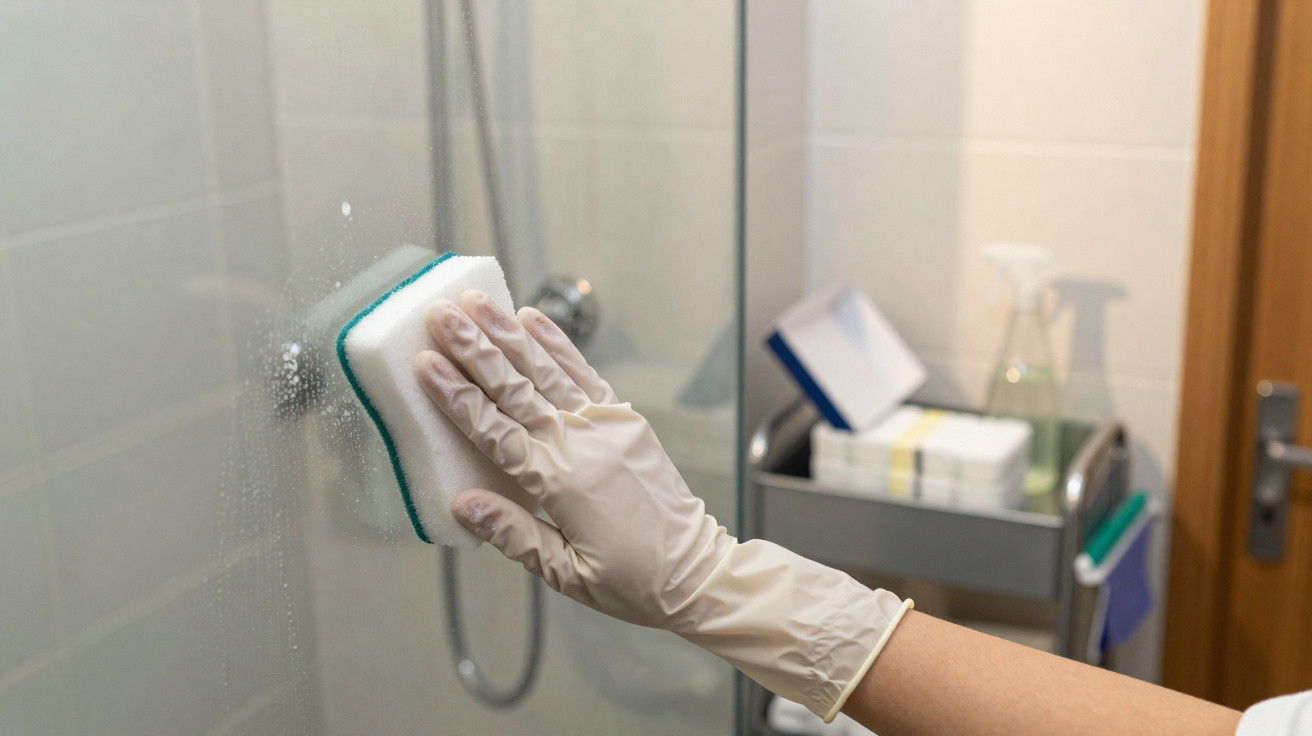
With one simple professional trick, that can be changed.
Anyone who walks into a hotel room and sees a spotless, completely transparent shower screen soon wonders: why does mine at home not look like that? In everyday life, limescale marks, soap residue and a cloudy film stubbornly cling to the glass, while hotels seem to keep their screens looking newly installed every day with little effort. The secret is not an expensive miracle spray, but a surprisingly straightforward technique that can easily be copied in any home.
Why hotel shower screens always look new
Perfection is a requirement, not an extra
In hospitality, a guest's first impression of the bathroom can often determine their review. A shower screen with white edges or streaks is immediately seen as neglected. Cleaning teams therefore work to clear objectives: work quickly, remove every visible mark and leave the glass looking as though it has never been used. There is no time for specialist cleaners to sit and work for long periods.
Professional teams rely less on chemicals
When limescale will not shift, many households instinctively reach for harsh bathroom cleaners. Hotels take a different approach. Their teams have learned that powerful chemicals can attack seals, leave fittings looking dull and become costly over time. Instead, they use another strategy: as little product as possible, combined with targeted mechanical action using the correct tool.
The difference between “quite good” and a mirror-clear shower screen is rarely the cleaning product – it is almost always the tool.
The inconspicuous “secret weapon” on the cleaning trolley
The star item on many hotel cleaning trolleys is not a specialist bottle, but an unassuming white block: a melamine sponge. Many people know it as a “magic eraser” from the supermarket. The material works like ultra-fine sandpaper, but in a far gentler and more controllable way. That is exactly why it is so effective against the stubborn film on glass.
What really makes a shower screen cloudy
Limescale is the persistent main cause
Depending on the area, tap water contains varying quantities of minerals. When water evaporates from the glass screen, tiny crystals of calcium and magnesium salts remain behind. Each shower adds another layer. After several weeks, a rough whitish crust develops that many bathroom cleaners can barely remove.
Soap residue adds a sticky layer
Shower gel, shampoo, soap and skin oils add to the problem. Together, they form a greasy film that binds to the limescale. This mixture adheres firmly to the glass, allows less light to pass through and leaves the surface looking dull. Fresh limescale deposits gain even more grip as a result – a gradual process that often goes unnoticed until the screen has already become noticeably cloudy.
Two issues that one product rarely solves
An acidic cleaner dissolves limescale, but has little effect on greasy soap deposits. A standard degreaser removes soap residue effectively, yet quickly reaches its limits with thick limescale layers. In practice, a shower screen needs two forms of attack at once. This is precisely where the hotel trick comes in.
| Problem | Typical cause | Responds well to |
|---|---|---|
| White, rough marks | Limescale deposits | Acid (for example vinegar) and mechanical rubbing |
| Greasy, grey film | Soap and shower-gel residue | Surfactants (cleaner) and mechanical rubbing |
The combination of these two layers makes cleaning laborious. With the right type of sponge, both can be removed at the same time without much physical effort.
Why melamine sponges are so effective in the bathroom
How the “magic” sponge is made
A melamine sponge is made from a hard plastic foam with exceptionally fine pores. Under a microscope, the material resembles a dense mesh of tiny, tough threads. During cleaning, these threads act like a huge field of miniature scrapers. They lift dirt away layer by layer without leaving deep scratches.
Mechanical cleaning rather than a chemical bomb
The sponge itself contains no cleaning agent; its effect is entirely mechanical. Used with water, it glides across the surface and loosens limescale crystals, soap residue and other deposits from the tiny irregularities in the glass. Many hotels use only tap water, adding a mildly acidic cleaner occasionally where the water is extremely hard.
Benefits in hotels and at home
- Quick: The cloudy film disappears from the glass after just a few passes, with no waiting time required.
- Thorough: Even old limescale lines along the bottom edge of the shower screen can be reduced considerably.
- Versatile: It also works on tile grout, plastic frames, certain plastics and chrome, provided it is tested carefully.
- Affordable: The sponges cost little and can replace several specialist cleaners.
Anyone who uses a melamine sponge regularly often needs only vinegar, an all-purpose cleaner – and far less frustration in the bathroom.
How hotels use the shower screen trick step by step
Dampen it correctly – never scrub when dry
The sponge should always be used damp. Cleaning staff immerse it in clean water and squeeze it gently until it is no longer dripping but remains thoroughly saturated. In this condition, it glides more easily and wears down much more slowly.
Gentle pressure delivers better results
Many people tend to scrub very hard. With melamine, that is more likely to be counterproductive. The sponge works effectively with only light pressure. Professionals use small overlapping circles or move the sponge in vertical strokes from top to bottom. This lifts limescale and soap film evenly.
Rinse thoroughly and squeegee afterwards
After treatment, a fine layer made up of dirt and sponge residue remains on the surface. Hotels therefore rinse the shower screen with plenty of water. They then almost always use a rubber squeegee: pull it from top to bottom using overlapping strokes, then collect water droplets around the edges with a microfibre cloth. Only then does the result become genuinely clear.
How to use the hotel method at home
Where to buy the sponges and what to look for
Melamine sponges are sold in the cleaning aisles of many supermarkets and chemists, often in packs of 5 or 10. Their shape matters very little; what matters more is a pure melamine structure without an additional coating. Anyone with delicate surfaces should test the sponge in an inconspicuous area first, such as along the lower edge of the shower screen.
An everyday routine: little effort, major impact
In a typical household, one thorough treatment every two to four weeks is often enough, alongside a quick clean when visible streaks appear. It is useful to keep a sponge in the shower so it can be used quickly when needed. This prevents deposits from building up into a thick layer in the first place.
Environmental balance: fewer chemicals, but plastic remains
Melamine sponges are disposable products: they visibly wear away during use and will eventually go into the bin. At the same time, they can save a considerable amount of aggressive cleaner containing fragrances, colourings and preservatives. Restricting their use to stubborn cases, while relying mainly on a squeegee, vinegar solution and a microfibre cloth for day-to-day cleaning, offers a sensible middle ground.
Additional professional tips for permanently clear shower screens
The daily helper: a shower squeegee
The easiest way to prevent limescale is to keep a rubber squeegee in the shower. Simply wipe down the glass briefly after every shower – nothing more is needed. This leaves much less water on the surface to evaporate, keeping new limescale layers thin.
Vinegar water as a protective ritual
A spray bottle filled half with water and half with clear vinegar is entirely sufficient. After using the squeegee, mist the glass lightly, leave it for a few seconds and wipe it over with a microfibre cloth. This routine stops new layers from forming at an early stage.
Effective ventilation against moisture and mould
High humidity lengthens drying time and encourages limescale, streaks and mould. If there is a window, open it wide for several minutes after showering. In a bathroom without a window, the extractor fan needs to run properly – slightly longer is better than not long enough.
What melamine can do – and where it is best avoided
Suitable and sensitive surfaces
Melamine works very reliably on glass, ceramic tiles and many plastics. Care is needed with coated glass, matt fittings, painted furniture and acrylic baths. Its finely abrasive action can leave marks on these surfaces. A small test in a hidden spot will provide clarity.
When chemicals can help after all
Especially in areas with extremely hard water, thick and stubborn crusts can sometimes form. In these cases, a combination is worthwhile: first allow a mild limescale remover or vinegar to work for a few minutes, then follow up with the melamine sponge. Most of the layer will then lift more easily, and the sponge has less material to remove.
Anyone who adopts these few tricks – a melamine sponge, squeegee, vinegar water and good ventilation – can achieve almost the same everyday effect normally seen only in well-maintained hotel bathrooms: a shower screen that stays clear for longer and does not look dull again immediately after cleaning.



Comments
No comments yet. Be the first to comment!
Leave a Comment