
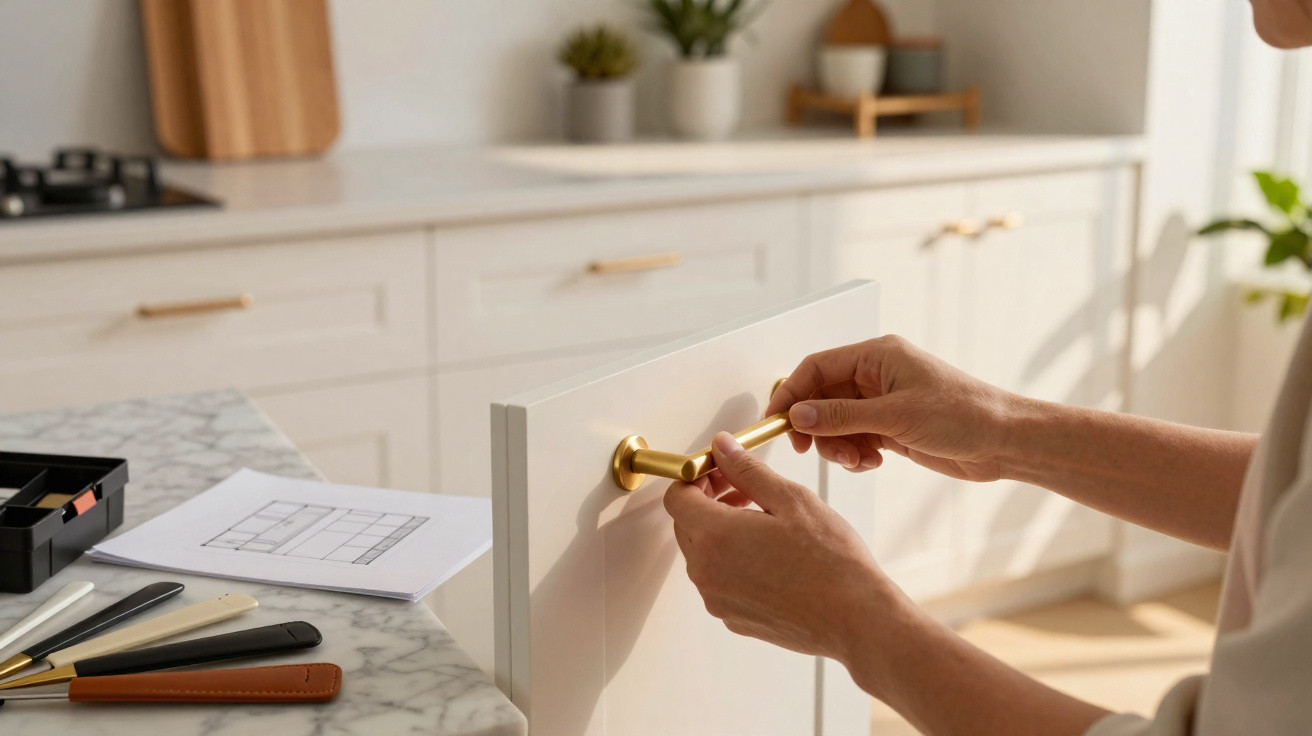
The couple adore the way it appears in the showroom. It is pure Pinterest: flat-fronted units, concealed grips, and the sort of kitchen you might find in a luxury hotel suite or on the pages of a design magazine. Then she asks one straightforward question: “Do you cook every day?”
There is silence. They look at one another, then give a half-laugh.
Two months on, the same couple return to the studio, now armed with photographs on their phone: greasy fingerprints, small dents where doors have been pushed rather than pulled, and a toddler’s face pressed against a push-to-open drawer.
“We want handles,” they say. “Real ones.”
A subtle change is taking place in our kitchens.
Why handleless cabinets are losing their shine
Handleless cabinets had their moment in the sun. They offered clean lines, uninterrupted surfaces and an almost futuristic sense of calm. For years, they were the default choice for anyone seeking an “architect-designed” look at home. There was no visual clutter or protruding hardware, only glossy expanses reflecting the light.
Then everyday life arrived: wet hands, heavy pans and children slamming cupboard doors.
Designers began to hear familiar complaints: chipped edges on push-to-open doors, unreliable mechanisms and constant cleaning of fingerprints from the upper edges of fronts where people naturally grip them. The minimalist ideal started to reveal fine cracks. Nothing dramatic, simply persistently irritating.
That is precisely how trends fade: not through outrage, but through minor frustrations repeated every day.
In one London renovation, a family proudly fitted an entire wall of handleless cabinets. The photographs looked exceptional. Yet six months later, the cabinet maker returned to make adjustments. The doors had sagged by a millimetre. The push-to-open systems worked well in principle, but the hinges required recalibration under the demands of everyday use.
“We cook a lot,” the owner admitted. “We’re always in here. I’m pressing with my elbow, my hip, the back of my hand. It’s just… fiddly.”
Eventually, they retrofitted slim black pulls to the doors they used most often: the bin, the main pan drawer and the coffee station. It was a compromise, but one that revealed something important. The cabinets needed to accommodate their lives, rather than requiring them to adapt their behaviour.
Kitchen retailer reports express the same point in less romantic language. Across several design surveys, homeowners rank “easy to clean” and “easy to open with messy hands” above a “minimal look”. It may seem like a small consideration, but it quietly reshapes the entire hierarchy of what makes a kitchen pleasant to use every day.
The reasoning is remarkably simple. Our hands are not always clean, empty or available. We open drawers with fingertips, knuckles and wrists while balancing hot pans, a buzzing phone or a shouting child. In that setting, a sturdy handle is not the enemy of good design. It is a small point of stability amid the chaos.
There is also a hidden cost to extreme minimalism. Handleless systems depend on additional hardware: runners, electric openers and profiles concealed within the cabinet carcass. More components mean more potential failures over ten or fifteen years. A traditional metal pull is straightforward engineering. It simply remains in place, doing its job day after day.
Kitchen fitters know this quietly. Ask one what they would choose for their own house, and the answer is often accompanied by a shrug and a few candid words: “Handles. Proper ones.”
The quiet power of a really good handle
This return is not about filling every surface with bulky knobs. It is about selecting handles in the way you would choose a good pair of shoes: they should suit how you move. The practical feature making a confident comeback is the well-designed pull, positioned exactly where the hand instinctively reaches.
Consider a deep drawer with a long bar handle positioned along its edge. Hook in a finger and it glides open. There is no pressing and no searching for the correct spot. On tall pantry doors, a vertical pull running almost the full height allows children to reach it lower down while adults can grip it higher up.
A small technique increasingly used by designers is to combine handle styles within one kitchen. Less frequently used upper cupboards can have integrated edge pulls, while heavy drawers benefit from stronger, more tactile handles. Visually, the room still feels calm and cohesive. Physically, it becomes far more comfortable to use.
This is where many homeowners make a quiet mistake: they fall for a handle on a moodboard rather than testing it in their hand. A slim, graceful pull may conjure a peaceful Sunday morning. But at 7 p.m. on a Tuesday, when you are pulling open a drawer packed with pans, that delicate bar may be digging into your fingers.
In practical terms, comfort is as important as appearance. Rounded edges are kinder than razor-thin profiles. Some depth prevents fingers from striking the cabinet front. In a busy family kitchen, dark handles conceal fingerprints more effectively than polished chrome.
On a human level, it concerns energy too. We scarcely notice the small details that work properly, but we certainly notice those that resist us twenty times a day. Handles are touched more than almost any other object in your home; they quietly educate your senses about how your space treats you.
“The hardware is like a handshake,” says one interior designer. “You feel straight away if the kitchen likes you back.”
It is rarely discussed openly, but everyone recognises the quiet comfort of a secure grip. On a cold morning, your hand wants something solid rather than a guessing game. At the end of a long day, you do not want to push, tap and wait for a mechanism to respond. You simply want to pull.
- Test handles in the showroom: pull them as though they are heavy, rather than gently.
- Imagine greasy hands, hectic mornings and guests unfamiliar with your system.
- Pick one “hero” handle and repeat it in the hardest-working areas.
- Keep upper cupboards visually lighter, and allow lower drawers to carry the heavier work.
- When in doubt, let function win without fuss.
From silent detail to new design statement
The most interesting development is that handles are not merely being accepted again; they are being celebrated. Rather than concealing them, designers are treating them as intentional accents: matt black bars against oak, brushed brass on deep blue, or leather loops on soft white.
Some of the most-saved kitchen posts on social media now showcase robust, straightforward hardware. It does not shout, but it is clearly there. A line of substantial pulls across a large island immediately communicates that this is a working kitchen, a room where things genuinely happen.
For many people, there is a quiet sense of permission in that idea. Your home does not need to perform as a showroom. It can look like somewhere pasta water boils over, children slam drawers and someone leans on the breakfast bar after a demanding day.
We have lived through years of hyper-curated interiors, filtered and perfected. Perhaps that is why the movement towards visible, functional details feels unexpectedly refreshing. A handle is honest: it openly states what the room is for.
There is a generational aspect to this conversation as well. Younger homeowners, facing steep renovation costs, want fittings that last and can be repaired. A failed touch-latch or motorised opening system requires a technician. A loose handle needs only a screwdriver. Let’s be honest: nobody is genuinely delighted to fetch the toolbox for a broken motorised rail.
At a deeper level, this modest hardware decision reflects a broader wish to inhabit spaces that are not only attractive on a screen, but also kind to our bodies, routines and mess. We seldom plan for “perfect” weeks. Life arrives in layers of disorder, noise and unexpected visitors.
In their unassuming way, handles make room for that chaos. They say: come in with your shopping bags, sticky fingers and sense of urgency. This kitchen is ready for you.
So when someone says, “Goodbye handleless cabinets,” it is not a declaration of war on minimalism. It is a quiet vote for something different: everyday comfort that does not need to be concealed. A small piece of metal that makes an entire space feel more human.
| Key point | Detail | Why it matters to the reader |
|---|---|---|
| Return of handles | Practical pulls are replacing fully handleless fronts in real-life kitchens | Helps you select fittings that withstand daily use well |
| Mixing systems | Combining discreet grips with strong handles on key cabinets | Provides a balance between clean lines and genuine ergonomics |
| Handles as accents | Hardware is used as a design feature instead of being hidden | Gives you a simple way to add personality without rebuilding the kitchen |
FAQ:
- Are handleless cabinets going “out of style”? Not overnight, but the trend is softening. Many new kitchens now combine slim profiles with visible handles in high-use areas, exchanging pure minimalism for everyday comfort.
- Do handles make a kitchen look less modern? Not when you select the right form and finish. Slim, linear pulls in black, stainless steel or brass can appear just as contemporary as handleless fronts, while offering better usability.
- Are handleless kitchens harder to keep clean? Often, yes. You touch the door fronts more frequently, leading to more fingerprints along the edges. A solid handle concentrates the contact point and is faster to wipe clean.
- Can I add handles to an existing handleless kitchen? In many cases, yes. A skilled joiner can drill and install new hardware, sometimes filling former profile grooves or adjusting doors so that the finished look appears deliberate rather than improvised.
- What’s the best type of handle for a busy family kitchen? Seek sturdy bar or D-shaped pulls with rounded edges, sufficient depth for your fingers and a finish that conceals marks. Try them in person; your hand will quickly tell you whether they are suitable.



Comments
No comments yet. Be the first to comment!
Leave a Comment