
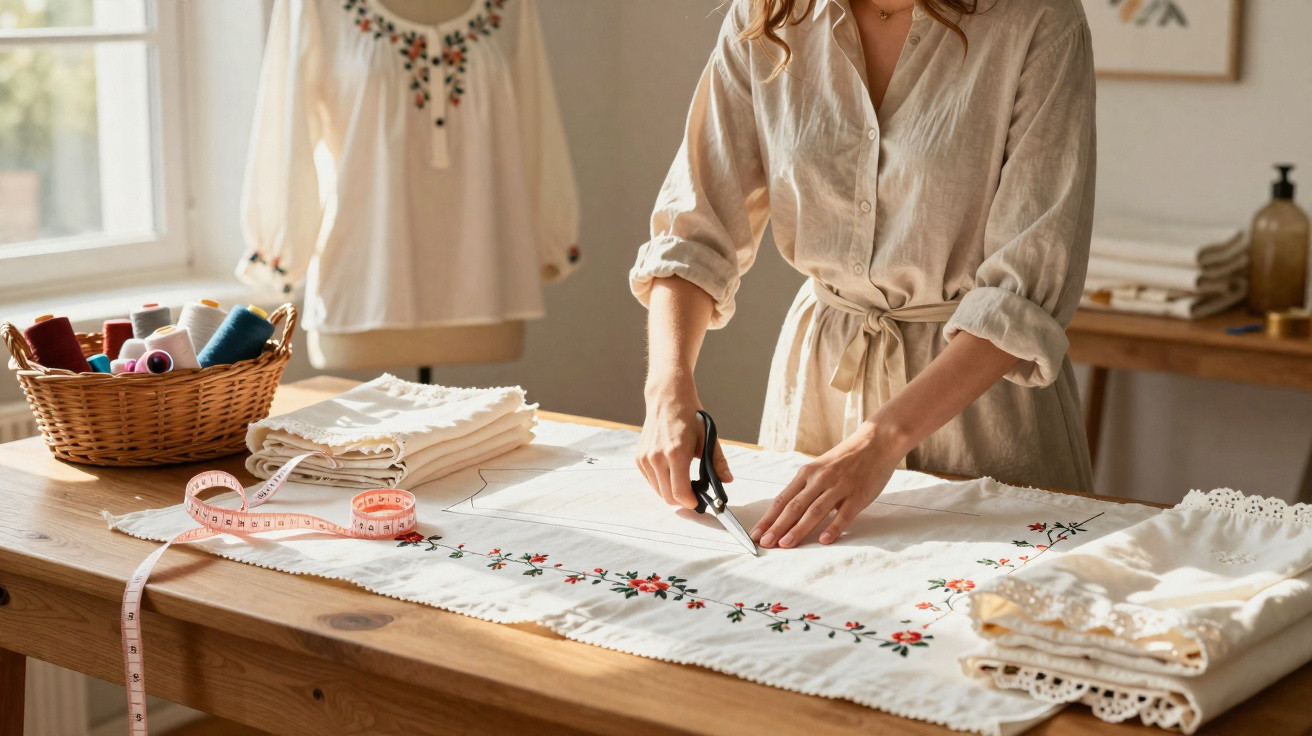
With one simple trick, they can become real eye-catchers.
Many people know the situation: a neatly folded pile of old, impeccably embroidered bed sheets inherited from a grandmother. They are too delicate for everyday use, yet too sentimental to throw away. This is where a clever sewing technique comes in, transforming these treasured fabrics into one-off garments and home accessories while making a clear statement against textile waste.
Why old embroidered bed sheets are so valuable today
Anyone who owns sheets like these has more than nostalgic memories stored away. They often come from an era when quality and durability mattered more than cheaply made mass-produced goods.
Old bed sheets passed down through families are usually more tightly woven, hard-wearing and comfortable against the skin than many new fabrics sold in shops.
Textile and clothing institutes have highlighted this for years: traditional trousseau sheets are often made from pure linen or a linen-and-cotton blend. They commonly have a fabric weight of more than 200 grams per square metre, can withstand high washing temperatures and become softer with every wash without immediately pilling.
There is also the sustainability aspect. In one European country alone, such as France, hundreds of thousands of tonnes of textile waste are generated each year. Similar trends can be seen in German-speaking countries. Giving existing fabrics a high-quality new purpose saves resources and money, while creating a style statement far removed from fast fashion.
Preparing old bed sheets for sewing
Before reaching for the scissors, inherited fabric needs some care. Only then will its true potential become clear.
Washing, brightening and protecting the fabric
- Wash thoroughly: Start with a high-temperature wash to remove dust, odours and residue from storage.
- Check the measurements: Measure again after washing. Many older fabrics shrink slightly, which matters when cutting the pattern pieces later.
- Treat yellowing: Pale but yellowed fabric can be freshened with very hot water and lemon juice. Oxygen bleach, such as sodium percarbonate dissolved in hot water, works even more effectively.
- Avoid chlorine: Traditional chlorine bleach can severely weaken natural fibres and leave them brittle.
Then press the sheet carefully. Smooth fabric makes it easier to plan the pattern layout and reveals precisely where minor flaws, thin patches and especially attractive embroidery are located.
Mark the treasures and identify weak areas
This is where the real creative work begins. Use tailor's chalk to mark out the special details:
- cutwork patterns or broderie anglaise
- decorative edges and scalloped finishes
- initials and monograms
- wide hems or decorative drawn-thread hems
At the same time, inspect any thin or damaged areas carefully. These sections are less suitable for high-stress parts such as shoulder seams or button plackets. However, they can still work well for linings, internal pockets or decorative inserts.
The professional trick: using embroidery as inset panels
The brilliant idea behind this technique is almost simple, but it makes all the difference: rather than cutting the embroidery out along with the rest of the fabric, plan it deliberately as inset panels.
The embroidery is not an extra; it becomes the star of the new garment.
In practice, begin by placing the pattern pieces on the sheet and moving them around until the prettiest details sit in exactly the right place.
Examples:
- A large monogram can sit precisely on the breast pocket of a summer jacket.
- A strip of broderie anglaise can run along the lower edge of a blouse or kimono.
- A decorative drawn-thread hem can define the rear shoulder section or the upper back.
Only once the layout is final should you start cutting, leaving generous seam allowance around the embroidery. If an area is slightly weakened, apply a lightweight fusible interfacing to the reverse to prevent tearing. A neat zigzag or overlocked edge will stop the fabric from fraying later.
A practical example
One home sewer had a three-metre sheet featuring a striking initial positioned in the centre. She solved the problem by cutting out the monogram generously and using it as a breast pocket on a lightweight mid-season jacket. The remaining fabric supplied the body, sleeves and facings. The result was a unique Boho-style piece that immediately prompted questions such as: “Where did you buy that jacket?”
What you can make from old bed sheets
Once the initial hesitation has gone, a whole range of projects opens up for both the wardrobe and the home.
Clothing ideas
- Loose blouses and shirts: Use plain sections for the main body, with embroidery on cuffs, collars or button plackets.
- Kimono jackets: Longer open jackets with borders running along the front edge or hem.
- Summer dresses: Simple straight cuts enhanced with decorative strips at the waist or neckline.
- Skirts with inset panels: A wide embroidered strip at the hem can turn a plain skirt into a statement piece.
Ideas for the home
Old sheets are surprisingly versatile for interiors too. Here is an overview:
| Project | Use of the embroidery | Difficulty level |
|---|---|---|
| Duvet cover | Monograms or borders placed at the opening or in the centre | Medium |
| Tablecloth | Embroidery at the corners or along the edge | Easy |
| Napkins and tea towels | Small motifs in one corner, with a monogram as a focal point | Easy |
| Cushion covers | Position and frame the motif exactly in the centre | Easy to medium |
| Upholstered headboard cover | Large surface incorporating several embroidered details | Advanced |
Cushion covers are particularly quick to make: cut rectangles or squares, position the motif exactly in the middle and keep the reverse plain. The result is a standout sofa accessory with a story behind it. For curtains, you can often use the existing hem as the channel through which the curtain pole will later slide.
Common mistakes to avoid
People working with old bed sheets for the first time often encounter the same pitfalls.
- Cutting too soon: Plan first and cut afterwards. Once embroidery has been cut away, it is difficult to correct.
- Cutting through the embroidery: The appeal lies in showing motifs in full. Split letters or half a border look unfinished.
- Ignoring seam placement: Even the most beautiful motifs achieve little if a seam or dart runs straight through them.
- Pressing too heavily: Areas already under strain, especially around embroidery, do not respond well to constant pressure at maximum heat.
Why the effort is worthwhile
Ideally, one large sheet can produce several projects: a jacket, two cushion covers and perhaps a bag or table runner as well. Every finished item carries not only craftsmanship but also family history forward. When you give such pieces as gifts, you are passing on a story at the same time.
For many people, upcycling projects like these provide their first route into sewing. Having quality fabric already to hand removes the pressure of “ruining” expensive fabric bought by the metre. At the same time, putting an heirloom to meaningful use feels far more satisfying than leaving it stored in a cupboard.
There is another advantage: old natural fibres are generally kind to the skin and breathable. This is especially beneficial for summer clothing or bedding. Compared with synthetic materials, they trap less heat, develop sweat odour more slowly and can be washed at higher temperatures without immediately losing their shape.
Anyone exploring the subject in more depth will soon come across technical terms such as “fabric weight”, “drawn-thread hem” and “fusible interfacing”. It is worth looking these up and applying them consciously in your next sewing project. The better you understand your own materials, the more reliable the results will be - and the more enjoyable it becomes to sew forgotten sheets into deeply personal favourite pieces.

Comments
No comments yet. Be the first to comment!
Leave a Comment