
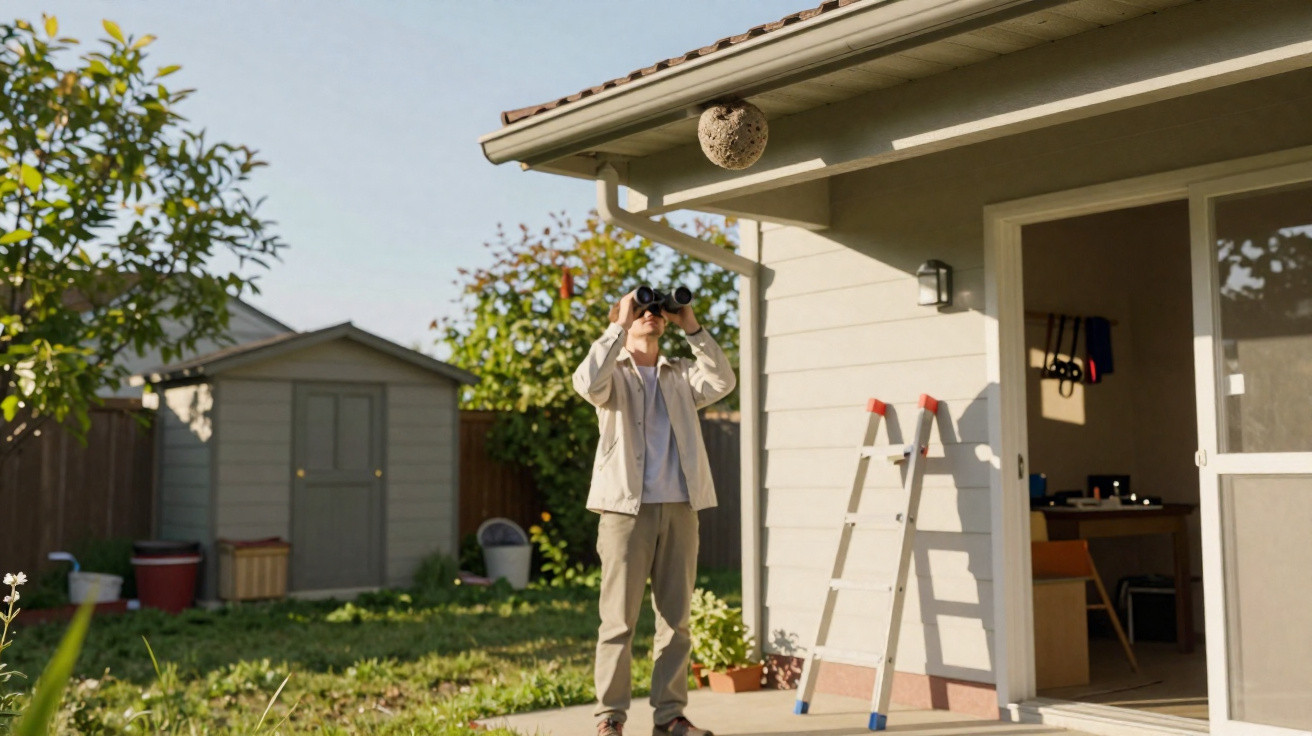
Between the first mild days of February and late spring, Asian hornets can build inconspicuous mini-nests directly on homes and garden sheds. Many householders mistake these small grey balls for dirt or cobwebs, only discovering in summer that a fully developed nest has formed around the roof. Spotting them early can prevent this.
Hidden danger in spring
As temperatures rise, overwintering Asian hornet queens emerge. They quickly look for a sheltered spot close to buildings, where they start constructing what is known as a primary nest. This initial nest is tiny, usually measuring just three to five centimetres across - roughly the size of a table-tennis ball - and made from grey “paper”.
That is precisely what makes it problematic: at this early stage, it appears harmless and is easily overlooked. Yet the queen is already laying the foundations for a large later nest that may house hundreds of hornets during summer. Flight activity then becomes far more noticeable, while the risk of painful stings increases, particularly if people get too close or create vibrations near the nest.
Anyone who spots a mini-nest between February and May can prevent a dangerous colony developing by late summer.
These insects are rarely found in obvious places. They make use of cracks, ledges and dark corners, especially above head height. A brief walk around the house may be enough to find a newly built nest.
Beneath the roof: common hiding places on houses and façades
The most frequent hiding places are immediately below the roof, in locations that few people inspect closely. However, much can be identified from ground level if you know where to look.
How to search correctly from the ground
Stand a little way back from the building, at least three to five metres away. Slowly inspect the roofline, especially where:
- roof overhangs project a long way out;
- timber boards or cladding are visible;
- cracks or gaps exist between the façade and roof structure;
- the sunny side of the house is located - usually the south- or west-facing side.
It is important to watch not only for the nest itself, but also for insect traffic. A repeated pattern of entering and leaving at one exact point is typical. At first, you may see only one hornet returning to the same location over and over again.
A quiet, low buzzing that repeatedly comes from the same direction can also be a sign. Do not approach the area directly; remain on the ground. No ladder is needed for this visual check.
A common Asian hornet hotspot: the underside of the roof overhang
Primary nests are particularly often found on the underside of the roof edge. The queen attaches her small grey ball to boards directly beneath the overhang, usually close to the fascia board. The location is sheltered, warm and dry, with wood for the nest’s “paper” readily available.
The ball resembles thin, marbled cardboard: smooth and enclosed, with a small opening on its underside or at the side. The hornet will regularly enter and leave through this opening.
Typical appearance: a grey ball measuring three to five centimetres on the underside of the roof edge, with a small hole at the side or underneath.
If you repeatedly see a hornet-like insect at such a spot, stay alert rather than dismissing it. The earlier a nest is reported, the easier it is for specialists to remove it.
Garden sheds and tool stores: nests at hand height
House roofs are not the only attractive sites. Garden sheds, carports and tool stores offer ideal conditions: they are dry, protected from wind and seldom entered. In these places, people can easily find themselves standing right beside a nest without realising it.
The risky corner above stored equipment
In garden buildings, it is worth looking carefully upwards. Typical locations include:
- the junction between crossbeams and roof panels;
- dark corners that receive little light;
- areas above shelves or tool racks;
- just above internal door frames or windows.
Many people open their shed for the first time in April or May, reach absent-mindedly for a rake or pair of garden shears, and come within just a few centimetres of the nest. If the Asian hornet queen feels threatened, she responds defensively at once. Multiple stings may follow.
Checking the ceiling briefly before starting work can prevent these situations. A torch can illuminate dark corners without requiring you to stand directly beneath the nest.
Observe safely without putting yourself at risk
Anyone checking their garden area can use a few simple aids:
- Binoculars: Scan the roof edge from the lawn or a neighbouring property.
- Torch: Shine it towards the ceiling in garden sheds while standing to one side of the doorway.
- Distance: Always keep several metres away and avoid sudden movements directly in front of the nest.
In unsettled weather, there may be very little visible flight activity for days at a time. A brief rise in temperature is enough for activity to begin again. One inspection is therefore not sufficient. Several short observation periods at different times of day are sensible.
What should you do if you find a nest?
As soon as you suspect a nest or see one, the first step is to create distance. Keep children and pets away from the area, and mark the zone so that nobody accidentally walks underneath it.
Mistakes you must avoid
Out of ignorance, many people try dangerous methods that can make the insects aggressive. Do not under any circumstances:
- knock down or dislodge the nest using sticks or tools;
- spray it with water, for example using a garden hose;
- burn or set fire to it;
- use household insect sprays not intended for hornets;
- tape over or block the entrance holes.
It is actions like these that repeatedly lead to accidents. Hornets react strongly to disturbance and perceived threats. Several insects can sting simultaneously, particularly around the face and head.
A calm, methodical approach is better: move away, secure the area and document the nest.
The correct course of action
Take a photograph from a safe distance, ideally using your smartphone’s zoom function and without flash. The image should show the nest, its position on the building and any possible access points.
Then contact the relevant local service. This may be your local council or environmental service. They can advise which specialist contractors are responsible, or whether there is a central reporting point for Asian hornets. The more accurately you describe the location, the more precisely a specialist can plan safe removal:
- “Underside of the roof overhang on the south side, above the patio”
- “Inside the garden shed, ceiling to the left of the door, roughly at eye level”
- “On the carport, upper post facing directly towards the road”
The rule of thumb is: locate it, keep your distance, report it - never attempt to deal with it yourself.
How dangerous is the Asian hornet really?
Many people are frightened by this large, dark insect. Its sting can certainly be painful, similar to or worse than that of an ordinary wasp. For people with allergies, it may be life-threatening. Anyone who has previously had a severe reaction to bee or wasp stings should take particular care around hornets and seek medical help immediately in an emergency.
However, the main issue is the large number of insects in a developed summer nest and their close proximity to people. In addition, the Asian hornet is considered an invasive species and places considerable pressure on bees and other insects. Every colony prevented therefore also helps to protect native ecosystems.
How to tell Asian hornet nests apart from similar insects
Many people confuse the small springtime balls with wasp nests or spider nests. A few characteristics can offer clues:
- Colour and texture: Asian hornets create smooth, grey-marbled “paper balls”.
- Shape: Initially almost perfectly round, with a small opening underneath or at the side.
- Location: Often directly beneath roof edges, on beams or inside sheds.
- Flight pattern: A larger, darker insect with a relatively calm, direct flight path.
Reliable identification is often possible only for specialists. If you are unsure, still treat the nest as a potential hornet nest and do not attempt to handle it yourself.
Practical prevention around your home
A few regular habits can reduce the day-to-day risk. Schedule brief inspections around the house during spring. Check again after storms or extended rainy spells to see whether new nests have appeared. Watch for larger insects repeatedly flying to the same place.
If you are putting up a new garden shed or refurbishing a carport, take care not to leave overly open cavities. Enclosed ceiling linings and fewer accessible gaps make it harder for hornets to establish a nest. This cannot prevent nesting entirely, but it makes the location less appealing.
The better informed residents are about typical hiding places and nest development, the less likely they are to have unexpected encounters directly beneath the roof. A quick look upwards in spring is far more pleasant than a nerve-racking encounter with fully developed hornets in late summer.






Comments
No comments yet. Be the first to comment!
Leave a Comment