
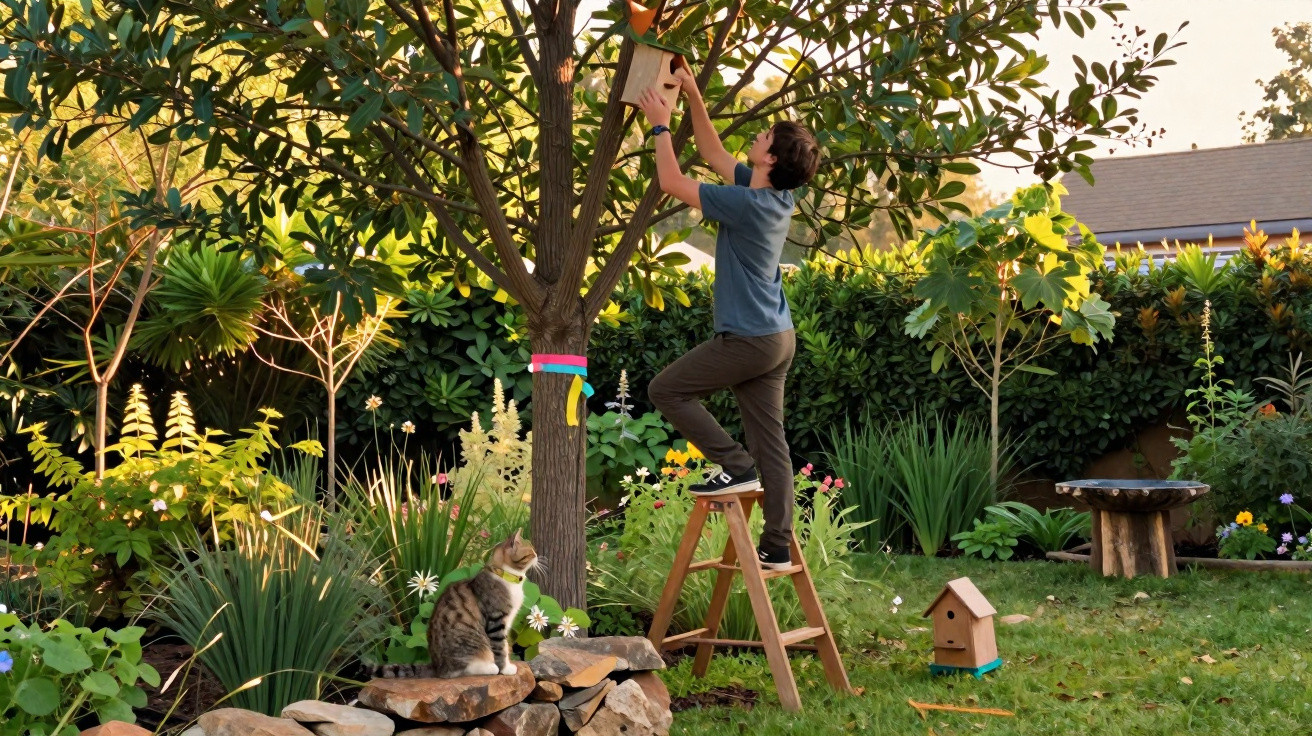
Many people adore their pet cat while also enjoying the colourful activity around bird feeders and hedgerows. Yet as soon as the breeding season begins, these two passions can collide head-on. A cat’s hunting instinct meets helpless fledglings on the ground, often with fatal consequences. A few carefully chosen changes in the garden can greatly reduce this conflict without having to banish your four-legged companion.
Why your garden can quickly become a hunting ground
Domestic cats may seem relaxed, but deep down they are little lynxes. They hunt not only because they are hungry, but also through instinct and curiosity. Studies show that while some cats catch almost nothing, others roam their territory for hours and hunt regularly.
The period from March to July is particularly sensitive. Many garden birds breed at this time, and their young are often found on the ground, in low hedges or close to ground level. These are precisely the places cats like to patrol.
A second issue makes matters worse: the overly “tidy” garden. What looks neat and well kept to us can create risks for birds.
- Fallen leaves and old stems are removed completely
- Hedges are trimmed into smooth shapes
- Lawns are kept very short
- Old branches and wood piles are cleared away entirely
This leaves birds without cover or escape routes. Nests are more exposed, while fledglings find it harder to camouflage themselves. For cats, it is like an open shop window.
“The cleaner and more manicured a garden appears, the easier cats find hunting – and the more defenceless young birds become.”
The “3-2-1 Refuge”: turning your garden into a safe haven for birds
One effective approach is to avoid tidying every part of the garden and instead create protected areas deliberately. A proven method can be described as the “3-2-1 Refuge”: three layers, two functions and one safe space.
Three layers that provide more cover
This refuge relies on several planting layers that break up a cat’s line of sight and give birds places to hide:
- A dense ground layer – using hardy ground-cover plants such as sedges or cranesbills, for example. These make it more difficult for cats to creep up silently.
- A shrub layer with thorns or dense foliage – such as blackthorn, hawthorn, rosehips, barberry or hazel. Many bird species feel at home in these shrubs.
- Small trees or tall-growing shrubs – these add further height and conceal the flight paths leading to and from nests.
Anyone who does not want to redesign the entire garden can begin with one corner where birds are especially active, such as around a favourite tree.
Leave one area untouched during the breeding season
It is particularly helpful to leave one section of the garden as undisturbed as possible from mid-March until the end of July. Birds can breed and raise their young there in peace during this period. The following steps have a greater effect than they may initially seem to:
- Leave at least one square metre of leaf litter beneath dense hedges instead of raking it all away
- Build a pile of wood and branches in one garden corner, then leave it undisturbed
- When mowing for the first time, leave a strip of lawn to grow taller
- Do not cut back old, hollow stems from faded perennials until summer
- Cover beds with a thick layer of organic mulch, allowing birds to forage and hide within it
“Even a small untamed strip can mean the difference between life and death for young birds.”
Safe nest boxes: small design mistakes, major consequences
Many people have good intentions when putting up bird feeders or nest boxes, but unknowingly place them where a cat can reach them most easily. This can lead to tragic scenes when a four-legged hunter needs only one short leap to reach the entrance.
How to hang nest boxes safely from cats
A few basic principles can significantly improve safety:
- Height: Around three metres above the ground is a useful guideline.
- Distance from branches and walls: There must be no horizontal branch, wall or roof overhang within jumping distance.
- Direction: Ideally, the entrance should face east or south-east, so it does not become too hot and receives better protection from heavy rain.
- No external perch: Small “perches” below the entrance may look attractive, but they help predators rather than birds, so they are best omitted.
- Nest-box depth: There should be roughly 15 to 20 centimetres between the entrance hole and the base, preventing a cat’s paw from reaching the nest.
Most importantly, do not install nest boxes directly in hedges or on low walls that cats already use as routes. The danger is especially high there.
“The worst location for a nest box is within a cat’s jumping distance – however idyllic it may look.”
Helping your cat become a reasonably considerate neighbour
An outdoor cat will never be completely “bird-friendly”, but the harm it causes can be reduced substantially. The key is to make certain places and times less appealing for hunting.
Restricting critical hunting periods
Many cats are most active at dawn and dusk, exactly when numerous bird species are flying and feeding particularly intensively. Anyone able to control outdoor access can take considerable pressure out of the situation. In practical terms, this means:
- Where possible, do not let the cat outside in the hours after sunrise during the breeding season
- Keep the cat indoors around sunset in the evening
- It can be allowed out more readily in rain and storms, when birds are often less active
This may seem strict to some owners, but many cats adapt to regular daily routines if these are maintained consistently.
Bright colours and gentle deterrents in the garden
To reduce hunting success, some owners use conspicuous collars with colourful fabric ruffs. Studies from several countries indicate that birds notice these bright colours sooner and are more likely to fly away in time.
Within the garden, sensitive areas can also be made less inviting for cats. Options include:
- Mesh guards around particularly important trees, so trunks cannot be used as climbing routes
- Coffee grounds around tree bases or beneath hedges, as many cats avoid their smell
- Citrus peel at key spots, since many cats dislike citrus scents
- Targeted planting of species whose fragrance deters cats, such as varieties with strongly aromatic leaves
In the long term, neutering also reduces roaming and hunting behaviour in many animals. Another factor is that occupied cats generally hunt less. Providing enough play opportunities, climbing options and food puzzles redirects energy away from hunting and into other activities.
A garden full of life: more than bird protection
Adapting a garden to suit birds brings several benefits. More shrubs, leaf litter and dead wood also attract insects, hedgehogs and other small creatures. The ecological balance becomes more stable, pests are kept under better control, and the garden feels alive rather than sterile.
There is also a legal aspect to consider. Many bird species are protected, and breeding sites must not be destroyed or deliberately put at risk. Owners who knowingly ignore straightforward protective measures can quickly enter a grey area. A garden that is friendly to cats while also suitable for birds helps to ease this conflict.
In practical terms, it makes sense to start small: one safe tree with a nest box, one untouched corner with leaves, or a new thorny shrub as a refuge. Changes can often be noticed as early as the first spring: more birdsong and fewer dead fledglings on the lawn.
Anyone who has seen an entire sparrow family successfully raise its young while their own cat lies contentedly in the sun nearby soon understands that, with a little planning, love for animals and hunting instinct no longer have to be at odds.





Comments
No comments yet. Be the first to comment!
Leave a Comment