
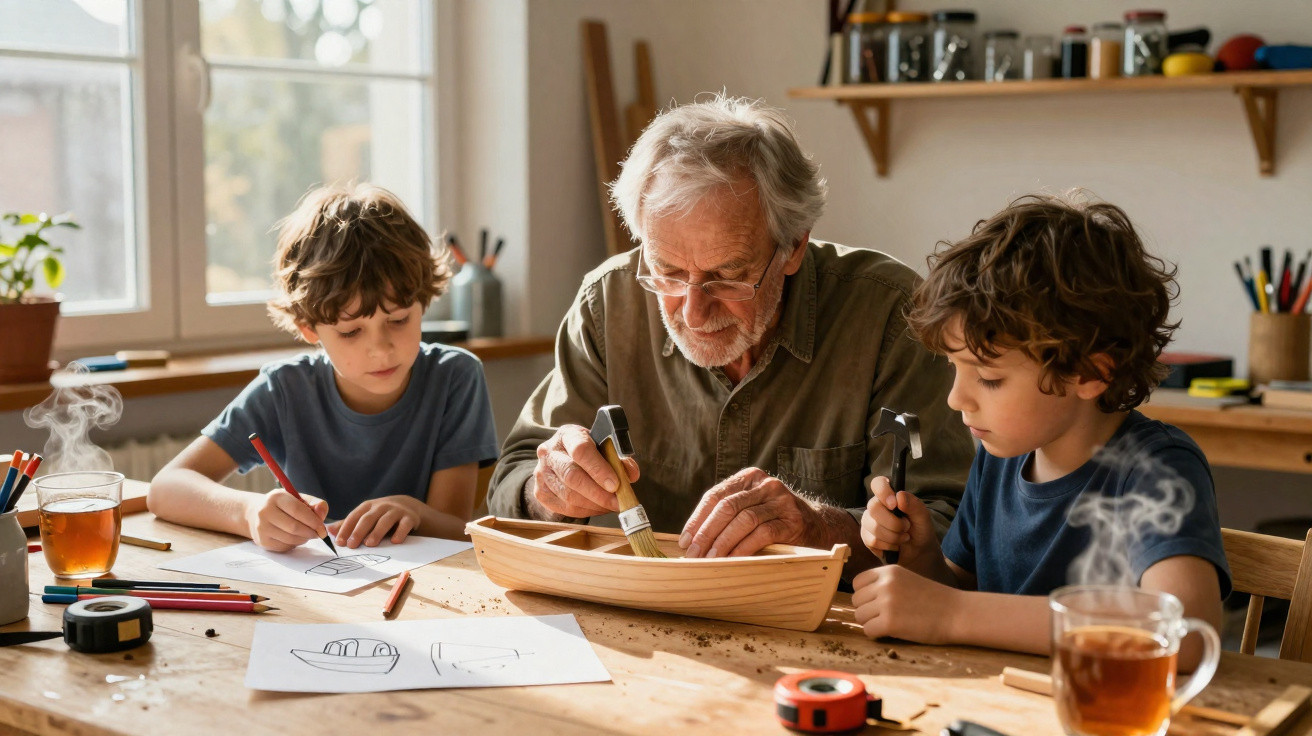
A retired grandfather explains how glue, cardboard and imagination became his strongest connection with his grandchildren. It is a gentle way to deepen their bond without grand speeches - or screens.
My grandson looks at me like a master builder directing his workshop assistant, and I nod as though I know precisely how to turn egg boxes into rockets, even though I am making it up too. We all know that moment when a child has an idea and you decide to follow rather than lead. Then everything goes quiet.
Crafting as a bridge in retirement
I have discovered that crafting is a wordless language. Once hands are busy, stories begin to flow, like small streams quietly joining a river. Suddenly, while pressing aluminium foil onto a cardboard tube, the nine-year-old is telling me what has been bothering him at school. There is no need for elaborate teaching methods: only time, materials and the willingness not to correct mistakes, but to nudge them towards a direction that feels right.
One day, we made a birdhouse from three milk cartons, two elastic bands and a wooden dowel. Only afterwards did we realise it looked more like a spaceship with a balcony. We put it up anyway, because sparrows evidently have a sense of humour, and I swear my grandson seemed taller as he stood on the ladder tying it in place. Various studies show that making things together supports attention, language and self-efficacy, but the feeling is more straightforward: you are together, making something deliberately.
Why does crafting create closeness? Because creating stretches time, calls for decisions and leaves immediate, visible marks that you can look at together. Amid the cuttings and splashes of glue, a gentle rhythm emerges - a ritual that tells the nervous system: this is safe; here, you can slow down; here, you are allowed to get things wrong. Conversations arrive from the side rather than head-on, and that is exactly what opens doors that might otherwise stay closed.
Ideas that last: method, rhythm and a small workshop
I use the 3-2-1 method: three materials, two rules, one story. Three materials stop the choice becoming overwhelming - cardboard, string and fabric offcuts, for instance. Two rules keep a framework in place - scissors stay at the table, and the glue lid goes back on. One story provides the drive - “Today, we are making something that could fly.” It channels everyone’s energy, prevents distractions and gives each crafting day its own small narrative.
The most common trap is perfection. Adults want neat edges, while children want feeling, and the two only work together if those edges are allowed to be soft. Let us be honest: nobody truly does this every day. Once a week is enough: forty minutes, phones put away, tablecloth spread out, done. And if the rocket is crooked, it will still fly in the game. I have stopped trying to improve things; instead, I simply ask: “How does it feel?” The answer shows us where to go next.
Sometimes a short phrase works like an anchor: Time beats things. I keep an old tin ready with basic supplies and call it the “toolbox for ideas”; that name alone changes something for the children, who suddenly become the experts.
“Grandad, today we are building something that talks - maybe a postbox for secrets,” says my granddaughter, and I pause for a moment because she is right: things speak when we listen to them.
- 3-2-1 method: three materials, two rules, one story
- Short sessions: 30–45 minutes, then a break
- Basic box: cardboard, glue, string, washi tape, wooden craft sticks
- Ritual: three minutes at the end for showing and naming what was made
- Take a photo and add the date - keep progress visible
How bonds grow when hands do the talking
Bonds are not poured from big days out, but built through small, heartfelt repetitions. I have made Friday our making day, and simply saying, “Today is Craft Friday,” brings a calm to the home, as if a lamp has been switched on. At the end, we photograph the result, stick the picture into a notebook and add one sentence: one table, two hands, three generations.
The grandchildren grow older, and so do the projects, but the pattern stays the same: a question at the start, a moment of quiet, then the first confident cut. I hear them thinking aloud as they cut, and I learn how they tackle problems, what they fear and what they discover. I can share my old workshop tricks without becoming the instructor. Mistakes are invitations, not stop signs; every slip becomes a new turning.
There are days when nobody wants to craft, so we go on a materials hunt around the house, finding buttons, corks and strips of paper. In the end, we may make only a tiny nothing that sits amusingly on the shelf. That is enough. I breathe more slowly when I see their brow furrowed over a detail, and I feel that retirement is not an ending but room for beginnings. Sometimes closeness needs only a pair of scissors, some sticky tape - and someone who asks: “What shall we make today?”
Where it leads remains open: perhaps to a summer when the birdhouse is suddenly occupied, or to a winter workshop that smells of cinnamon, or to quieter afternoons when we simply leaf through the notebook and marvel at how much work can sit inside such light things. You cannot preserve this time, but you can collect it like found objects in a jar, gleaming when you hold them up to the light. Sometimes one cardboard box is enough to hold the world.
| Key point | Detail | Benefit for the reader |
|---|---|---|
| Ritual rather than chance | A regular crafting time, a short structure and clear rules | Easier to begin, less stress and greater commitment |
| 3-2-1 method | Three materials, two rules, one story | Focus, creativity and quick successes |
| Basic box | Cardboard, glue, string, tape, wooden craft sticks | Always ready for spontaneous ideas |
FAQ:
- Which craft ideas work for different age groups? Toddlers love collages and modelling-clay figures; primary-school children enjoy vehicles, dollhouses and simple mechanisms; teenagers often move on to upcycling, lampshades or small electronics.
- How long should a crafting session last? 30–45 minutes is ideal, followed by five minutes for showing and talking. Longer sessions should happen only when the child wants them, never out of a sense of duty.
- What if the grandchildren only want to use a tablet? Combine the two: recreate a character from their favourite game or print templates as a starting point. Afterwards, they will often carry on building voluntarily.
- Which materials are affordable and safe? Milk cartons, cardboard, old magazines, washi tape, wooden craft sticks, non-toxic glue sticks and children’s scissors. Watercolours and wax crayons are suitable for adding colour.
- How can I keep the mess under control? Use a tablecloth, a tray as a work surface and a small box for leftovers; take a photo at the end and tidy up together as a ritual. It saves time and reinforces responsibility.


Comments
No comments yet. Be the first to comment!
Leave a Comment