
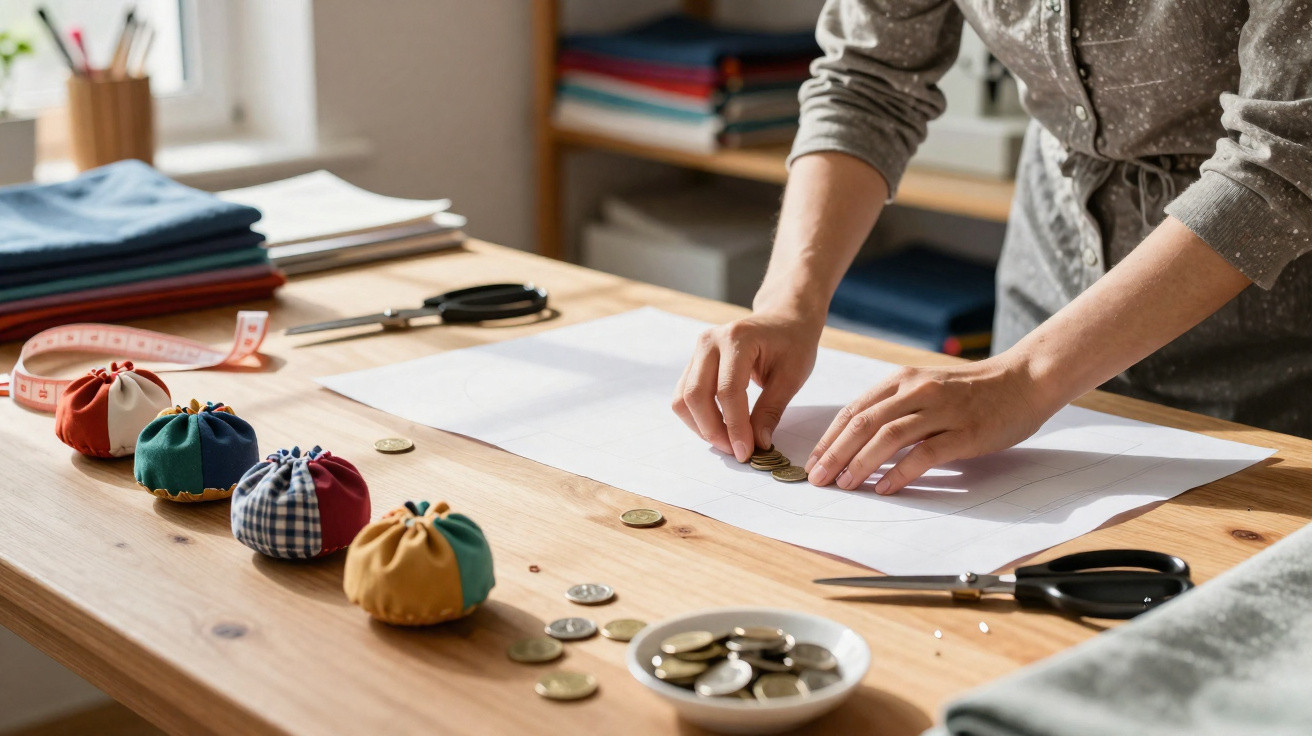
What once jingled around in a purse can now sit neatly beside a rotary cutter and fabric shears: retired coins make small, precise weights for holding delicate fabrics in place. The technique originates in professional workrooms, yet it is easy to recreate at home with a few simple steps – protecting silk, softshell and leather from unsightly holes.
Why sewists put loose change on the cutting table
Many homes have jars filled with old coins that are no longer spent. This seemingly worthless loose change is ideal as a sewing aid: it can be turned into compact pattern weights that keep paper pattern pieces and layers of fabric exactly where they belong.
The principle is simple: rather than piercing fabric and the pattern with pins, hold them in place with weight alone – precisely and without any perforation.
This makes a real difference with sensitive materials in particular. Textile research specialists have long recommended using as few pins as possible with certain fabrics. Every puncture damages fibres, and this can become a genuine issue with modern performance textiles.
Where pins can cause real damage
The following materials are especially vulnerable:
- Silk and fine fabrics – tiny holes often remain visible, and the fabric may tear.
- Leather and faux leather – every puncture is permanent; the hole will never close again.
- Coated fabrics and rain jackets – each pinhole can later become a point where water seeps through.
- Very lightweight jerseys – the knit structure can become distorted and the fabric may stretch out.
This is exactly where coin weights come into their own: they secure fabric across its surface rather than at individual tiny points. There is no pulling, no hole and no thread being torn out.
Check the value before coins move to the sewing machine
Before the contents of the coin jar are permanently moved into the sewing room, it is worth checking their value briefly. Not every old coin is simply scrap metal: some pieces may interest collectors or retain considerable monetary value through their metal content alone.
Numismatists use a rarity index ranging from 0 to 100. A low figure means the coin is common and therefore of little interest to collectors. Everyday copper-nickel coins of this kind are particularly suitable for this sewing project.
Silver coins are a different matter. A typical example is an older silver coin containing a little over four grams of fine silver: based on metal value alone, it may already be worth a single-digit euro amount, depending on the current silver price. That price fluctuates and is only a guide, but it demonstrates why such pieces are best kept away from the sewing machine.
Rule of thumb: sort first, then make. Anything rare or made from precious metal stays with collectors – everything else can go into the sewing box.
How heavy coin weights should be for cutting out fabric
For this approach to work, weight matters greatly. A few loose coins will not be enough. Pattern weights need to rest noticeably heavily on the surface so that neither the fabric nor the paper can shift.
Many older coins weigh almost exactly 10 g, making the calculation straightforward:
| Number of 10 g coins | Total weight | Typical use |
|---|---|---|
| 3 coins | 30 g | very fine silk, small pattern pieces |
| 4 coins | 40 g | lightweight cotton, lining fabrics |
| 5–6 coins | 50–60 g | softshell, denim, coated fabrics |
For a standard paper pattern piece on ordinary cotton, 40 to 60 g per weight has proved effective. Anyone regularly working with very fine silk can begin with slightly lighter weights.
Step by step: sew your own coin pattern weights
Making these small sewing aids is straightforward and requires no specialist equipment. One afternoon in the sewing room is enough to put together a full set.
Preparing the coins
First, give the loose change a basic clean so that old dirt or odours do not transfer to the fabric:
- Soak the coins in warm water with a little washing-up liquid.
- Rub them briefly using a soft brush.
- Rinse them well and dry them thoroughly, preferably spread out on a towel.
Then stack four to six coins for each weight. If preferred, wrap the stack in a strip of masking tape or add a thin felt layer. This softens the metallic feel and reduces rattling sounds.
Sewing the fabric cover
Ordinary cotton or linen is sufficient for the cover. Small offcuts are ideal, making this a lovely upcycling project.
Continue as follows:
- Cut squares measuring approximately 10 × 10 cm.
- Place the stack of coins in the centre.
- Fold the fabric edges upwards to form a small parcel.
- Sew the overlapping corners together, either by hand or with a sewing machine.
The result is a compact “fabric block” that feels pleasant to handle, does not slide around and will not scratch the table. Those who care about appearance can sew colour-coordinated sets for different projects.
How coin weights work with softshell, silk and leather
The benefits of coin weights are especially apparent in practical use with modern performance fabrics. Softshell, for instance, often has a membrane that blocks wind and moisture. Each needle pierces this layer, creating a point through which water could later enter.
Instead, smooth the fabric layer onto the cutting mat, lay the pattern on top and distribute the weights around the outer edges. At corners, it is perfectly acceptable to stack two weights, while long straight lines should use several weights spaced roughly 15 to 20 cm apart.
On very slippery materials such as silk or chiffon, the weight helps prevent the fabric from “walking”. Where pins along the edge would pull the fabric and create folds, everything remains calm and smooth. This acts rather like a safety net when cutting with a rotary cutter – less movement and less waste.
With leather and coated fabrics, another consideration takes priority: every puncture remains visible. Completing the cut without a single hole leaves far more freedom when planning the later seam line, without needing to conceal previous pin marks.
Fine pattern pieces need plenty of weights
One weight is not sufficient for sharply curved or very small pattern pieces. A series of several closely placed points is better, securing the path of the line. Anyone who often works with patterns full of curves is best served by owning more weights that are slightly lighter and can be positioned closer together.
Why the method is so appealing – and its limits
Using coin weights provides a range of practical benefits:
- No risk of permanent holes in delicate fabrics.
- Faster work because pinning is unnecessary.
- Less rippling and distortion along the cut edge.
- Old coins and fabric scraps gain a new purpose.
- The weights last for many years without noticeable wear.
Even so, this method does not replace pins in every situation. During sewing itself, particularly for narrow hems or curves, some localised fastening is often still needed, whether with pins, clips or temporary spray adhesive. Coin weights are most useful when cutting out fabric and transferring markings.
People who sew frequently can develop the system further: use different colours for different weight classes, embroider gram values onto them, or add small loops so the blocks can be stored together on a rail. These kinds of individual solutions are now increasingly common in larger workrooms.
There is one further point that surprises many people: children being introduced to sewing machines often find weights easier to use. They do not need to insert and remove pins, there is less risk of pricks, and cutting out fabric feels clearer and more manageable. Old coins therefore become not only professional sewing aids, but also a rather family-friendly sewing upgrade.






Comments
No comments yet. Be the first to comment!
Leave a Comment