
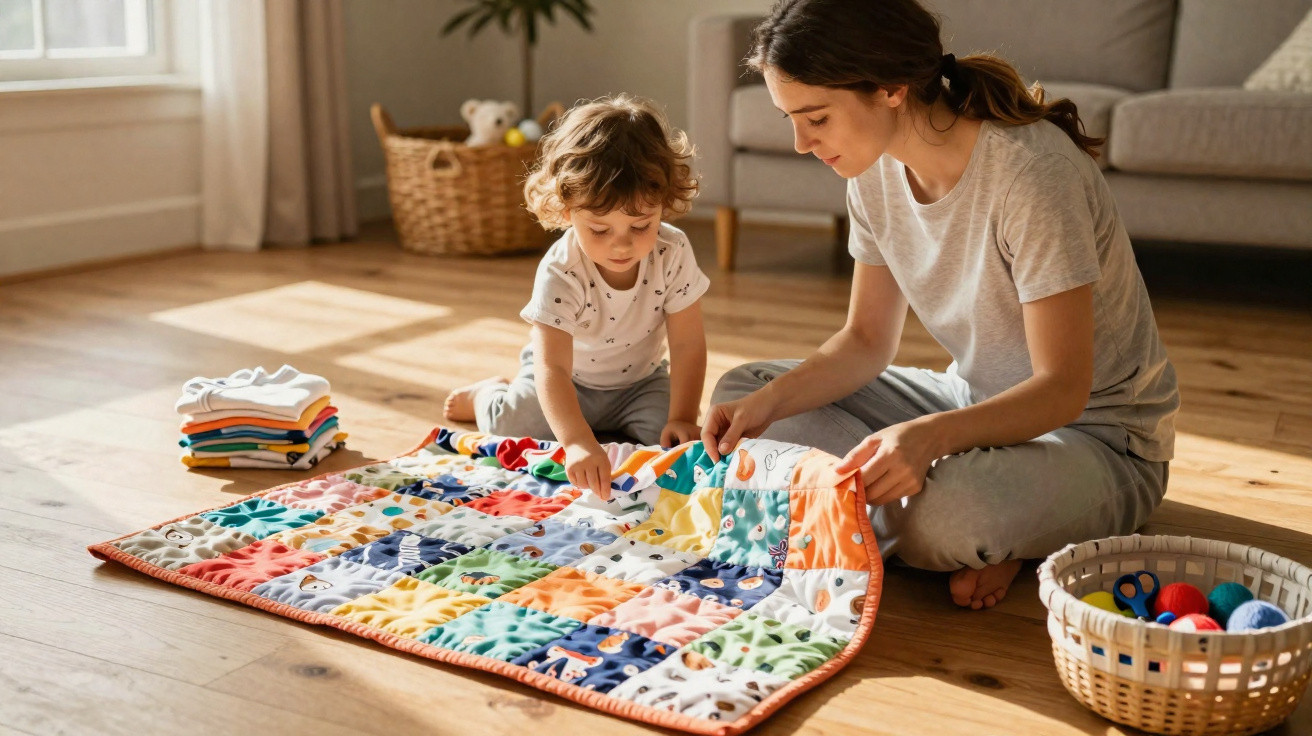
Many parents know the feeling: boxes packed with baby clothes, carefully stored away yet virtually absent from everyday life. Every item represents a moment, a smile or a sleepless night. Throwing them away is out of the question, while selling them is hardly worthwhile. This is where a sewing idea comes in, turning piles of fabric into one tangible keepsake.
Why baby bodysuits are too precious for a box
During their first year, babies get through clothes at an extraordinary rate. Using five to seven bodysuits a day is far from unusual. Stains, milk spills and nappy mishaps all end up in the wash, with much of it later packed into boxes. By the time a child reaches their first birthday, there may be several boxes holding clothes from those early months.
These tiny garments carry an enormous emotional weight: the outfit worn home from hospital, the bodysuit from a first Christmas, the set given by a favourite uncle. Everything is kept because it will be sorted “later” – yet that later date keeps moving further away.
At the same time, these memories are stored in the least suitable places: the cellar, loft or under the bed. They can yellow, take on a musty smell and attract moths. The memories may remain in the mind, but the fabrics age away in the dark. They could instead take on a new, visible place in the home.
“Instead of three dusty boxes full of baby clothes, there is one piece of textile history that is handled every day.”
Memory quilt: turning tiny clothes into a family heirloom
The central idea is both simple and brilliant: favourite bodysuits, sleepsuits and miniature outfits are made into a patchwork blanket, often called a “memory quilt” or keepsake throw. Numerous small pieces become a large fabric mosaic, suitable for draping over the sofa, hanging beside a child’s bed or using at story time.
Each square captures a particular scene. Rather than taking one bodysuit from a box at a time, the whole babyhood period is laid out like an open book. Parents and children can move their fingers from panel to panel, recalling moments, photographs and smells.
- The bodysuit that brings back the milk stains from the start of breastfeeding
- The sleepsuit from the first holiday with a sea view
- The top worn on the day of a christening or welcome celebration
- The set the baby wore when taking their first steps
Paired with a photo album, a box containing the birth announcement and hospital wristband, or a diary, it becomes a kind of “textile chronicle” of the first few months. Its great advantage is that it does not need to be fetched from a cupboard: it sits at the heart of family life and naturally becomes part of the daily routine.
The technical challenge: jersey can be tricky – until it is tamed
Anyone planning to sew a memory quilt soon encounters a difficulty: baby bodysuits are generally made from jersey, a knitted and stretchy fabric. It stretches under the sewing machine, curls at the edges and can distort the entire cut.
The most important item, alongside a sewing machine and time, is therefore iron-on stabilising interfacing for the reverse of the fabric. This prevents the pieces from stretching.
“Without stabilising, the quilt loses its shape; with it, the squares stay firm and the seams remain neat.”
Preparing a baby clothes memory quilt
For a throw in a classic sofa size, around 25 to 30 items of baby clothing are suitable. Anyone making a larger snuggle blanket can, of course, allow for more. The process is always broadly the same:
- Wash the clothing and allow it to dry thoroughly.
- Choose the favourite items: special occasions, attractive patterns and personal stories.
- Make a 15 x 15 cm square template from cardboard.
- Iron the stabilising interfacing onto the reverse of the bodysuits and sleepsuits.
- Cut the squares only after stabilising them, positioning motifs and slogans centrally.
The cut squares can then be arranged on the floor or a large table to test different layouts. Colour gradients, a random mix or groupings by motif are all possible.
Sewing for neat edges and a soft backing
Sew the quilt one row at a time: place two squares right sides together, stitch them with a seam allowance of around 1 cm, then add the next square. Once every row is complete, sew the rows together to form one large rectangle.
For the backing, a soft fabric such as fleece or Minky is recommended. Place it right sides together with the patchwork, sew fully around three sides and almost all the way along the fourth. Turn the throw through the opening, close the turning gap and topstitch close to the edge. If desired, quilt several seams across the surface as well, so that nothing shifts.
A lovely extra detail is to cut off popper strips from old bodysuits and reuse them. They allow the throw to be secured later to cot bars, a buggy or a child car seat, so it does not continually slip.
Make it yourself or commission it?
Not every mum or dad feels comfortable using a sewing machine. This raises an obvious question: should it be made at home or entrusted to a professional workshop?
Benefits of a DIY project
Sewing it yourself means handling every bodysuit once again. Looking through, sorting and cutting the clothes becomes almost a small ritual. There may be laughter, a brief lump in the throat and shared stories.
- Complete control over the design, colours and size
- Personal additions such as sewn-on labels or embroidered names
- Lower costs if a sewing machine is already available
- A particularly personal connection to the finished piece
On the other hand, the project requires time, space and a basic level of confidence with fabric and a machine. Anyone who has never sewn before is better off beginning with a smaller format, such as a cushion made from a few squares.
When a professional studio is worthwhile
Specialist sewing studios can make a finished throw from baby clothes sent to them. They often offer several sizes, such as 75 x 75 cm for a pram, 90 x 120 cm for a cot, or large blankets of up to around 135 x 180 cm for the family sofa.
Depending on the size, studios need between 20 and more than 100 items. Waiting times are usually between four and twelve weeks, depending on the season and workload. Clothing must be clean and freshly washed; heavily damaged pieces are often used only in part.
“Whether you sew it yourself or have it sewn: in the end, what matters is the blanket that lives in everyday life – not the box in the cellar.”
How a memory quilt changes family life
Many parents say that the throw becomes a regular part of the bedtime routine. During story time, a child points to squares and asks, “Was I wearing that when…?” – and a little journey through time begins. The fabric acts as an opening for family stories.
It can have a special effect on siblings, too. An older child sees that their baby clothes do not simply disappear, but are given a place of honour. Later, the throw may move into their teenage bedroom or even go with them to their first home of their own.
There is another aspect that should not be underestimated: sustainability. Rather than buying new decorative items, existing material is reused. The emotional attachment also makes it unlikely that the blanket will later be thrown away. It often stays with the family for decades.
Practical tips and small pitfalls
Anyone planning such a project should allow plenty of time, avoid making the selection under pressure and set aside a few more items than they think they need. When laying out the squares, it sometimes becomes clear that certain colours do not work together after all, or that a motif would be cut awkwardly.
Stains need not be a concern: light shadows and marks from washing are part of the story. Only areas that are badly worn away or extremely thin should be reinforced or left out altogether. Delicate appliqués can sometimes be moved onto other squares if the original backing fabric is no longer stable.
For anyone uncertain, making a test piece is worthwhile: sew a small mini patchwork from 4 to 9 squares, perhaps as a cushion cover. This gives a feel for jersey, seam allowances and the effect of the colours.
Ultimately, the result is more than simply a blanket. It is a fabric archive of the first months: tangible, cosy and present in everyday life. The boxes can then become smaller with a clear conscience – the memories have already found a better place.

Comments
No comments yet. Be the first to comment!
Leave a Comment