
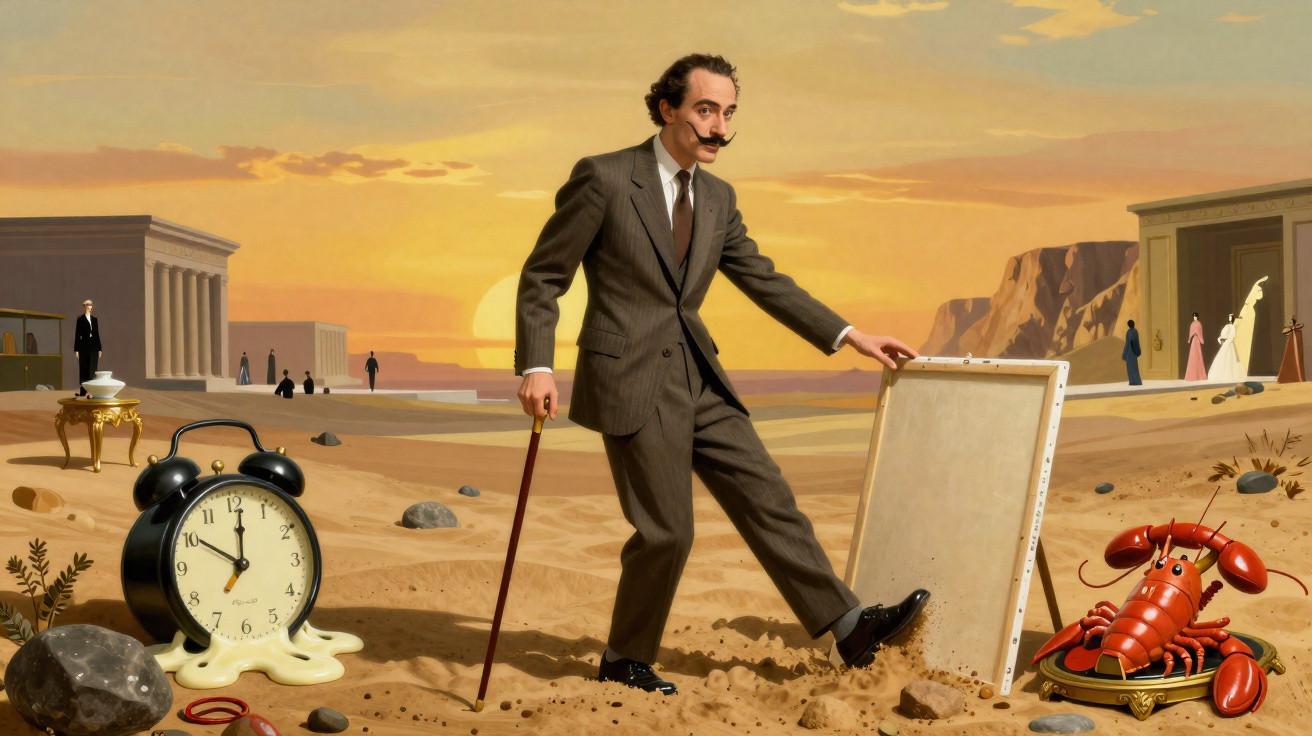
Few admissions reveal as much about someone as Salvador Dalí’s account of his own childhood. At six, he dreamed of becoming a cook; at seven, he wanted to be Napoleon; eventually, he realised that being himself was the only thing that made sense. The statement offers a lesson in identity that has resonated across generations.
The restless childhood that shaped one of surrealism’s greatest names
Born in Figueres, Catalonia, Spain, in 1904, Salvador Dalí showed an extraordinary imagination from an early age. His changing childhood ambitions, from a cook’s apron to a general’s uniform, reveal a boy trying on different identities before discovering his own.
That persistent urge to reinvent himself would later become the artist’s defining trait. In subsequent years, the same restless spirit helped establish the foundations of surrealism, the movement that transformed how art and the unconscious were perceived.
- Creative childhood: at the age of 6, he dreamed of being a cook; at 7, a general.
- Iconic moustache: his flamboyant moustache became one of art’s most recognisable features.
- ⏰ Masterpiece: he painted The Persistence of Memory, featuring the celebrated melting clocks.
- Lifelong partnership: Gala Dalí was his muse and his principal creative support.
- Work in cinema: he collaborated with Luis Buñuel on the surrealist classic An Andalusian Dog.
When art teaches us to accept who we are
Salvador Dalí’s life reflects an experience familiar to many people: the urge to model ourselves on others before finding our own direction. Admiring larger-than-life figures such as Napoleon is part of the process of growing up.
Just as Gala was crucial in helping Dalí maintain his artistic identity, support and self-knowledge can help anyone stop imitating external models and begin appreciating their own essence.
The little-known detail about the master of surrealism
The remark about childhood and identity was not made without reason. It appears in the artist’s autobiography, The Secret Life of Salvador Dalí, published in 1942, a book that exposes a more reflective side behind his extravagant public persona.
Dalí in numbers and curiosities
From canvas to personal myth
Salvador Dalí lived from 1904 to 1989 and became one of the most recognisable faces of modern art worldwide.
Beyond painting, the Catalan artist worked in film, jewellery and even advertising, demonstrating that his creativity had no fixed boundaries.
This blend of humour, irony and depth is one reason why Salvador Dalí’s words remain so relevant, even decades after they were written.
What, then, does Dalí’s eccentricity teach us about courage?
Publicly declaring that he wanted only to be himself demanded courage in an era shaped by rigid conventions. Salvador Dalí turned that conviction into a way of life, making his own image part of his work.
For today’s reader, the message reaches far beyond art. Recognising talents, embracing eccentricities and ceasing to compare ourselves with ready-made models is often the first step towards a more authentic life.
Between museums and catwalks: a legacy that keeps growing
Salvador Dalí’s legacy remains alive at the Dalí Theatre-Museum in Figueres, as well as in contemporary fashion, cinema and advertising, all of which still draw on the surrealist imagery he created.
Decades after his death, Salvador Dalí is remembered not only for his melting clocks or unmistakable moustache, but also for daring to say plainly that an artist’s greatest work may be their own identity.
If this story of authenticity and genius has inspired you, share it with someone who also needs a reminder of the importance of simply being who they are.




Comments
No comments yet. Be the first to comment!
Leave a Comment