
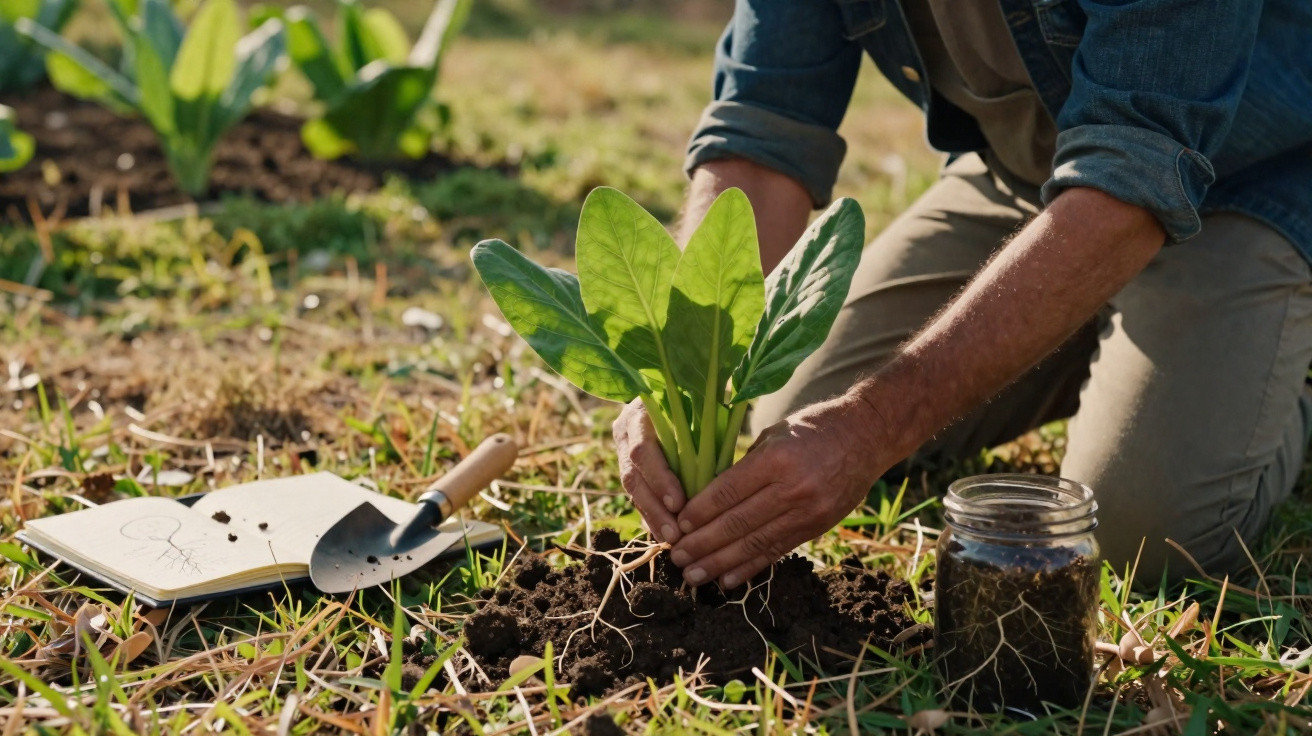
Gardeners, however, are beginning to see it in an entirely new light.
As climate extremes alter the way we garden, a formerly despised “weed” is proving to be an overlooked ally. Rather than being a pointless invader, plantain – the low rosette found on paths and between paving slabs – can play an important part in soil health, water management and low-input gardening.
Meet the unwanted neighbour that never leaves
Gardeners across Europe and North America will know the sight: a persistent cluster of leaves pressed close to the ground, ideally shaped to avoid mower blades and passing boots. It is plantain, usually one of these species:
- broadleaf plantain (Plantago major), which has broad oval leaves
- ribwort plantain (Plantago lanceolata), with long, slim lance-shaped foliage
The two species have one unmistakable trait in common: pronounced parallel veins extending along each leaf. Pull a leaf apart slowly and its tough fibres remain joined like fine threads. This fibrous structure helps explain why plantain withstands trampling when a carefully kept lawn cannot.
Plantain commonly grows in places where other vegetation finds survival difficult: compacted driveways, field gateways, playground margins and parched lawns. Many gardeners take this as evidence that it is “invasive”. Soil scientists interpret it differently, seeing a pioneer species occupying ground that many favoured garden plants cannot tolerate.
Where your lawn dies under heavy foot traffic, plantain steps in as a survivor – and as a diagnostic tool.
The free soil report hiding in your lawn
Within agroecology and permaculture, plantain is regarded as a “bioindicator”. Large areas of it seldom appear without reason; they can point to a particular issue lying just below ground level.
When plantain dominates paths, parking verges or sections of a lawn, it generally indicates compacted soil lacking sufficient air. Repeated footfall, heavy equipment and cultivating clay soil while it is overly wet are frequent causes of this compaction.
Under these conditions, the gaps between soil particles are squeezed shut. Oxygen levels fall, rainwater has difficulty soaking in, and aerobic microbes – those responsible for decomposition and nutrient cycling – begin to decline. Root-supporting fungi and bacteria become less active, while plants with fine, shallow root systems weaken or disappear.
Plantain effectively reads these soil conditions as a headline. Its roots are more robust and persistent than those of grasses, enabling it to endure hardpan that defeats other plants. Its arrival is therefore not so much a sign of a villain as a highly visible warning.
Instead of asking “how do I kill it?”, the more useful question is “why does it thrive here when everything else fails?”
From symptom to strategy
For gardeners seeking living, well-structured soil rather than an immaculate green surface at any price, plantain can serve as a useful adviser. Applying herbicides heavily to “tidy” compacted soil merely removes the messenger. Compaction remains unresolved, and other weeds adapted to stress are likely to arrive later.
Interpreting plantain properly encourages a different set of actions:
- limiting foot traffic over the most affected areas
- aerating by hand with a garden fork or broadfork instead of cultivating
- incorporating organic matter to restore soil structure
- maintaining roots in the soil throughout the year rather than leaving it bare
Viewed this way, plantain is not an adversary but an early-warning system for the state of soil biology.
Plantain: the underground engineer loosening hard soil
Plantain does more than reveal compaction; it can begin to improve it. Botanists occasionally call it a “biological decompactor”, and that description is justified.
Its root system is fibrous, like that of grass, but more substantial and persistent. The roots penetrate dense clay and stony subsoil, creating minute fissures and channels. During each growing season, they gradually extend deeper and farther, separating clumps of soil and relieving compaction.
This gradual, drill-like process produces several benefits:
- air can reach deeper soil layers, supporting aerobic microbes
- water infiltration increases, allowing rainfall to soak in rather than run off
- later roots from crops and wild plants can follow pre-formed channels
Every dead plantain root leaves behind a tiny, organic-lined tunnel, ready for worms, fungi and new roots to move through.
Mechanical cultivation may loosen soil for a short while, yet it can leave a dense layer immediately below the cultivated depth. It may also cut through fungal networks and disturb soil animals. Plantain operates on another timescale: less conspicuously and more slowly, but in keeping with the way soil ecosystems create structure over years rather than weekends.
Living armour against erosion and drought
The low, flat rosette of plantain functions like natural paving. During winter storms, raindrops strike its leaves before reaching exposed soil. This reduces the force that might otherwise break up soil aggregates and form a sealed, crusted layer. Reduced crusting means improved infiltration, less run-off and lower erosion on slopes.
During summer, that same rosette works as living mulch. Its shade lowers the temperature of the soil surface and limits moisture loss. Lift a plantain plant on a July afternoon and the ground beneath will often be cooler and a little damp, even if the nearby lawn appears worn and brittle.
| Soil surface | Winter effect | Summer effect |
|---|---|---|
| Bare soil | Crusting, erosion, nutrient washout | High evaporation, cracking, heat stress |
| Soil under plantain | Gentler rain impact, better infiltration | Cooler, moister, improved soil life |
For gardeners in areas experiencing hotter summers and unpredictable rainfall in both the US and UK, durable groundcovers such as plantain can maintain living roots in awkward places without frequent watering.
A quiet fertiliser factory under your boots
Plantain has a chemical function too. Many soil ecologists place it among the so-called “dynamic accumulators” – plants particularly able to draw up selected minerals and hold them in their soft tissues.
Its deeper roots allow plantain to reach nutrients beyond the range of shallow-rooted lawn grasses and lettuces. Leaf analyses often find significant quantities of calcium, magnesium, sulphur and trace elements. Although the precise mineral mix depends on the soil, the underlying process is consistent: minerals are gathered from depth and retained near the surface.
Left on the soil as mulch or tossed into the compost, plantain leaves act as a free, slow-release mineral supplement.
This is useful for gardeners looking to reduce their reliance on synthetic fertilisers. After weeding, it is common to throw removed plants away. With plantain, the more productive options are to:
- chop up the leaves and use them as mulch around hungry crops, including tomatoes and squashes
- add them in layers to compost heaps to enrich the finished compost
- spread them around tree basins, where their deep-sourced minerals can support perennial roots
This straightforward practice converts an “eyesore” into part of a closed nutrient cycle. The plant that irritated you on the path can quietly contribute to the vegetable bed.
From sworn enemy to managed ally
This does not mean allowing plantain to overwhelm every border. A balanced approach is still necessary, but understanding its function makes complete eradication seem like the wrong objective.
A subtler approach views plantain as a collaborator that may occasionally require clear limits. Many gardeners now retain patches in:
- quieter corners of lawns
- path margins and informal routes
- known compacted sites, where its roots can provide a benefit
In places where it is unwelcome – between low-growing annual flowers or amongst closely spaced vegetables – hand tools are useful. A slim weeding knife or daisy grubber can be pushed beside the root base, allowing most of the plant to be levered out. The removed growth can then become immediate mulch rather than waste.
When it repeatedly returns in the same location, plantain is sending an obvious message: soil conditions still suit it. Instead of battling it without end, some gardeners redesign such areas using stronger groundcovers, stepping stones or deliberate paths that reflect how the space is really used.
The first-aid kit hiding in the grass
In addition to its soil-related qualities, plantain has a long record in folk medicine, from Roman writings to present-day guides for foragers. Broadleaf and ribwort plantain both contain compounds with anti-inflammatory and antihistamine properties.
Walkers and allotment gardeners often use a simple method: after a nettle sting, midge bite or minor graze, crush several clean plantain leaves between your fingers until juice appears, then hold the green pulp against the affected skin. Many users describe unexpectedly rapid relief from itching and slight swelling.
It is not a substitute for appropriate medical treatment after serious reactions, but it can make a disregarded plant from the pavement a useful part of outdoor first aid.
What plantain reveals about future gardens
As water restrictions become stricter and input costs climb, gardens based on delicate, thirsty lawns can seem increasingly out of touch with current conditions. Plants such as plantain point towards more resilient, multi-purpose groundcovers that provide greenery as well as toughness.
Handled with care, plantain can assist gardeners in:
- spotting and improving compacted areas before they deteriorate entirely
- retaining living roots in demanding places where lawn grass fails
- returning deep-sourced minerals to productive growing areas
- shielding soil from erosion during heavier rainfall
For anyone interested in how soil works, plantain offers a practical example. Mark a compacted area today, leave some plants growing, add organic matter and revisit it each season. Gradually, soil structure alters, worm activity rises and other plants start to establish themselves. That modest patch can become a living illustration of ecological repair on a garden scale.
The next time those ribbed leaves make you reach for weedkiller, consider stopping first. With weather patterns shifting and budgets tightening, the modest plant you once resented may be carrying out some of the most important work your soil requires.





Comments
No comments yet. Be the first to comment!
Leave a Comment