
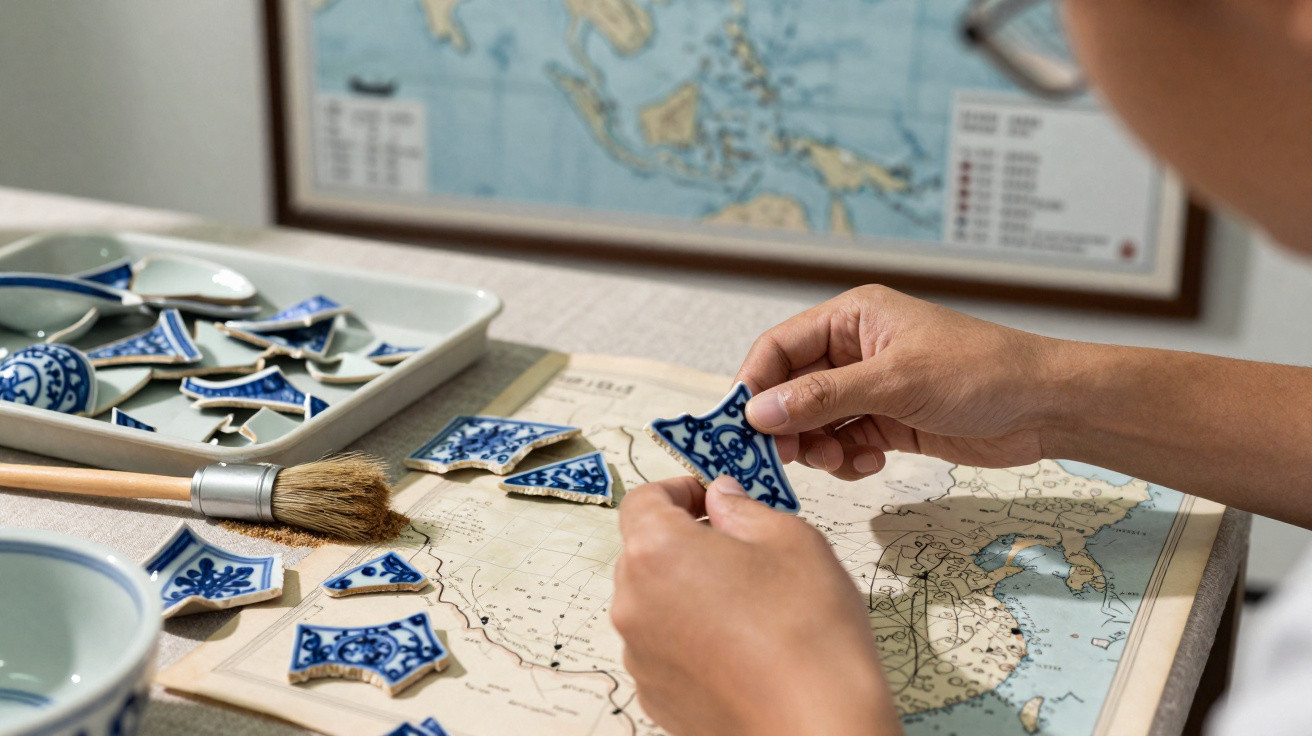
Researchers have established that a shipwreck near Singapore contains a greater quantity of 14th-century Chinese blue-and-white porcelain than any other wreck known to date.
The discovery connects one mid-14th-century voyage directly with early Singapore, providing a clearer chronology for its emergence as an important commercial port.
Preservation of ceramic fragments
A wreck beneath the water at the eastern approach to Singapore Strait safeguarded thousands of ceramic fragments from one lost consignment.
After cataloguing the material, Dr Michael Flecker of HeritageSG recorded over 2,350 blue-and-white sherds, as well as several largely intact vessels that characterise the cargo.
Even though the shipment is only partly preserved, the fragments indicate that it exceeds every previously documented shipwreck collection of this type.
With the vessel itself gone, the cargo provides the only basis for establishing its origins, date and place in regional trading networks.
Motifs that provide historical evidence
Blue-and-white ware represented only about 136 kg, or 3.9 percent, of the cargo, but it offered the most revealing evidence.
Bowls were the principal component of the shipment, while surviving complete bases indicate that at least 300 remained intact until the vessel sank.
Among the ornamented bowls, images of ducks in lotus ponds were approximately three times as common as lotus bouquets.
As decorative motifs shifted with fashions and imperial regulations, these designs serve not just as ornamentation but also as tools for dating the cargo.
Mapping kiln networks across China
Longquan celadon, a green-glazed ceramic produced in southern China and valued for its jade-like surface, accounted for 44.5 percent of the haul, vastly outweighing all more refined wares.
Higher-quality tableware from Jingdezhen travelled alongside whiteware and greenware manufactured in Fujian.
Several of these objects carried the Privy Council mark, associated with a bluish glaze that was significant to blue-and-white production.
“Even with relatively few intact pieces, the overall ceramic quality is often ‘superlative’,” said Flecker.
Pinpointing the date of the voyage
During this era, potters in Jingdezhen, a leading ceramic-production centre in south-eastern China, developed blue-and-white porcelain and exported much of their output.
Flecker maintains that the prevalence of the ducks-in-a-lotus-pond pattern indicates a date after 1340, when imperial limitations probably became less restrictive.
From 1352, civil war disrupted Jingdezhen, and kiln closures may have ended the supply represented by this vessel's cargo.
This pressure creates a narrow dating range of approximately 1340 to 1352, an unusually exact timeframe for such an old cargo.
Temasek as the most likely port
Comparable bowls, glass beads, gold foil and a black bangle recovered on land tie the wreck to nearby excavated sites in Singapore.
These sites form part of a 14th-century trading settlement identified in official Singapore heritage records as Temasek.
Conversely, the large blue-and-white dishes favoured in India and the Middle East are largely missing from the shipment.
This disparity points to Temasek as the most probable purchaser and provides little basis for placing the vessel farther west.
Tracing a vessel without its hull
Virtually none of the ship remains, as waves, currents and marine organisms that consume wood removed its hull over the centuries.
Instead, the surviving evidence of its route lies in the cargo: it was almost wholly Chinese, with very few objects originating elsewhere.
Quanzhou in southern China, now recognised for its Song-Yuan maritime trade system, is a plausible loading port.
A Chinese junk sailing from there towards Temasek is therefore the most straightforward interpretation, although conclusive proof cannot be obtained.
A market served by multiple merchants
A substantial proportion of the shipment consisted not of luxury tableware but of durable jars that likely transported other products.
Storage jars comprised about 38 percent of the haul, whereas narrow-mouthed jars may have contained wine instead of mercury.
In contrast, blue-and-white bowls and smaller vessels appear to have been intended for affluent households and ritual display.
This combination indicates that Temasek accommodated routine trade as well as elite consumption, rather than functioning solely as a stopping point for passing vessels.
A benchmark for archaeology
Because the assemblage derives from a single journey, archaeologists can use it as a fixed date rather than an accumulation built up across centuries.
Researchers frequently compare mixed materials from land sites with inadequately dated wrecks and then find it difficult to date them accurately.
In this case, a closely dated consignment provides a more reliable reference point for blue-and-white, celadon and other ceramics discovered elsewhere.
The wreck is consequently important beyond Singapore, particularly when museums and excavators assess fragments with uncertain origins.
Singapore’s prominent trading status
Dated in context, the wreck belongs to an era when Singapore was already receiving merchants from China, India and maritime Southeast Asia.
Earlier accounts occasionally portrayed precolonial Singapore as an insignificant outpost, yet the cargo suggests it may have been a more active port.
Its quantity and quality demonstrate local demand sufficient to draw fresh ceramics during the peak of Yuan production.
Although this does not resolve every argument about early Singapore, it makes the portrayal of a quiet backwater much more difficult to sustain.
Within this broken cargo, shattered bowls, jars and plates become evidence of trade, taste and chronology.
Additional cleaning, comparative study and excavation may yet clarify the route and consignment, while the material already recovered is reshaping Singapore’s history.






Comments
No comments yet. Be the first to comment!
Leave a Comment