
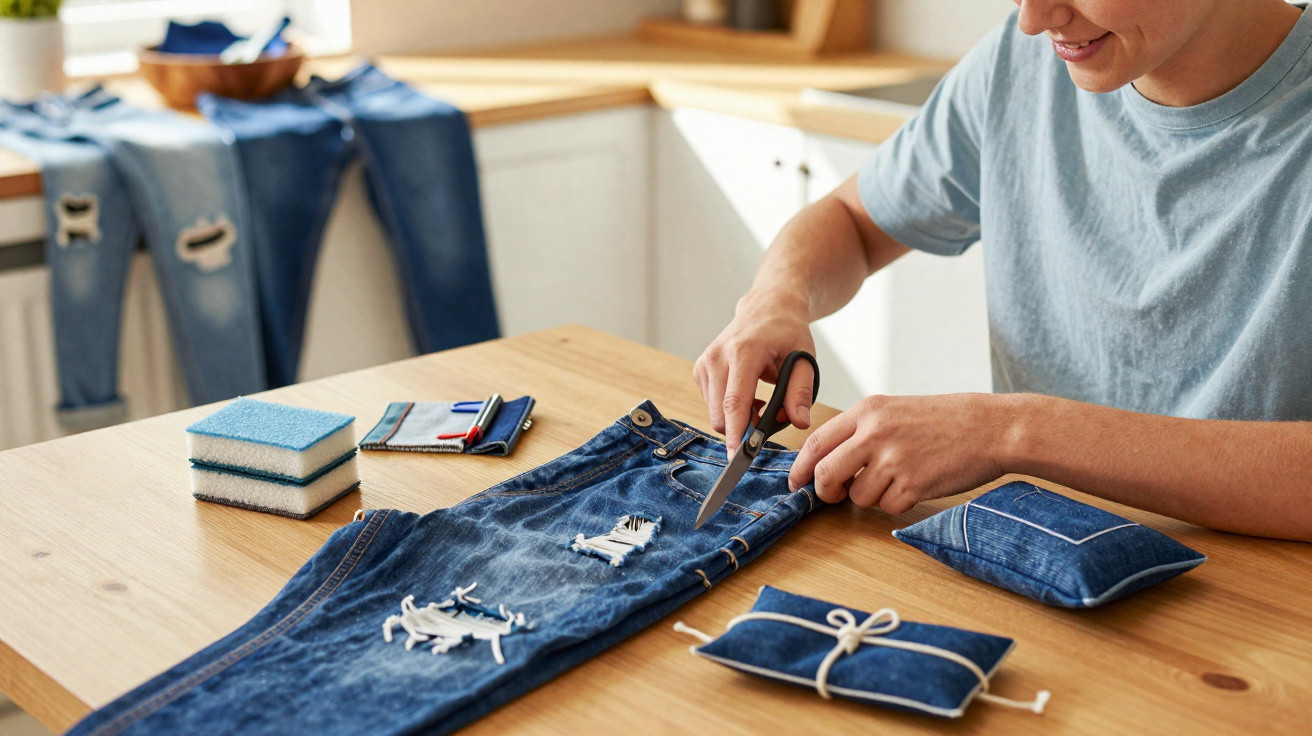
Many people throw away a pair of trousers as soon as the knee wears through or the fabric fades too much. Yet denim is ideal for giving it a second life. This hard-wearing material can become useful items for the kitchen, bathroom, living room and even the garden – often in under 15 minutes and without any specialist equipment.
Why your old jeans are far too good for the bin
Denim is among the most resource-intensive fabrics to produce. Making one pair of trousers can use up to 10,000 litres of water, from growing the cotton through to dyeing it. Throwing the fabric away after a small hole appears in the knee therefore wastes more than a garment: it also wastes a huge amount of resources.
What is more, traditional denim is exceptionally durable. Its particular weave – known to specialists as a “twill weave” – means it does not fray quickly and can be cut neatly. That makes it ideal for quick upcycling projects at home.
Continuing to use damaged jeans saves water, waste and money – while providing practical everyday helpers.
Rather than looking forward in frustration to the next shopping trip, reach for the scissors instead. With a few purposeful cuts, some glue or a needle and thread, an old pair of trousers can be turned into items you will genuinely use every day.
The basics: what makes denim so durable
Classic denim is usually made from cotton woven in a diagonal pattern. Blue threads run in one direction and lighter threads in the other, creating a dense diagonal design. This construction slows down tears, even once a hole has already formed.
This strength means that:
- cut edges do not immediately unravel;
- pockets and seams remain especially sturdy;
- even worn sections still offer enough support.
That makes almost every old pair of jeans useful as a source material: the legs, waistband, back pockets and even the thick side seams. Most of these parts can be reused without much prior experience.
Three quick denim projects in under 15 minutes
1. Washable cleaning pads from denim offcuts
Trouser legs can be quickly transformed into reusable cleaning pads. The method using woven strips is straightforward and also works well as a small project to do with children.
Here is how to make them:
- Cut open a trouser leg lengthways and lay it flat.
- Cut strips roughly 2–3 centimetres wide.
- Make a small grid from a wooden board and a few nails, or use an old cooling rack.
- Weave the strips through it in a criss-cross pattern until you have a dense square.
- Knot the ends or secure them with a few stitches.
The finished denim scrubbing pad can be washed in the washing machine at 60°C and lasts considerably longer than many plastic sponges. Its rough texture is well suited to cleaning pans and the sink, as well as the bathroom.
2. Wall organiser made from back pockets
The back pockets of jeans are naturally designed to take wear and weight. In just a few minutes, they can become a practical organiser for a desk, hallway or child’s bedroom.
Step by step:
- Cut out both back pockets generously, leaving about 1 centimetre of fabric around each one.
- Use a piece of cork board, a wooden board or sturdy cardboard as the backing.
- Glue the pockets on with fabric adhesive or attach them with drawing pins.
- Leave to dry, hang it up, and it is ready to use.
It provides a designated place for pens, letters, scissors, charging cables or sunglasses. If you like, arrange several pockets one below another to create a small organisation area beside the front door.
3. Hot-water-bottle alternative: a dry denim heat pad
For cosy evenings on the sofa or when you have stomach ache, try another quick project: a heat-pad roll made from a trouser leg.
To make it:
- Cut a section around 20 centimetres long from a trouser leg.
- Sew one end shut by hand or with a sewing machine.
- Fill the tube with around 500 grams of rice or cherry stones.
- Close the open end.
- Before use, heat it in the microwave for around two minutes, increasing the time gradually depending on your appliance.
The pad retains heat for a long time, while denim feels pleasant against the skin and protects it from excessive heat. For cold relief instead, place the pad in the freezer for a few hours and use it for sprains or headaches.
Family solution: when children wear through their knees
In many families, everyday life regularly destroys younger children’s trousers, usually at the knees. Rather than being annoyed, there is an easy solution: turn the still-good sections into summer shorts.
Method:
- Have the child try on the trousers and mark the desired length.
- Cut around 1–2 centimetres below the mark.
- Turn the hem inwards and stitch it in place – or deliberately leave it raw for a “worn look”.
The cut-off lower sections can immediately be used to make heat pads as described above. One garment therefore takes on two new roles: shorts and a sofa companion.
Meanwhile, woven cleaning pads can be made from the remaining strips – one worn-out pair of jeans can provide a whole small range of household helpers.
Waste almost nothing: use even the final denim scraps
One frequently overlooked treasure is the trousers’ thick side seams. Made from several layers of firmly stitched fabric, they are perfect for use as ties.
These strips work surprisingly well in the garden:
- Cut close along the seam to create a long, strong strip.
- Use these ties for tomatoes, beans or cucumbers.
- The soft cotton will not cut into plant stems.
Even tiny offcuts do not need to go in the bin. They are useful as stuffing for small sewing projects such as pin cushions, doorstops or soft toys. Anyone who enjoys sewing can save on stuffing fibre while reducing textile waste.
How to decide whether jeans are still wearable
Before you start cutting, take a quick look at their condition:
| Condition of the jeans | Recommended use |
|---|---|
| Only small holes or an open seam | Repair and continue wearing |
| Good fit, light wear | Second-hand sale, clothing swap, donation |
| Heavily faded, several tears | Upcycling: cleaning pads, organiser, heat pad |
| Only small fabric scraps remain | Stuffing material, craft projects |
Making these steps a habit greatly reduces the pile of clothes intended to be “thrown away someday”. What appears to be waste becomes a small stock of useful items.
Practical advice on safety, care and combinations
The heat-pad roll requires a little care in particular. The fabric must not scorch in the microwave, and the filling must not overheat. Always warm it in short intervals and check the temperature in between. Children should only be given the pad after an adult has checked that it is not too hot.
Handmade denim cleaning pads can be washed in the machine without difficulty. Washing them together with towels or bed linen removes bacteria and helps keep the kitchen and bathroom hygienic. If they are very dirty, wash them at 60°C with a little heavy-duty detergent.
It becomes especially interesting when several upcycling ideas are combined: one pair of trousers can produce a wall organiser, two heat pads, several cleaning pads and a few garden ties. Add some buttons or fabric remnants from other garments and you can even create gift ideas – such as a small “relaxation set” with a denim heat pad and sleep mask.
Once you have started, you will soon see old clothing differently. A hole in the knee no longer marks the end, but the beginning of the next small project at the kitchen table – without a sewing studio or specialist tools.


Comments
No comments yet. Be the first to comment!
Leave a Comment