
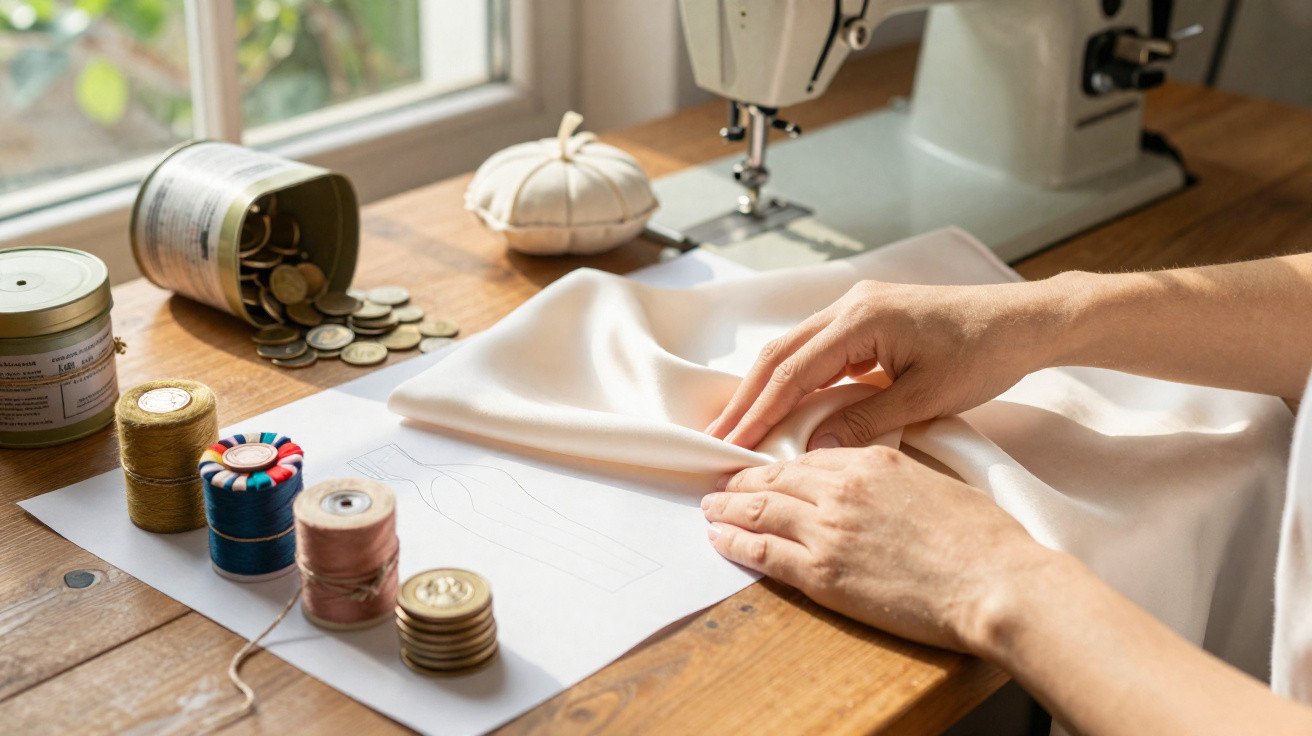
Anyone who enjoys sewing will know the issue: silk, softshell or fine jersey can shift while being pinned, develop holes or lose their water-repellent finish. That is why many professional studios use an aid that does not look especially glamorous at first glance: unwanted coins. Used properly, they can replace pins, protect the fibres and make cutting out far more accurate.
Why sewing weights made from coins are a genuine insider tip
Sewing studios often have jars of loose change that has no everyday use: obsolete currencies, souvenirs and demonetised coins. For many dressmakers, these pieces are not junk but useful equipment. They use them as sewing weights: small, precisely calculated points of weight that secure pattern pieces and fabric solely through their own mass.
“The trick: pattern pieces and fabric stay still without a single puncture – and without any risk to expensive or delicate textiles.”
Textile engineering specialists have advised using pins sparingly on sensitive fabrics for years. Every puncture damages fibres; with coated or waterproof materials, it creates tiny openings that may later allow in water or wind. This matters especially with:
- silk and fine chiffon
- softshell and rain-jacket fabric
- fine jerseys and knitted fabrics
- coated cotton fabrics and faux leather
- real leather
In these materials, the holes may remain permanently visible or impair the fabric’s performance. Sewing weights keep everything in position without piercing it. Gravity takes over the task normally performed by pins.
Check first, then recycle: which coins are suitable
Before an old coin is put to use in the sewing room, it is worth taking a quick look at its collector value. Not every coin belongs in the workshop: some can be unexpectedly valuable, either because of their precious-metal content or their rarity.
Numismatists often refer to a so-called rarity index, which broadly indicates how easy or difficult a coin is to find. Very common examples sit at the lower end of this scale, making them suitable candidates for upcycling in the sewing room. Coins made from pure silver or with a high precious-metal content, on the other hand, may have noticeable everyday value and are better kept in a coin album or taken to a precious-metals dealer.
A practical rule of thumb for the sewing room:
- common modern alloys, usually copper-nickel: ideal as weights
- visibly worn and scratched circulation coins: fine for the workbench
- commemorative and special issues, plus silver or gold coins: check first, then decide
If you are unsure, quickly look up the coin’s year and description on established auction sites or collectors’ portals. The amounts listed there are guide prices rather than guaranteed purchase offers, but they are useful for a rough initial sort.
The ideal weight and how to make your own sewing weights
For coin weights to work properly, a little planning is needed. If they are too light, the fabric will move; if they are too heavy, delicate paper can tear or shift. Many sewists use standard coin weights as a guide for calculating a practical total.
Finding the right weight for each sewing weight
Individual circulation coins often weigh between 5 and 10 grams. Stacking several together produces a range that has proved effective in practice:
| Number of coins | Total weight (approx.) | Suitable use |
|---|---|---|
| 3–4 pieces | 30–40 g | small pattern pieces, thin paper |
| 4–6 pieces | 40–60 g | standard tissue-paper patterns |
| 6–8 pieces | 60–80 g | heavy fabrics, large pattern pieces |
Weight is not the only factor; its distribution matters too. A broad, flat “block” holds more reliably than a narrow tower. The aim is a stable contact surface that neither wobbles nor rolls away.
Step by step: turning coins into professional sewing weights
With a few fabric scraps and only a handful of steps, worthless coins can become durable sewing aids:
- Clean the coins: Wash them in lukewarm water with a little soap, rinse thoroughly and allow them to dry completely. This helps prevent odours and tarnishing.
- Make coin stacks: Place 4 to 6 coins on top of one another, depending on the desired final weight.
- Add anti-slip protection: Wrap the stacks with a narrow strip of felt, interfacing or painter’s tape. This reduces metal noise and prevents abrasion.
- Cut the fabric cover: Cut squares measuring around 10 x 10 centimetres from sturdy cotton or linen.
- Wrap the stacks: Position a stack in the centre, fold in the fabric edges all around it, then shape it into a small cushion or a “Tetra Pak-shaped” pouch.
- Sew it closed: Securely close every open edge, either by machine or by hand. The tighter the seam, the longer-lasting the weight will be.
The result is a set of small, easy-to-handle weights that sit comfortably in the hand, do not scratch the cutting table and can be stacked without difficulty.
Using sewing weights correctly: from softshell to silk
The advantage is particularly clear when cutting softshell. Pins pierce the functional membrane directly, and every puncture is a potential weak spot through which rain may eventually enter. Sewing weights leave the fabric intact.
In practice, place the pattern on the folded softshell fabric and position weights along every edge. Double the number at corners and along long straight sections so that nothing can move. Then trace the lines with tailor’s chalk and cut the fabric, without making a single hole.
Silk is similarly sensitive. It can quickly distort, and even slight tension may create permanent ripples. Sewing weights keep the fabric flat without stretching it. This is a particular benefit for bias-cut pieces or pattern sections with very curved edges.
With leather and coated fabrics, there is also an aesthetic consideration. Every puncture remains visible, even once the needle has been removed. Once pierced, it is always visible. The weight method secures the layers in place, while lines can be transferred using a specialist marking pen or chalk without damaging the material.
Everyday tips for the sewing room
Anyone new to sewing weights usually needs two or three projects before the method becomes routine. A few useful techniques make getting started easier:
- Use several lighter weights rather than one extremely heavy one.
- Along long side seams, place weights at intervals of 15–20 centimetres.
- Position them more closely around curved necklines so the fabric does not “tip away”.
- Treat patterns made from very thin paper with a light spray of starch first; this makes them more stable.
- Store sewing weights in a shallow box so they are easy to reach while working.
Many home sewists report that, after a short time, they almost completely stop using pins or clips when cutting out. The gentle technique is especially beneficial for anyone who regularly works with technical fabrics, lingerie materials or fine blouse fabrics.
Benefits beyond the sewing machine
There is also an interesting sustainability benefit. Old coins often sit unused in drawers for years because they are no longer legal tender and exchanging them is not worthwhile. Using them as sewing weights gives them a new, long-term purpose. At the same time, it reduces the need to buy new metal, glass or ceramic weights.
Sewing weights are not limited to cutting out, either. They can stabilise fabric while fusible interfacing is being pressed on, keep edges still while measurements are taken, or secure fabric layers when marking button bands or facings. Quilters can even use smaller weights to hold rows in place before they go under the machine.
Finally, it is worth considering the potential risks. Working with coins is normally straightforward, but very old or heavily tarnished pieces may leave residue behind. A well-sealed fabric cover prevents direct contact with the fabric and also protects hands from a metallic smell. Anyone with a nickel allergy should ensure the covering is dense and the seams are as fully closed as possible.
Home dressmakers often only realise that such a simple method has long been standard in many professional studios when they attend a course or see behind the scenes. With one afternoon, a few coins from a drawer and some fabric scraps, the idea is easy to put into practice at home – and sensitive fabrics can retain their structure, appearance and function in future.



Comments
No comments yet. Be the first to comment!
Leave a Comment