
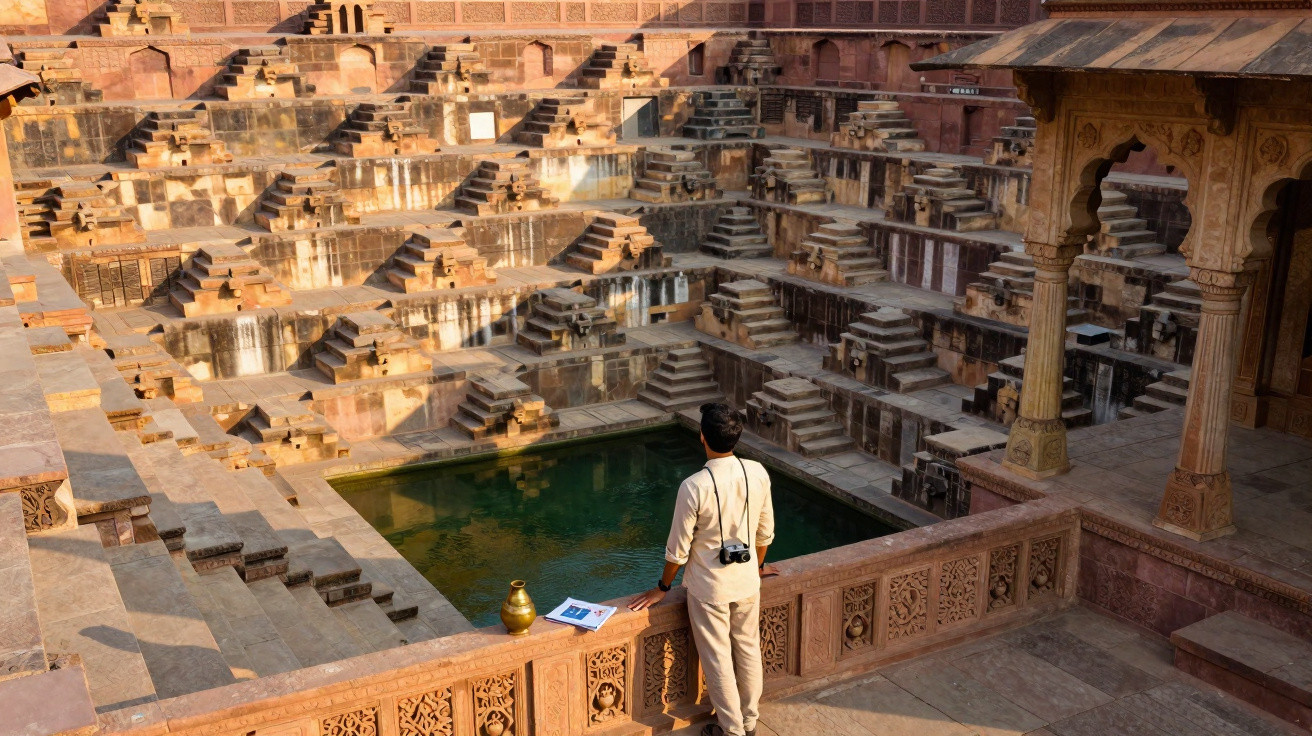
Chand Baori defies imagination through its 3,500 steps, set out with remarkable precision in a captivating geometric design. It demonstrates how ninth-century engineering turned water scarcity into a monumental solution.
What makes Chand Baori one of the world's most impressive wells?
Situated in the village of Abhaneri, Rajasthan, Chand Baori was built around the ninth century and became one of the largest and deepest stepwells ever constructed. Its structure extends roughly 13 storeys below ground level.
Its geometric layout, made up of around 3,500 symmetrical steps, produces a maze-like visual effect. Beyond its architectural appeal, every feature served a practical purpose: storing water in an exceptionally dry region.
How could this enormous well store water in the desert?
For centuries, limited rainfall led communities to devise ingenious ways of securing their water supply. Chand Baori was designed to collect and retain monsoon water while limiting losses through evaporation.
Even during the hottest periods, the lower levels remained noticeably cooler than the surface. Residents could therefore draw water there while also benefiting from a more temperate environment.
Why does the Chand Baori design resemble a labyrinth?
The well's walls are covered with rows of stairways that visually intersect, creating geometric patterns and illusions of perspective. As a result, the structure can look different when viewed from different angles.
Although it appears intricate, the design was governed by practical logic. Its many access routes made it possible to reach the water at varying depths, regardless of how the reservoir level changed throughout the year.
What engineering lies behind Chand Baori?
The scale of the construction remains striking for the accuracy of its calculations and the orderly arrangement of its steps. Each level made water easier to reach as the stored volume fell over the dry seasons.
Among the most notable features of this ancient structure are:
- Around 3,500 steps arranged with exceptional symmetry.
- A depth of approximately 20 metres.
- 13 levels built beneath the surface.
- A structure designed to withstand Rajasthan's arid climate.
- A connection to an ancient temple dedicated to the goddess Harshat Mata.
Chand Baori continues to draw visitors from around the world
As well as being an important part of India's historical heritage, the monument attracts tourists, photographers and architecture scholars. Its preservation offers an insight into how ancient civilisations addressed environmental challenges creatively.
The setting also gained international recognition after appearing in film productions and documentaries. Centuries after it was built, Chand Baori remains one of the most remarkable examples of hydraulic engineering ever created.






Comments
No comments yet. Be the first to comment!
Leave a Comment