
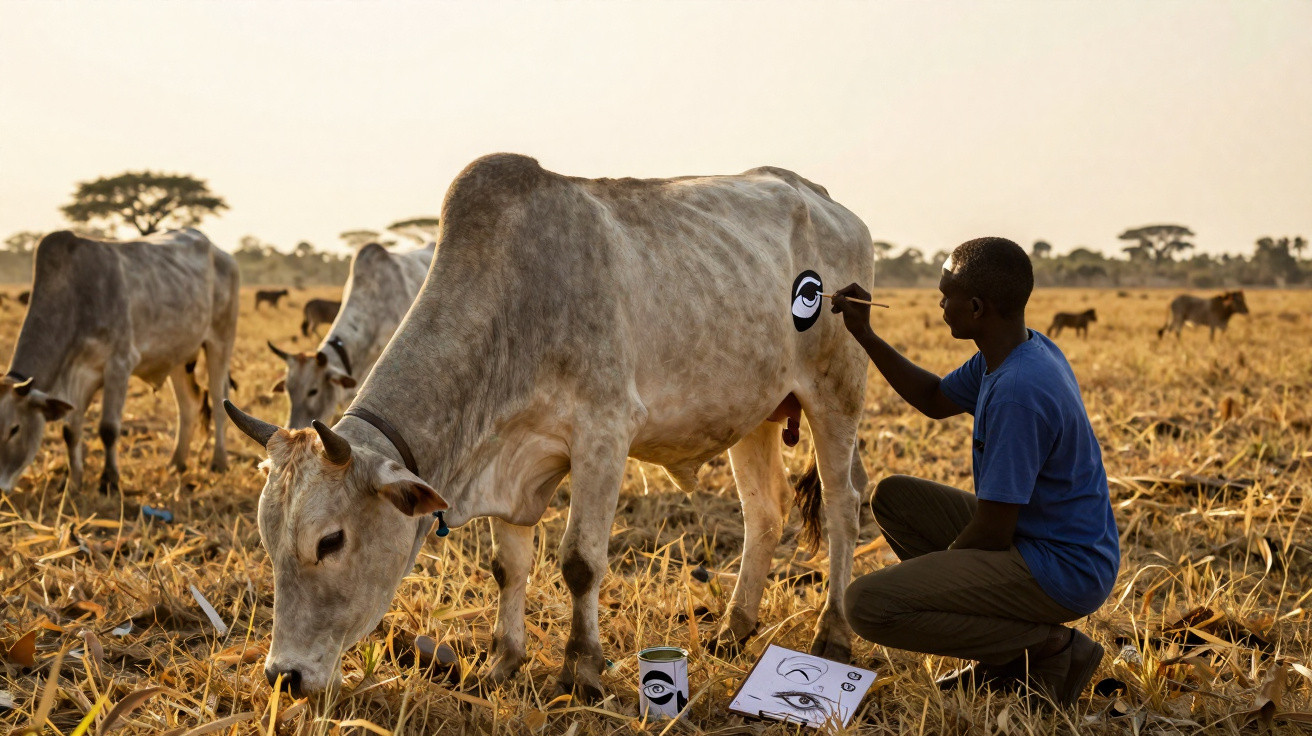
Researchers painted fake eyes on the rumps of cows reared in Botswana’s Okavango Delta to test a straightforward way of reducing attacks by lions and leopards. The method draws on the behaviour of ambush predators, which rely on approaching quietly and may abandon an attack if they think their prey has spotted them.
Why were eyes painted on the cows’ rear ends?
Lions commonly watch, stalk and move in unnoticed before launching an attack. If the prey looks directly at a predator, the element of surprise is lost, making the hunt more difficult and potentially riskier.
The idea was to make it appear that a cow was alert even while facing away. Large, high-contrast designs could act as a visual signal that the predator had been detected, prompting the big cat to reconsider its approach. Developed in partnership with Botswana livestock farmers, the research describes the approach as an attempt to disrupt natural hunting behaviour without harming the predator.
- The designs were painted on both sides of the rump;
- Colours were selected to stand out against the animals’ coats;
- Some cows were given complete eye designs;
- A separate group received only cross-shaped marks;
- Other animals were left unpainted for comparison.
How was the Okavango Delta study carried out?
The trial involved 14 herds that had previously experienced lion attacks. Over four years, researchers conducted 49 painting sessions and monitored 2,061 cattle grazing by day in areas close to the habitats of large carnivores.
In total, 683 cows were painted with artificial eyes, 543 were marked with crosses, and 835 were left without designs. All three groups grazed together, allowing the researchers to compare animals facing similar grazing conditions and attack risks.
What were the results for painted and unpainted cows?
None of the 683 cattle with painted eyes was killed by ambush predators during the study period. Four animals bearing only crosses died, compared with 15 losses in the unpainted group. Of the 19 fatal attacks included in this comparison, 18 were attributed to lions and one to a leopard.
The findings suggest that artificial eyes provided the strongest protection, although crosses were also linked to better survival than no markings at all. This indicates that the effect may stem both from the appearance of being watched and from the unfamiliarity created by a highly visible new mark.
- 683 cows with painted eyes, with no recorded deaths;
- 543 cows marked with crosses, with four deaths;
- 835 unpainted cows, with 15 deaths;
- The artificial-eye group had the highest survival rate;
- The contrast of the markings may have produced an additional effect.
How can fake eyes painted on cows protect lions too?
Losing a cow can be a significant financial blow for families reliant on livestock farming. When attacks happen repeatedly, lions and other large carnivores may be hunted and killed in retaliation, worsening conflict between rural communities and wildlife conservation.
Painting the animals offers an inexpensive, non-lethal option that can be used alongside overnight enclosures, herd monitoring and other preventative measures. The principle resembles another visual experiment in which cows were painted with zebra-like stripes to assess changes in how flies approached them, illustrating how coat patterns can influence the behaviour of other animals.
Do painted eyes guarantee that cows will not be attacked?
The technique produced promising results, but it is not a guaranteed form of protection. Throughout the study, herds always contained both painted and unpainted animals, so it remains unclear whether the effect would be the same if every cow had eyes painted on it. Predators may also become accustomed to the markings after repeated exposure.
Painted eyes on cows should be regarded as a complementary tool for reducing conflict, rather than a replacement for proper supervision and livestock management. Even with these limitations, the experiment shows that understanding how a predator observes and decides to attack can inspire simple measures to protect herds, support rural families and reduce the persecution of lions.






Comments
No comments yet. Be the first to comment!
Leave a Comment