
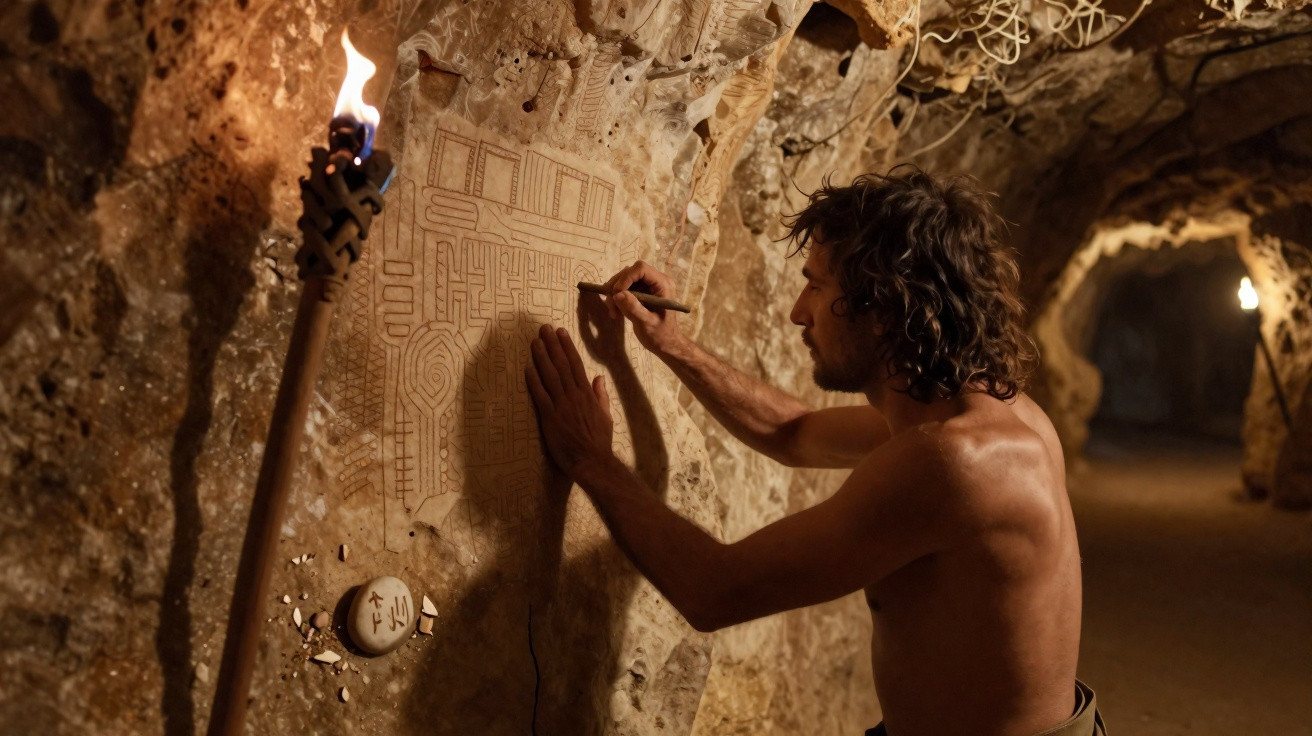
A collection of ancient cave markings, thought to date back as far as 75,000 years, was probably made by Neanderthals.
Researchers who examined the artwork in La Roche-Cotard cave in France say it is the earliest unequivocal example of Neanderthal cave engravings yet identified. The discovery indicates that our closest evolutionary relatives shared our capacity for creativity and self-expression.
Dating the La Roche-Cotard cave engravings
Archaeologist Jean-Claude Marquet of the University of Tours in France and his colleagues dated sediment that had formerly blocked the cave entrance. Their results showed that the artwork was cut off from the outside world between 51,000 and 57,000 years ago.
The chambers remained sealed, and their secrets hidden, until the entrance was rediscovered in the early 20th century.
These findings mean that Homo sapiens could not have entered the cave and produced the engravings after our ancestors reached western Europe, about 45,000 years ago.
"Fifteen years after the resumption of excavations at the La Roche-Cotard site, the engravings have been dated to over 57,000 years ago and, thanks to stratigraphy, probably to around 75,000 years ago, making this the oldest decorated cave in France, if not Europe!" Marquet and his colleagues argue.
Recent evidence from Lebanon suggests that Homo sapiens left Africa and travelled to western Europe sooner than specialists had previously believed. While these early movements may have brought them close to the cave, they appear largely to have bypassed present-day France, perhaps because Neanderthals already living there resisted them.
Objects recovered in and near La Roche-Cotard cave indicate that Neanderthals occupied the banks of the River Loire from just under 100,000 years ago until 65,000 years ago.
Marks made by fingers, not animal claws
During that 35,000-year period, Neanderthals created finger drawings on certain cave walls. These do not show recognisable subjects such as animals or plants. However, no known hominin - including our own species - was producing figurative art at that point.
The earliest known painted figures by Homo sapiens, or indeed by any species, come from an Indonesian island and are approximately 45,000 years old.
Determining when abstract, expressionist art began - including parallel lines and circles - is more difficult. It depends on how experts define 'art'.
Alongside apparently random scratches that seem to have been left by animals, the La Roche-Cotard researchers recorded dozens of "elongated or dotted, spatially organized marks" that appear to have been made by hominins.
Wall marks linked to animal claws are narrower, deeper and V-shaped. In contrast, the shallower U-shaped marks are "consistent with the morphology of a fingertip or similarly shaped tool."
Marquet and his team explain that, by rubbing the cave's pale, porous rock, the people using it millennia ago probably shaped its softer outer layer and formed a "smooth and regular groove".
Subsequent weathering has removed many crisp edges from the cave walls, although the markings were likely once plainly visible.
One area of the cave art is arranged around a buried bivalve shell. The finger engravings there seem almost to "underline its presence", the researchers write.
The circular design beneath it was created with notably deep, seemingly forceful finger marks, whose edges appear to have worn away with time.
By contrast, a triangular group of marks has a sudden, intentional boundary marking where the parallel finger traces begin and finish.
Another especially notable 'panel' consists of a scattered pattern of fingertip dots.
Having assessed the characteristics of the complete collection, Marquet and colleagues suggest that the designs are "more graphic than functional", forming an "organized, deliberate composition" shaped by "conscious design and intent".
Evidence for Neanderthal artistic expression
It is not possible to determine whether the engravings held a wider symbolic meaning. Yet an increasing body of evidence indicates that Neanderthals may have been much more artistic than they were once credited with being.
For example, the highly disputed Mask of la Roche-Cotard, found outside the cave and dated to roughly 75,000 years ago, looks remarkably like a face. Eyes seem to have been deliberately carved into a flat flint slab. Equally, because humans are inclined to identify faces in patterns where none exist, it may be a misreading.
In 2021, a bone carving discovered in Germany, probably made by Neanderthals, was dated to around 51,000 years ago. It may even have been boiled to soften it for carving.
Elsewhere, in Spain, cave walls painted red and hand stencils date to more than 60,000 years ago. Some scientists have cited that chronology in arguing that Neanderthals produced them.
Naturally, Homo sapiens may have arrived in western Europe earlier than the archaeological record currently indicates. Still, based on the evidence available, it is becoming increasingly difficult to maintain that Neanderthals were not artists of some ability.
There is even evidence that they mixed red ochre paint as long as 250,000 years ago.
Archaeologist Dirk Leder, who helped to uncover the German bone carving, has put forward an even more controversial idea. In 2021, he told Amy McDermott at PNAS that Neanderthals may not have been the first hominins able to express themselves through abstract art.
Some evidence suggests that Homo erectus engraved shells with abstract designs in Java, Indonesia, as far back as 500,000 years ago.
Whether this should be regarded as genuine artwork remains fiercely disputed, but archaeology, like art, benefits from an open mind.
The study was published in PLOS ONE.






Comments
No comments yet. Be the first to comment!
Leave a Comment