
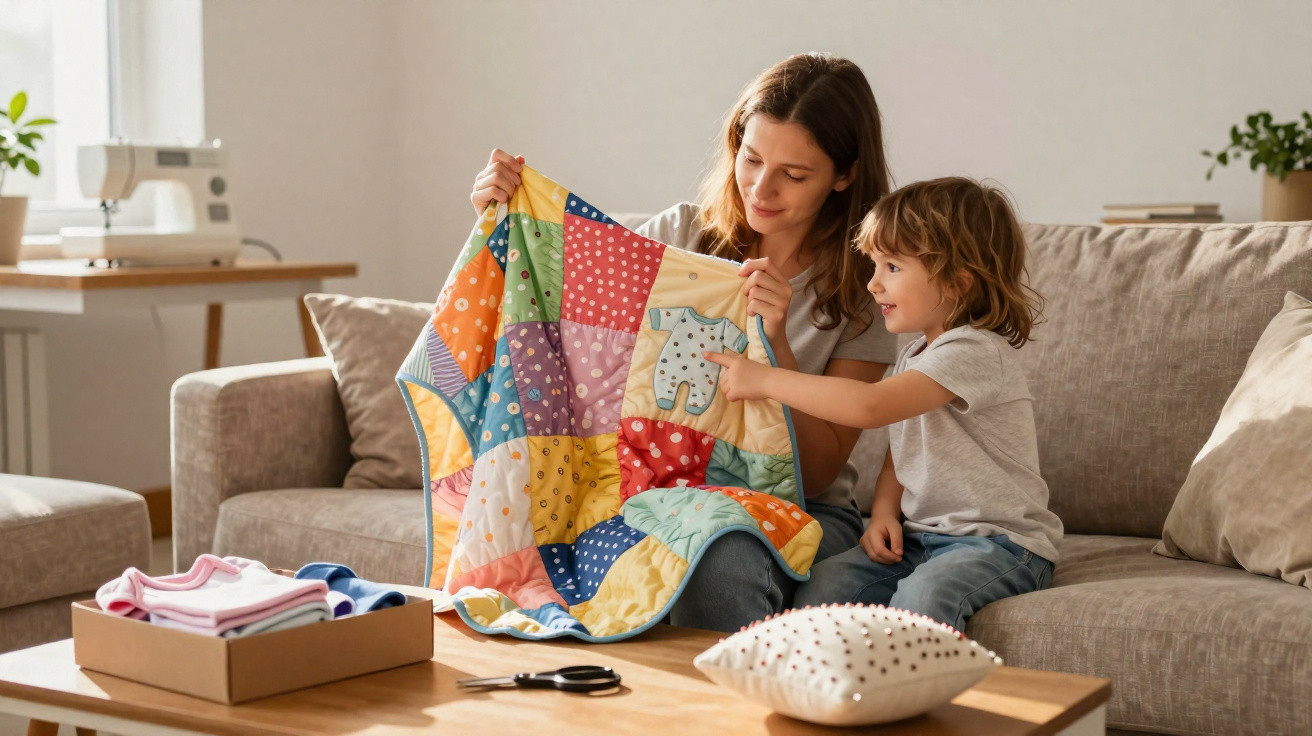
Almost every family knows them: boxes filled with tiny bodysuits, babygros and miniature pyjamas that have sat untouched in a corner for years. Nobody can bear to part with them, yet nobody uses them any longer. A creative sewing project can turn these items into a new favourite piece for the sofa, nursery or family bed.
From a dusty box to the sofa
The earliest months with a baby fill not only the heart but also the wardrobe. During the first few months, a child can easily need five to seven bodysuits a day – accidents happen, as do growth spurts. That is why many parents keep nearly everything: the outfit worn home from hospital, the bodysuit from the first Christmas, or the top given by a godmother.
From a financial perspective, storing them rarely pays off. Pre-loved baby clothes usually fetch very little when resold. Emotionally, however, their value is immense. Every item recalls a particular stage, a scent or a touch. Giving them away feels difficult, so favourite pieces end up in a box – out of sight, but never forgotten.
This is exactly where the idea of a memory blanket comes in: rather than going to a car boot sale, the tiny clothes return to the centre of family life as a large, soft and practical focal point.
“Many small moments come together in one tangible keepsake that is used every day.”
What a bodysuit memory blanket is all about
The principle is straightforward: selected bodysuits, pyjamas and special outfits are made into a patchwork cuddle blanket, known as a memory throw. Each square represents a chapter of babyhood, much like a page in a photo album – except it is made from fabric.
Typical items to include in the blanket might be:
- the first outfit worn after birth
- the bodysuit for a christening or naming ceremony
- the set from the first holiday
- the pyjamas worn through those very short nights
- gifts from grandparents, friends or colleagues
Spread across the sofa or placed at the foot of a child’s bed, the blanket becomes a kind of “fabric diary”. Parents and children can look through it square by square, recall moments and tell stories. The baby clothes are therefore not merely preserved; they take on an active role in everyday family life.
Where sentiment meets organisation
As well as holding memories, the idea has a highly practical benefit: boxes become emptier and storage space increases. Instead of several containers holding dozens of separate garments, there is one useful item that can be used regularly. For many parents, this feels like a balance between letting go and holding on.
Jersey fabric is tricky: what really matters when sewing
Anyone who sews will quickly notice that baby clothes are generally made from jersey, a knitted rather than woven fabric. It stretches in every direction. Under a sewing machine, it can distort, ripple or go out of line. Without preparation, producing a straight blanket from it is almost impossible.
“The most important trick for a neat memory blanket is stabilising the stretchy fabrics.”
To ensure that the squares fit together precisely later on, an iron-on interfacing is needed on the reverse of the bodysuits before any cutting begins. This interfacing removes the fabric’s stretch and prevents it from becoming misshapen. Only then can edges and corners be aligned neatly.
A step-by-step guide to a baby bodysuit throw
Anyone wishing to make one themselves can broadly follow these instructions:
- Choose the garments: Around 25 to 30 items are enough for a standard-sized blanket. Set aside a few extra so that you have more options when combining them later.
- Cut roughly: Remove seams, poppers and bulky hems, leaving only the smooth sections of fabric.
- Iron on the interfacing: Attach it to the wrong side of the fabric to stabilise the jersey.
- Use a template: A square measuring around 15 x 15 centimetres, cut from card or cardboard, works as a guide. It also helps position motifs effectively.
- Cut the squares: Use the template to cut each piece accurately.
- Sew the rows: Place squares right sides together, sew them using a seam allowance of around 1 centimetre, and create strips.
- Join the strips: Stitch the rows into one large blanket panel and carefully press the seams flat.
- Add the backing: Place a layer of fleece, plush or Minky fabric behind it and sew all the way around. This conceals the seams and makes the blanket cosy.
There is another useful touch: the popper fastenings from many bodysuits can be reused too. They can act as practical attachments for securing the blanket to a car seat, pram or cot, preventing it from slipping out of place.
Make it yourself or use a professional studio – which is the better fit?
The main question is whether to sit down at the sewing machine or put your trust in a studio. Both options have their own appeal.
The benefits of sewing it yourself
Making the blanket yourself lets you revisit the whole journey. Every garment passes through your hands and is sorted and reconsidered anew. Many parents say the process feels almost therapeutic: the intense baby stage takes on a physical form, allowing them to let go without losing it.
You will need a domestic sewing machine, iron-on interfacing, some sewing experience and, above all, uninterrupted time. It does not have to be perfect – slight unevenness almost becomes part of the blanket’s story.
When a studio makes sense
Those without a sewing machine, with limited time, or who are not confident handling jersey fabric can also place their keepsakes in professional hands. Specialist studios offer a range of sizes, including:
| Format (approx.) | Use | Items required |
|---|---|---|
| 75 x 75 cm | Cuddle blanket for a cot | around 20–30 garments |
| 90 x 120 cm | Sofa or play blanket | around 40–60 items |
| 135 x 180 cm | Large family blanket | up to 100–120 items |
Studios generally use a Minky fabric or fleece backing, sometimes with light wadding as well. Depending on the season and size, turnaround times are often anywhere from several weeks to three months. All garments need to arrive washed and, ideally, free from stains.
Why children love their baby blanket
Children’s own reactions are particularly interesting. Many only truly discover the blanket for themselves once they reach nursery age. The bodysuit with little cars, once stored away in an album, now appears again as a square on the blanket. This can become part of an evening ritual: choose a square, briefly tell the story attached to it, then turn out the light.
As they get older, siblings can share the blanket, or it can later move with them into their first home. Few teenagers want boxes of baby clothes sitting in their bedroom, but many are happy to keep a subtle, stylish blanket.
Sustainability without the lecturing
The memory blanket trend suits a time when more and more families are questioning their consumption habits. Baby clothes are often worn for only a few weeks. Transforming them into a long-lasting favourite reduces waste and the need for new purchases – without any feeling of sacrifice.
Its emotional value also grows the longer the blanket remains in use. While second-hand clothing often disappears again after a few years, a throw like this can last for decades. Some families already intend to pass it on to the next generation one day – as an inheritance more tangible than a USB stick full of photographs.
Tips for choosing items, caring for the blanket and exploring alternatives
Not every garment has to go into the blanket. A small initial selection based on three simple criteria can help:
- Feeling: Which pieces immediately bring back memories?
- Condition: Which items are still sturdy enough and not overly stretched or heavily soiled?
- Design: Which prints, patterns or colours work harmoniously together?
The finished blanket can be cared for like any other textile: use a gentle wash cycle, a low temperature and avoid an aggressive tumble dryer. If it includes lots of appliqués or printed designs, put it in a large laundry bag to reduce friction.
Anyone wanting to make even more from old baby clothes can use suitable offcuts for other projects: small cushions, soft toys, PE bags for nursery or a wall banner for the child’s room. This can create an entire “memory corner” without adding more boxes to the loft or cellar.
In the end, the realisation is surprisingly simple: babyhood cannot be preserved, but it can be given a new form. A blanket made from old bodysuits does not take up space in your mind; it creates space instead – on the sofa, in the nursery and within your own emotional life.



Comments
No comments yet. Be the first to comment!
Leave a Comment