
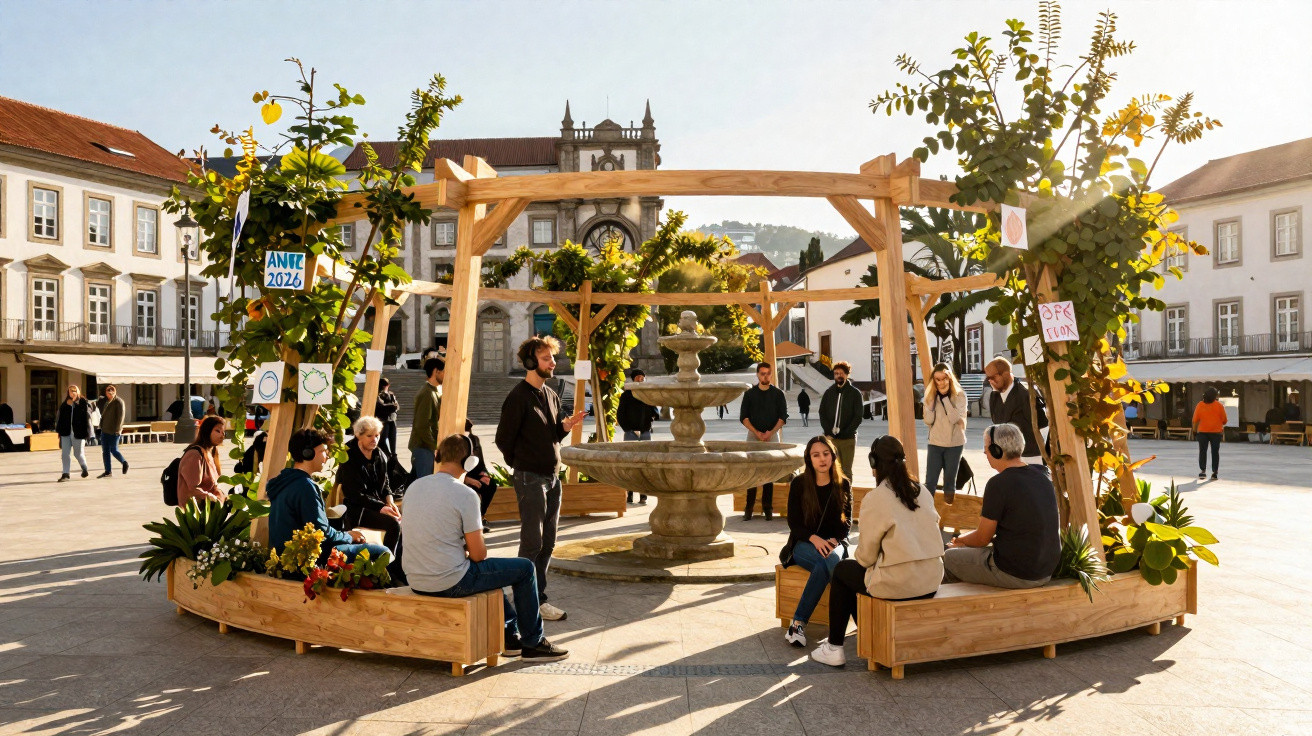
In the demanding task of devising a contemporary exhibition programme, etymology has proved a valuable ally. It is easy to see why. Like etymology, curating seeks out the origins of concepts and images, brings together their many meanings, and fosters or reveals unlikely associations. At the root of the curatorial programme for Coimbra’s Anozero biennial, which marks its tenth anniversary in this edition, lies a distant Indo-European word: ghabh. Through different routes, it gave rise to the words ‘hold’, ‘give’ and ‘receive’, which converge in this edition’s curators’ intentions like the ingredients of a politics of the common good.
Hans Ibelings and John Zeppetelli set out to assemble a multifaceted exhibition that, in some way, conveys what it means to inhabit the bewildering world of 2026. As usual, it is installed in the Monastery of Santa Clara-a-Nova and across seven further sites in the city, using architecture as a touchstone for a wider understanding of dwelling. Underpinning it is the belief that art can still convey a desire for cohabitation and the renewal of communities, their ethical foundations and shared practices, the material conditions that sustain them, and a response to the global complexity of a world that has only deteriorated over the past ten years.
As with every regenerative programme, its starting point can only be empathy. This is what we feel as we pass through the monastery’s long corridor, following in the half-light the chorus of mourning voices from 15 different cultures installed there by the American artist Taryn Simon. Their sombre force defines one of the biennial’s most powerful presences and, under its effect, we recognise the urgency of feeling again and… listening. Sound is, unsurprisingly, a fundamental material in several other works. It deepens the dark atmosphere surrounding the giant wings in Rui Chafes’s sculpture, accompanied by music from the black metal band Candura; addresses visitors in the intimacy of a bathroom in Luísa Cunha’s installation; recalls poets who were persecuted or murdered in Shilpa Gupta’s enumeration; animates Vasco Araújo’s sculptures, weaving together existential questions; and stitches testimonies and narratives into the dense, archaeologically layered installation Maria Trabulo developed from the Syrian context at the Convent of São Francisco.
Architecture and dwelling at Anozero Coimbra
Although they had already exerted an understated presence in earlier editions, space and architecture are perhaps the firmest foundations of the 2026 biennial. This is understandable: architecture, its codes and typologies, the social traces and aspirations inscribed within it, portray and capture the movement of societies as few other factors can. In Coimbra, several works invite viewers to consider how architects engage with pre-existing places, sometimes laden with history and identity, and how architectural protocols intersect with those of sculpture.
This attention may turn towards the memory of spaces, as in Arturo Franco Díaz’s work, or the re-signification of objects, as with Kosmos. It can encourage new encounters and social ties, as Inside Outside does; revisit the social responses of a particular period, as Carlos Ferrand Zavala does; or recover historical ideological references in Anarchism and Planning. It may become a laboratory for thinking about the other, as in the Xenia project of projects; seek universal archetypes without erasing difference, as in Pezo von Ellrichshausen’s houses and shelters; or establish existential meditations that produce an “amplified” nature, as in the work of the Centrala collective.
There are also more idiosyncratic moments, often among the most significant precisely because they are among the hardest to frame thematically. In “Marrow”, Christian Andersson presents a plaster human figure lifting a hypercube, while light emerging from its skull illuminates the geometric form in a materialised philosophical reflection shaped by conditions of light. Light likewise forms the entire mise-en-scène of Julian Charrière’s film “Controlled Burn”, a dazzling, apocalyptic winding trail of inverted fireworks above industrial complexes.
Underlying this edition of the biennial is the idea that art can still be a vehicle for a desire for cohabitation and the regeneration of communities.
Speaking of apocalypse, Charles Stankievech’s installation “The Desert Turned to Glass” places a life-size meteorite hovering a hand’s breadth above a sand-covered floor, moments before its impact forces that sand to transform into glass. While Stankievech’s image has every potential to become a political metaphor, Jonathas de Andrade’s “O Peixe” articulates another relationship with the world. In a film with an epidermal aesthetic, Andrade shows a ritual from a village in north-eastern Brazil, in which fishermen embrace and comfort fish before returning them to the river. This holistic ritual condenses an often ambiguous bond between inhabitant and habitat, between human beings and their surroundings, which urgently needs to be remade. Andrade proposes this more poetically than rhetorically.
Ecology, nature and the human figure
Outside the monastery, the exhibition in the CAPC headquarters building brings together the group most attuned to ecology and communion with nature. In the 1970s, the Catalan artist Fina Miralles and Alberto Carneiro were two pioneers of environmental art. Miralles is represented by photographs in which she explores a state of emotional and physical fusion with trees and other natural elements. Alberto Carneiro’s delicate wooden sculptures extend this programme into the 21st century, while Pedro Vaz’s video-an almost Impressionistic immersion in a forest-attests to the strengthening of this sensibility in contemporary art.
In the Chiado building, there is a group of artists working across different media but united by their exploration of gesture and the human figure. Among other contributions, the exhibition includes Adriana Molder’s spectral drawings and a painting of Expressionist sensibility by the Transavanguardia artist Sandro Chia. The highlight, however, is the drawings by Ivorian artist Frédéric Bruly Bouabré, which place figures within a linguistic logic of remarkable narrative energy.
Gaza, genocide and political dispossession
CAPC Sereia hosts the group with the most immediately political focus, dedicated to the idea of genocide and repeatedly referring to the situation in Gaza. Across the three proposals are accounts of murderous policies, territory and flight, dispossession and persecution. In the striking series “Just in Case”, Taysir Batniji photographed house keys and gathered testimonies from Palestinians who left their homes behind while fleeing Gaza. Thomas Demand presents three photographs of paradoxical situations that illuminate the absurdity of aggression, while Adam Broomberg and Rafael Gonzalez show photographs of olive trees that delineate the symbolic territory of Palestinian identity. The films by the Forensic Architecture collective document leaflets carrying bombing ultimatums falling on the Palestinian population and the routes of a desperate exodus.
The city gallery presents “The Stendhal Syndrome” by Nan Goldin, one of America’s most celebrated photographers. Set to music, this almost half-hour 2024 slide show combines images from art history with intimate photographs of her friends. Faces and bodies from past and present are illuminated and merged, creating a link between beauty and affection that embodies the biennial’s spirit in an essential and redemptive manner.
As in “Heal and Repair” (2017) or “Suffer No More” (2023), the 2026 edition confirms that Anozero’s titles and themes are, above all, watchwords. While a contemporary art biennial does not offer palliative care, in 2026 an event of this kind cannot avoid looking at the world, at the world’s lament and its chaotic landscape, and glimpsing within it the possibility of beginning again.
At the same time, Anozero places the home at its vital centre at a crucial strategic moment, when the city must decide whether the Monastery of Santa Clara-a-Nova will continue to house an international art biennial with an established identity, rather than becoming solely a luxury hotel. In that sense, this year’s programme also speaks of its own dispossession, making it an eloquent manifesto.




Comments
No comments yet. Be the first to comment!
Leave a Comment