
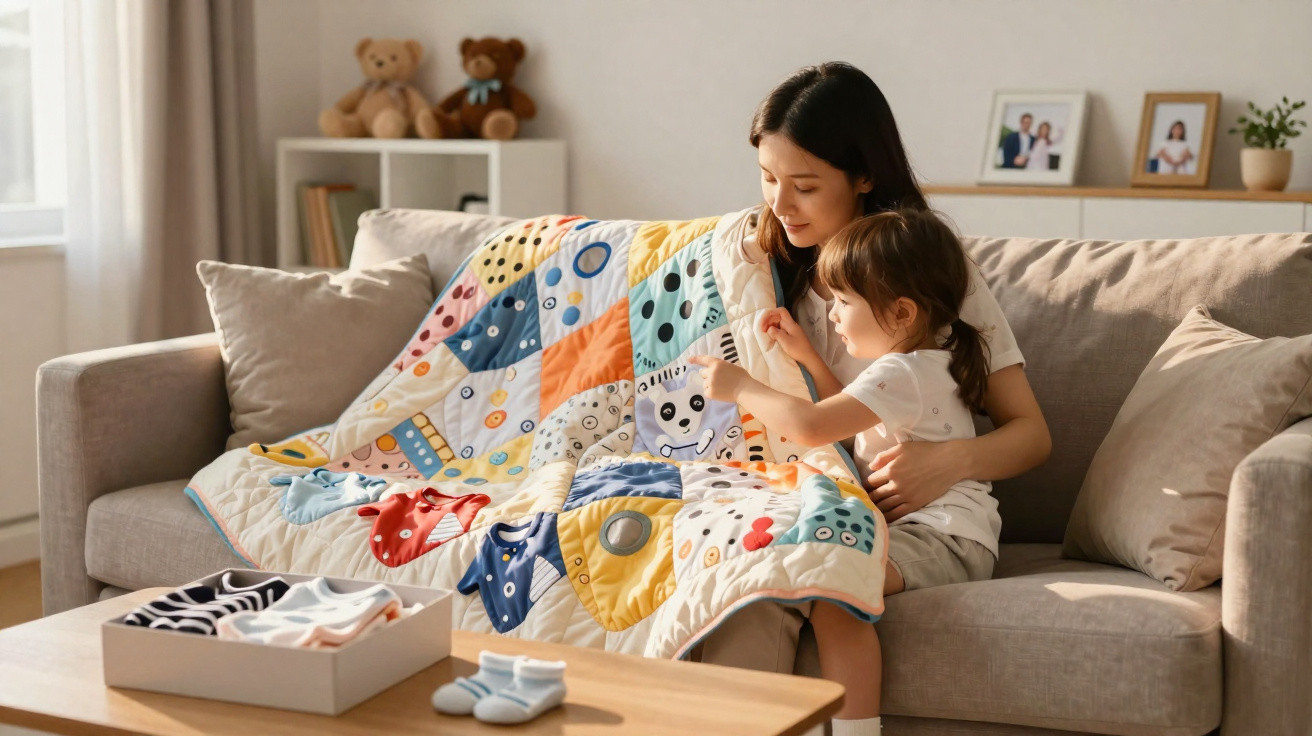
Almost every family has these boxes: tiny bodysuits, first babygrows, the miniature T-shirt from that first Christmas. They are kept with love, yet rarely looked at again. Instead, the boxes sit somewhere in a storage room, quietly ageing. But these textile memories can be turned into something that has a place in everyday life: a personal memory blanket.
From a dusty box to a favourite blanket on the sofa
A child’s earliest years create mountains of clothing. In the first few months, many babies get through five to seven bodysuits a day. Stains, spit-up incidents and changes in the weather mean the washing machine is constantly running. In the end, several boxes are often filled with tiny garments that nobody will wear again, but which are far too precious to part with.
This is exactly where an idea that is becoming a family insider tip comes in: rather than giving the clothes away or storing them forever, they can be made into a plaid – a large, cosy blanket formed from fabric squares cut from the most meaningful pieces. Every square recalls a moment: the first visit to the grandparents, New Year’s Eve with a baby in your arms, or those favourite dungarees that were really always too small but somehow worn all the time.
“The baby years do not disappear into a box; they become visible and tangible on the sofa.”
The blanket becomes an everyday item with its own family history. It can sit in the living room, travel with you, provide warmth during nights of fever, and eventually become a permanent part of childhood – much more connected to daily life than a forgotten moving box.
Memory blanket made from baby bodysuits: how the idea works
The term “memory quilt” has been used in English-speaking countries for years. It always describes the same approach: many small garments are transformed into one large patchwork piece with personal meaning. Whether it is called a memory blanket, family plaid or cuddly puzzle does not matter – the result is what counts.
Choosing the garments is where the real magic lies. There is no need to use every single item. A good selection might include:
- the first bodysuit worn in hospital
- the outfit from the first birthday
- gifts from grandparents or godparents
- favourite pieces that were worn constantly
- clothes featured in especially meaningful photographs
This creates a kind of fabric diary. Later, children can genuinely run their fingers across the individual squares. Parents are reminded of smells, sounds and exhausted nights – details that no photograph captures in quite the same way.
Sewing a memory blanket from baby bodysuits: why the fabric needs stabilising
Anyone starting this project soon notices a challenge: baby bodysuits are usually made from jersey. This knitted rather than woven fabric stretches in several directions. When fed through a sewing machine, it can easily distort, ripple or cause the squares to stretch unevenly.
The crucial professional tip is: stabilise it. Before any pieces are cut out, a thin fusible interfacing is ironed onto the reverse side of the fabric. Only once this backing is in place should you reach for the scissors.
“Without fusible interfacing, jersey distorts; with it, every square keeps its shape.”
A step-by-step guide to making your own memory blanket
Those ready to use a sewing machine can follow this broad guide:
- Collect the garments: For a medium-sized plaid, 25 to 30 items are usually enough, depending on their size.
- Make a square template: A size of around 15 x 15 cm works well. Cut the template from card or sturdy plastic.
- Reinforce the reverse side: Iron fusible interfacing onto the wrong side of the bodysuits and other garments. Cut the fabric only afterwards.
- Cut out the squares: Use the template to frame and cut out the nicest motifs, slogans, animals or patterns.
- Sew the rows: Place the squares right sides together and stitch them with a seam allowance of around 1 cm. First make strips, then join them into one large panel.
- Choose a backing: Many people select fleece, plush or Minky fabric for a soft, snuggly underside.
- Join the front and back: Sew them together right sides facing, turn the blanket through, close the opening and, if desired, topstitch at a few points so that nothing shifts.
A lovely additional idea: snap-fastener strips from bodysuits can be unpicked and used as fastenings – for example, to secure the blanket to a cot or pushchair.
Make it yourself or commission a memory blanket?
The romantic option is obvious: sew it yourself and revisit every garment as you go. Many parents say that while cutting and sorting, they laugh, sigh or suddenly begin sharing old stories. The sewing process becomes something like a small journey back in time.
Realistically, however, the project requires time, space and a certain level of confidence with a sewing machine. First-time sewers can easily underestimate the concentration and patience needed to produce a neat patchwork blanket.
There are now numerous specialist studios and small labels offering precisely this service. You send them a selection of baby bodysuits and favourite clothes, choose the size, style and backing fabric, and receive a finished blanket a few weeks later. Commonly offered sizes include:
| Blanket size | Use | Approximate number of garments |
|---|---|---|
| 75 x 75 cm | Baby comfort blanket, pushchair | approx. 20–30 |
| 90 x 120 cm | Sofa, nursery nap space | approx. 35–50 |
| 135 x 180 cm | Family blanket, bedspread | up to 100 or more |
Waiting times are often between four and twelve weeks, depending on the season. One important point: the garments should arrive freshly washed, dry and as free from stains as possible. Small flaws or tiny marks do not bother many parents – they are part of each garment’s story. Large holes or sections that have become very thin are less suitable, however.
Why children love their fabric memories
What is particularly interesting is that these blankets do not only move adults. Many children develop a strong attachment to “their” squares. A child may suddenly point to a motif and ask about the story behind it. This brings photographs, videos and anecdotes back into conversation when they might otherwise have remained untouched in some cloud folder.
In this way, the blanket works as a conversation starter. Grandparents can explain which item they gave as a gift. Siblings compare the motifs. At best, the blanket stays with the child for many years – from the cot to the sofa in their first home of their own.
Practical tips: avoid mistakes and make the joy last
Anyone sewing their own blanket will be on safe ground with a few basic rules:
- Wash all garments once beforehand, so that they do not shrink by different amounts later.
- Position large, striking motifs deliberately – they make more impact in the centre than around the edge.
- Do not cut up everything: one or two complete favourite items can intentionally stay in the wardrobe.
- Sketch the layout on paper before switching on the sewing machine.
- Unsure? Sew a small cushion from leftover pieces first to test the technique.
For care, a normal delicate wash cycle is usually sufficient. If you use very soft fabrics such as Minky, choose a mild liquid detergent and avoid the tumble dryer to keep the surface looking lovely. Parents should accept that the blanket can show signs of use. That is exactly part of its appeal.
Related ideas for sentimental fabric leftovers
Not every family immediately needs a large blanket. Baby clothes that feel too special to give away can be turned into other projects too: cushion covers for the child’s bedroom, soft toys made from old shirts, bunting for future birthdays or a small bag for the first days at nursery. In this way, the memories are spread across several everyday objects.
Families with more than one child can also divide up the garments: make one larger family blanket using a mixture of all the bodysuits, then later create smaller cushions or mini plaids for each child individually. This gives everyone a piece of their shared history to take into later life.
Ultimately, this is never only about fabric and thread. Baby bodysuits mark a period that often feels like it passes in fast-forward during everyday family life. A carefully sewn memory blanket slows that film down a little – square by square.

Comments
No comments yet. Be the first to comment!
Leave a Comment