
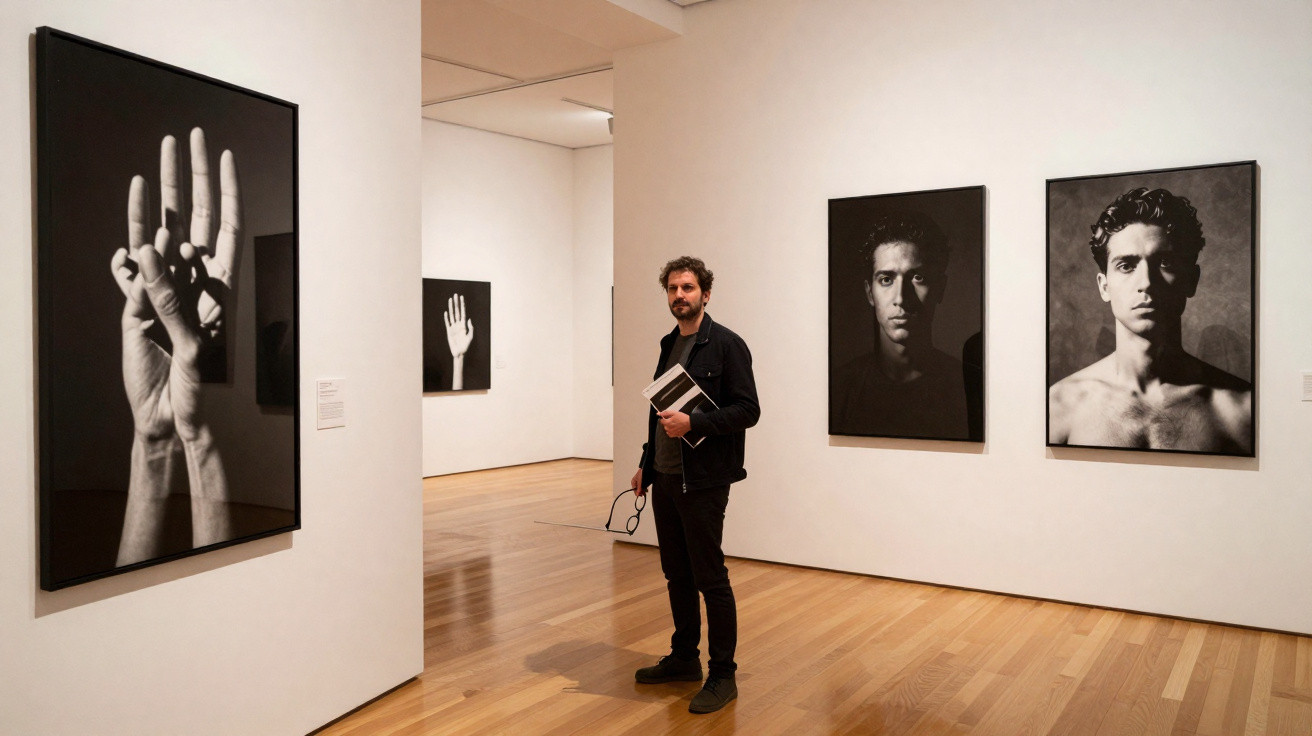
A show currently on view in Guimarães is well worth seeing. Presented as the first major systematic retrospective of the work of Jorge Molder, a photographer-artist and leading figure in contemporary art, Come Di (Part I) opens the programme devised by Miguel Wandschneider, who took over as artistic director of the Centro Internacional das Artes José de Guimarães (CIAJG) last June. This exhibition has an unusual format. Focusing on an arc of Jorge Molder’s work produced between 1991 and 2003, it unfolds in two separate stages. Part I runs until September, followed by Part II, from 26 September to 28 February 2027, with each instalment operating as an independent exhibition. The project offers an in-depth exploration of Jorge Molder’s artistic world: over five decades, he has built up a complex universe of images, completed through variations on the same subject and resulting in a monumental body of work.
As Miguel Wandschneider explains - having co-curated the exhibition with António Neves Nobre and Jorge Molder - the choice to split one exhibition in two was entirely practical. “I did not want this experience to be indigestible, either for the most inexperienced visitor and viewer or indeed for the most committed and won-over one. Even so, and since it was not possible to encompass all the work made over 50 years, it was necessary to divide and focus the work using a chronological marker set between the first moment when the artist began to appropriate his own figure as an object of representation in order to stage an abstract and unfathomable character, developed across multiple series, and the point at which he stopped using analogue photography and moved to digital, thereafter making significant changes to his body of work.” For around four months, the curators, always working closely with the photographer-artist, delved into his extensive archive. They traced and brought visibility to several series, disrupting sequences, remaking routes and thematic compositions, which are now presented in an accomplished installation.
Part I
Titles matter to Jorge Molder. Introduced as the driving spark behind his series, they may refer to an author, a film, a filmmaker, a book or even a Pope - as in Inox, where he deconstructs the name “Innocent X”. They become part of the fictional game proposed by the artist, while revealing nothing about that game itself. The enigmatic title of this exhibition, Come Di, was itself borrowed by Molder from Italian composer and musician Paolo Conte. It comes from a word that appears to mean nothing, yet when sung creates a game of homophony through the sound relationships between words - “La comédie d’un jour, la comédie d’la vie, la comédie, la comédie, la comédie...” - suggesting multiple settings within the same theatre.
Concentrating on the years from 1991 to 1996, this first instalment reveals the founding axis of a practice pursued obsessively from then onwards. The body becomes an alibi for representing, or dismantling, a character always derived from the same body - his own - fragmented into multiple selves and fictionalised as another.
Moving through the five rooms of the CIAJG’s central exhibition space, visitors find a chronological narrative built around eight series. It is punctuated by individual photographs from other series made during the same period, which are not otherwise represented in the exhibition but, as the curator puts it, function as “stitching”. Altogether, there are more than one hundred images, each disclosing the photographic environments that inhabit Jorge Molder’s creative universe.
Jorge Molder: from self-portrait to self-representation
This universe is introduced in the opening rooms through a group of series - Self-Portraits (1981-1987), Fencers (1986) and Waiters (1986) - selected as a kind of prelude to an earlier period. Still using the term self-portrait, Molder begins to test his own figure as an abstract, performative object within romantic and intimate settings. These images may evoke a character from film noir or an enigmatic story involving one or several waiters in a timeless place - once again playing on the word’s double meaning, as waiters are also those who wait. At times he appears from behind; elsewhere, there is only a silhouette, a pair of hands or a face that avoids looking directly into the camera.
From this introduction, the exhibition proceeds through The Secret Agent (1991), Insomnia (1992), The Sense of the Sleight-of-Hand Man (1993), Points of No Return (1994), Inox (1995) and T.V. (1996). These works mark the point at which the artist rejects the designation of self-portrait and moves instead into self-representation. In this transition, the position of the subject is displaced. His body, now definitively central to the work and staged and observed in multiple forms, becomes a metaphor and an enigma, sustaining an unending, unanswered interrogation of an intangible “I” pushed to the limits of possibility. A face looks at its double, seen from behind in the image. A face, sometimes in half-light and at other times partly or fully illuminated, breaks apart under the intensity of the light. An eye stands out in the profile of a figure peering at a tiny white mouse. One hand hides a face; two hands are outlined, moving like those of a conductor against a black background. Another hand tosses a silver coin into the air, while another conceals a card in a jacket pocket. A full-length man in suit and tie, compressed inside a strange object made of opaque glass, suggests a funereal levitation. The images are saturated: at times impure and warm, at others cool and clean. They are worked through dense black-and-white contrasts and presented in square formats of either 48 by 48 centimetres or 102 by 102 centimetres. The figure passing through them always wears a suit and tie, shirt, collars and immaculate, starched white cuffs. These are beautiful images, meticulously made within the controlled setting of the studio, where the production of each series can take months.
Focused on the years between 1991 and 1996, this first part reveals the founding axis of a body of work in which the body serves as an alibi to represent, or deconstruct, a character always derived from the same body: his own.
Jorge Molder, who was an invited artist at the São Paulo Biennial in 1994, represented Portugal at the 1999 Venice Biennale and received the EDP/Art Prize in 2010, has since followed an extensive career as a photographer. In a 2025 interview with Expresso, he said that his creative process does not always begin in the same way. “Chance matters,” he stressed. “There is no directed process; I let it direct me. I do not start from certain points in order to reach a particular end. Sometimes the opposite happens: where I begin is forgotten and I end up somewhere I was not expecting. If something starts to move away from what I wanted, it is better to consider whether it is not getting closer to something else, and whether I should pay attention to what is happening. And it is always an unfinished story. If it had an end, it would be tragic.”
The CIAJG programme: Aidan Duffy and José de Guimarães
The programme put together by Miguel Wandschneider for this season also includes Back Outside, an exhibition by the Scottish artist Aidan Duffy. At 31, Duffy is a young artist with a short career that began in London a little under six years ago. He creates sculptures from varied materials discarded or found on city streets, combining them with others bought at online auctions and items previously used by friends and family. From these, he makes sophisticated compositions presented as sculptural assemblages, in which forms and colours are developed in the studio through an informal, wholly intuitive gesture. This is the first time the artist’s work has been shown in an art centre, following a decision by the artistic director, who happened upon him in a Lisbon gallery and was immediately captivated by Aidan Duffy’s “punk, delicate and vital, constantly evolving” work. This programme was conceived initially to create a play of contrasts between the established artist and the young contemporary artist, allowing visitors to experience the diversity that belongs to an art centre.
A renewed display of José de Guimarães’s collection
At the same time, a programme of temporary exhibitions is being developed around the extensive archive of the artist José de Guimarães, which remains one of the CIAJG’s principal vocations. The centre opened in 2012 as an anchor project for Guimarães, European Capital of Culture. The first step was a reorganisation of José de Guimarães’s collection of traditional African art, assembled over four decades and partly held on deposit at the CIAJG. A new section, supplemented by several loans from the artist, is presented across three ground-floor rooms. The first displays a group of artefacts depicting animals or hybrid animal-human beings; the second is distinguished by reliquary figures; and the third brings together pairs of full-length sculptural figures, comprising a male and a female element. There is also a carefully selected series of masks which, placed on a bench built into the white wall, appear as singular and autonomous sculptures. This more pared-back reorganisation, aligned more closely with the display conventions of contemporary art than with those of an ethnology museum, enables focused attention on each object and establishes a new cycle for presenting José de Guimarães’s work.




Comments
No comments yet. Be the first to comment!
Leave a Comment