
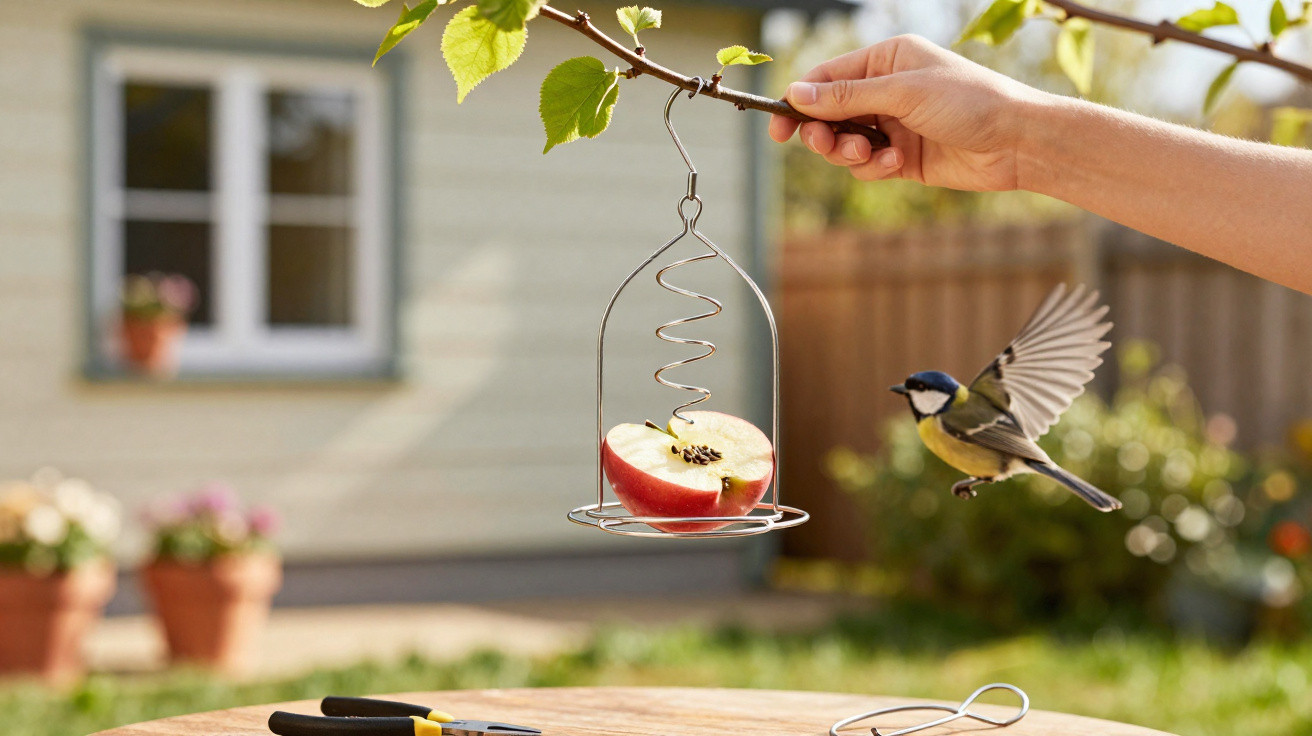
As the first birds become active in gardens again during spring, many people face the same issue: ready-made feeding stations from garden centres and DIY shops can be surprisingly expensive. Yet one unremarkable item from the wardrobe is all that is needed to make a sturdy, practical and rather appealing feeding point – free of charge, with a clear environmental benefit.
Why an old clothes hanger can help garden birds
Anyone who has checked the cost of “designer” bird feeders will know that £30, £40 or even more can quickly be spent. Many models, meanwhile, do not last beyond one or two seasons. However, the material for a durable feeding station is already found in many homes: the thin metal hanger commonly returned after dry cleaning, which is then never used again.
A bent wire hanger can become a fully functional feeding station in just a few minutes – sturdy, inexpensive and ideal for native birds.
Dry-cleaning metal clothes hangers are generally made from fairly soft wire. With a little force, it is easy to bend into shape, while remaining strong enough to securely support fruit, nuts or a portion of seed. Rather than being thrown away, the hanger is given a second and particularly useful purpose.
Household materials instead of an expensive DIY-shop trip
For this small project, a quick look in the wardrobe and kitchen drawer will often provide everything required. It is an ideal task for anyone who enjoys making do with what they already have.
What you actually need
- 1 metal clothes hanger (a standard dry-cleaning wire hanger)
- 1 pair of side cutters or combination pliers with a cutting edge
- 1 pair of round-nose or flat-nose pliers for shaping curves
- Work gloves to prevent cuts
- Either half an apple, a pear or similar fruit
- Or the base of a plastic bottle to use as a small seed dish
Most of these items will already be available at home. If necessary, a single pair of pliers can even do the job, provided that the wire hanger is not too thick.
Step by step: turning a wire hanger into a bird feeder
The conversion takes only a few minutes. Work carefully and make sure no sharp wire edges remain, so that neither hands nor birds are injured.
Straighten and smooth the wire
Begin by undoing the twist beneath the hanger hook. Grip it with the pliers, open it slightly, then gradually uncoil the wire until it forms one long, mostly straight length. It can then be roughly smoothed over the edge of a table or on another flat surface.
The straighter the wire is at the start, the more stable and professional the finished feeding station will look.
Ideally, this will leave you with a wire length of around 70 to 80 centimetres. Minor bends are not a problem; the important thing is that it runs reasonably evenly.
Shape a support for fruit or seed
The lower end now needs to be given its purpose. There are two straightforward options:
| Option | How to shape it | Suitable for |
|---|---|---|
| Fruit spike | Coil the lower third of the wire into a spiral around 5 cm in diameter, with the point facing upwards. | Apple halves, pear pieces, soft fruit |
| Seed dish | Make a closed ring at the bottom, into which the cut-off bottle base can be fitted. | Sunflower seeds, peanuts, ready-made seed mixes |
Important: the fruit spike should be shaped so that the apple is properly impaled and cannot slide off. For the bottle base, the ring must fit tightly enough to stop the small dish from wobbling.
Bend a secure hanging hook
At the upper end, create a generously sized hook resembling a traditional S-hook. It should be noticeably larger than the hanger’s original hook, allowing it to be hung easily from branches, roof overhangs or a pergola.
Round-nose pliers help to produce neat, rounded curves. If preferred, add a small bend at the end to make it less likely for the hook to slip off its support.
Food choices: what birds really benefit from in spring
As temperatures rise, birds’ needs change as well. Fat blocks and fat balls become less useful after a certain point, as they can turn rancid easily and are simply no longer necessary.
Suitable seasonal treats
The following are especially well suited to a homemade feeding station:
- Apple pieces or apple halves (unsprayed or washed very thoroughly)
- Pear pieces and grapes, in small quantities
- Unsalted peanuts, roughly chopped
- Sunflower seeds, around 50 to 100 grams per refill
- Ready-made seed mixes without salt or additives
In spring, seeds and fruit are ideal for many species – they supply energy without being unnecessary fat-heavy foods.
Important: do not offer bread, seasoned leftovers or salted nuts. These are more harmful than helpful. A small but high-quality selection of species-appropriate food is the better choice.
The ideal position: safe from cats and easy for birds to reach
The location often determines whether birds use the feeder at all. They need both peace and a quick escape route.
Height, distance and surroundings: what matters
- Height: At least 1.5 metres above ground level, preferably slightly higher.
- Distance from shrubs: Avoid dense hiding places nearby, so cats cannot launch a surprise attack.
- Clear view: An open area of several metres helps birds spot danger in good time.
- Visibility for people: Positioning it near a window or in front of a patio makes birdwatching especially enjoyable.
A clear tree branch, a crossbar on a pergola or a hook beneath a roof overhang are all ideal. The hanger will remain secure there, while birds can approach it from every direction.
Why this small project is much more than “just crafting”
Turning an old metal hanger into a feeding station does more than save money. It is also about conserving resources, supporting biodiversity and, as a bonus, bringing a good feeling into everyday life.
Recycling that makes a difference right outside the window
A disposable item is transformed into something useful. Nothing new needs to be manufactured, transported or packaged. Particularly in towns or densely built-up neighbourhoods, many bird species welcome additional food sources, especially during transitional periods when insects are not yet plentiful outdoors.
Every upcycled hanger offers a little help to blackbirds, tits and more – visible, practical and there to watch every day.
Once you have seen how quickly the first visitors adopt their new “restaurant”, you may automatically start wondering whether other worn-out household items could also be turned into something useful.
Care, safety and further ideas
To keep the feeding station hygienic, rinse the bottle base regularly with hot water. Replace fruit before it starts to rot or grow mould. A quick inspection is worthwhile after every downpour, at the latest.
Anyone who enjoys the project can use several hangers to create small “feeding galleries”: for example, one station exclusively for fruit, one for seed and one with a water container. With a little practice, these can become charming small sculptures that please both the birds and the eye.
One final thought: many aspects of modern sustainability can seem abstract. This is different. A few movements with pliers, an old hanger and some food are all it takes to place a feeding station outside the window, where every day you can see first-hand how even a simple idea can enrich your immediate surroundings.

Comments
No comments yet. Be the first to comment!
Leave a Comment