
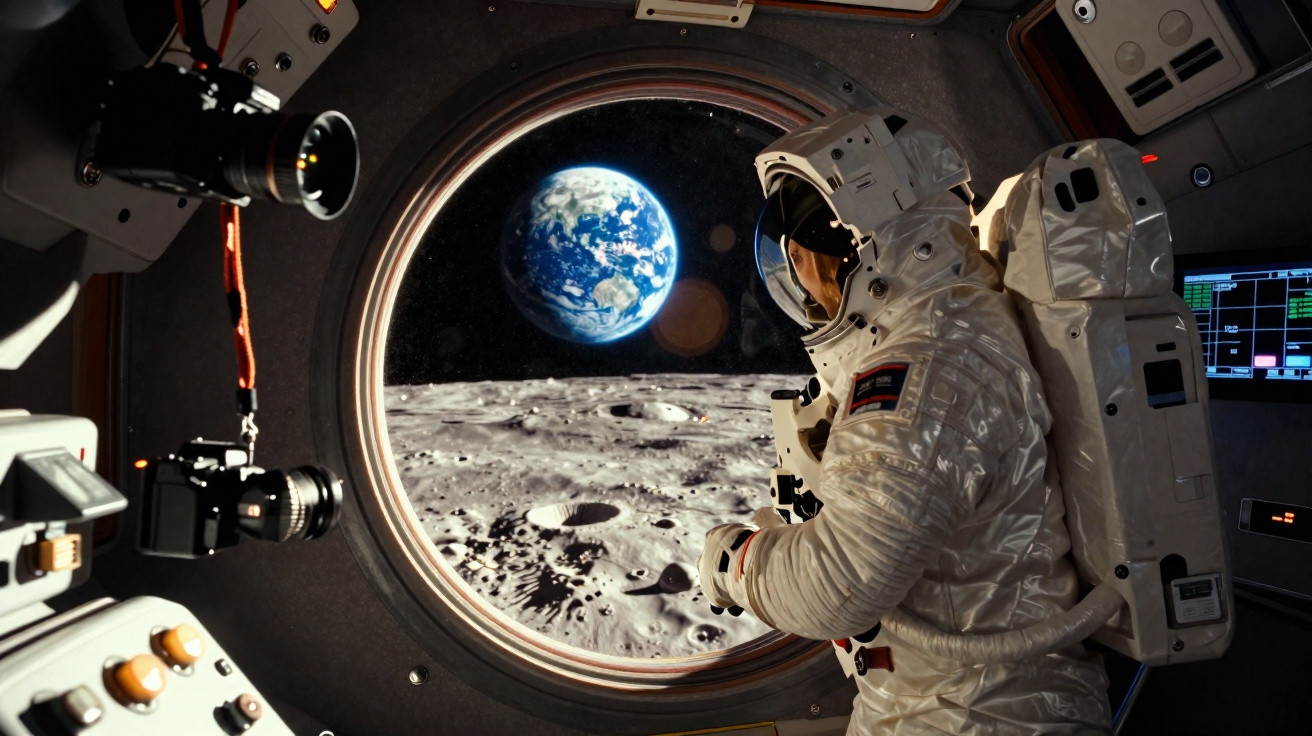
Artemis 2 and the new “Earthrise” photograph
As Artemis 2 passes around the far side of the Moon, its astronauts will attempt to create a new version of one of history’s most celebrated space images: “Earthrise”. The iconic photograph, showing Earth appearing above the lunar horizon, was taken by the Apollo 8 crew on Christmas Eve in 1968.
The Artemis 2 spacecraft is scheduled to fly around the Moon on Monday 6 April, more than 57 years after Apollo 8 first carried people to the Moon. During this manoeuvre, the crew will seek to capture its own “Earthrise” image.
NASA stresses that “Earthrise” was far more than a fortunate photograph. Against the backdrop of wars and mounting environmental concerns in the late 1960s, the image became a visual reminder of how small and vulnerable Earth is on a cosmic scale. The new attempt is therefore seen not merely as a technical objective, but also as a symbolic gesture.
How Artemis 2 will differ from Apollo 8
A key difference from Apollo 8 is that the original image was taken by chance. During the fourth orbit of the Moon, astronaut Bill Anders saw Earth emerging over the horizon and quickly photographed it with a Hasselblad camera. For Artemis 2, however, the photography has been planned in advance as part of the flight programme.
The new picture will not be an exact recreation of the Apollo 8 photograph. In 1968, the spacecraft was only about 97 km above the lunar surface, while Artemis 2 will pass at an altitude of roughly 6,400–9,650 km. As a result, both the perspective and the scale of the image will be different.
Modern cameras for the Artemis 2 “Earthrise” image
The photographic equipment will also change. Rather than the legendary Hasselblad cameras used during the Apollo era, the astronauts will use modern digital Nikon D5 cameras, offering considerably greater scope for adjustments and image quality.






Comments
No comments yet. Be the first to comment!
Leave a Comment