
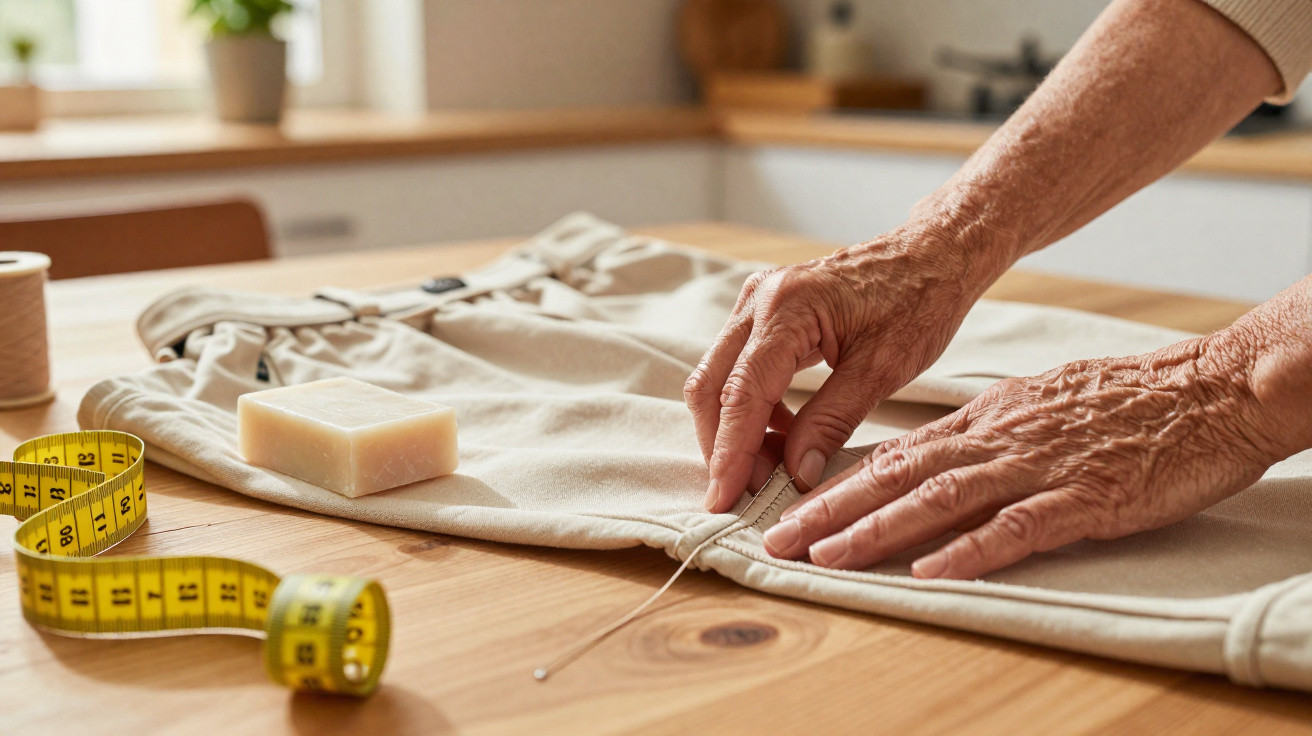
Many people know the problem: you have bought new trousers and an important appointment is approaching, but the hem is too long and professional alterations are not possible because of time, cost or simply a lack of equipment. Rather than reaching for a safety pin in an emergency, there is a neat, almost invisible answer using only a needle, thread, a few pins and a bar of soap.
Why this grandma trick is popular again today
Our grandmothers often had to manage without technical aids. Whether the sewing machine was broken or unavailable, and there was no iron in the cupboard, trousers still had to hang neatly and look smart. Out of that necessity came a remarkably accurate hand-sewing method for shortening trouser legs without showing the turned-up hem.
The clever part is that the finished hem looks as though it has just come from a tailor. There are no bulky ridges, uneven lines or obvious stitching on the outside. Once you have mastered the technique, it takes only a few minutes, even in a hotel room or while travelling.
An invisible, secure trouser hem is possible without a machine or an iron – provided you use the right hand technique.
Preparation: measuring the length and positioning the fabric
Start by measuring the length precisely. Put on the trousers with the shoes you will usually wear with them, as heel height noticeably changes the way the trousers fall.
- Put the trousers on and stand upright.
- Turn the trouser leg inwards to the required length.
- Check each side separately, as legs are rarely exactly the same length.
- Mark the desired length with a pin or a small stitch.
For many traditional tailored trousers, a turn-up of around 3 centimetres is a useful guide. This creates a clean, balanced appearance: the trousers lightly touch the shoe without creasing or brushing the floor.
Securing the turn-up: “ironing” the fold with your fingers
Perhaps the most surprising aspect of this method is that an iron is not needed at all. Instead, it uses an old technique known as “finger ironing”.
Finger ironing: how it works
First, fold the final turn-up inwards and align it carefully. The hem edge needs to run evenly; otherwise, the trousers will look crooked when finished.
Then proceed as follows:
- Firmly press the turn-up between your thumb and forefinger.
- Run your fingers along the full hemline while maintaining pressure.
- Smooth the edge all the way round for at least 30 seconds.
The pressure helps set the fabric fibres. Natural materials, particularly cotton, linen and wool, develop a surprisingly firm crease in this way – almost as if they had been quickly ironed.
To stop the turn-up from shifting, place roughly five pins vertically around it. This keeps every part in position until the hand stitching is complete.
The invisible stitch: achieving a professional-looking trouser hem
The second essential element is the correct hand stitch. Tailors refer to this as a type of “invisible stitch”. Although it may look delicate at first, the method is straightforward to learn in practice.
How to sew the invisible stitch correctly
Use a fine sewing needle and thread that matches the fabric colour. A closely matched thread enhances the appearance of a professionally finished hem.
Work through these steps:
- Insert the needle into the folded fabric, or “turn-up”.
- Pick up only a minute thread from the main fabric, just above the folded edge – genuinely no more than a tiny amount.
- Return the needle to the turn-up and pull the thread through gently rather than tightening it firmly.
- Leave approximately one centimetre between stitches.
Once complete, the outside will show only a fine, barely detectable point, ideally concealed by the fabric’s weave or pattern. The trouser leg stays smooth, with no visible zigzag line or raised hem edge.
The needle takes plenty of fabric on the inside and only a tiny thread on the outside – this keeps the hem secure without making it visually obvious.
This approach also spreads the tension across numerous small points. The hem is less likely to tear, remains flexible and can withstand greater pulling force. Avoid overtightening the thread to prevent puckering and retain a soft, comfortable drape.
The dry soap trick: shaping the hem like a tailor
Traditional household know-how offers one additional aid: dry soap. A conventional bar of soap, such as a cube-shaped one, can do more than clean hands.
Before finger ironing, run the edge of the soap bar precisely along the intended crease line on the inside of the trousers. The soap works rather like a natural stiffening agent, temporarily giving the fabric more hold. Its fibres stay in the required position more easily, the edge becomes sharper and the turn-up is less likely to slip.
The soap washes out completely the first time the trousers are laundered. It leaves no stains, residue or stiffness, making this trick particularly useful on holiday or during a business trip.
Does the grandma trick work on jeans too?
Invisible hems are often associated with suit trousers or office-ready fabric trousers. That is exactly where this method excels, since the stitching virtually disappears and gives the garment an especially polished look.
Jeans have a different style. Visible seams made with contrasting thread are often part of their design. Even so, a hand-sewn hem can be useful, for instance when you want to retain the original faded edge or when the denim is too thick for a basic domestic sewing machine.
The important thing is to work methodically: finish one trouser leg completely before moving on to the other. This keeps the length even and lets you spot immediately if a stitch has been left too loose and needs correcting.
Who benefits most from this hand-sewing technique?
This grandma trick is particularly useful for people who:
- do not own a sewing machine or are reluctant to use one;
- need to alter trousers regularly, such as for growing children;
- travel frequently for work and want to shorten trousers quickly while away;
- wear delicate fabrics that can look untidy with heavier machine stitching.
Anyone who becomes comfortable with the technique can often avoid a trip to an alterations tailor. It also brings the reassuring sense of being able to manage your own clothes. A small tear at the hem or trousers bought in the wrong leg length no longer feels dramatic, but becomes a 10-minute task.
Suitable fabrics and when to take care
Natural fibres are particularly well suited to this technique, including:
- wool and wool blends, such as suit trousers and business trousers;
- cotton fabrics, including chinos and finer cotton trousers;
- linen, where a crisp crease is wanted.
Synthetic fabrics with a high elastane content respond less readily to “finger ironing”. The turn-up will still hold, but it may shift more after extended wear. In such cases, it is worth placing the stitches slightly closer together.
With very lightweight, delicate fabrics, such as fine silk, take an even smaller amount of the outer fabric so that no tiny needle holes remain. Using an especially fine needle further reduces the risk of damage.
Practical additions for everyday use
If you are unsure, practise first on an old pair of trousers. This allows you to find the right stitch spacing without the pressure of an upcoming event. With a little practice, the movement soon becomes routine and almost automatic.
For travel, a small emergency kit is worthwhile: a hand-sewing needle, a piece of neutral-coloured thread, five pins, a tiny bar of soap and a tape measure will fit into any wash bag. It can be used not only for trousers, but also to make temporary adjustments to sleeve edges or skirt hems.
Parents benefit twice over. Trouser legs can initially be turned up and secured by hand as a temporary measure. When the child grows, simply unpick a section and fasten it again at a new length. The fabric remains intact, the trousers can accommodate several sizes and do not need to go straight into the textile recycling collection.



Comments
No comments yet. Be the first to comment!
Leave a Comment