
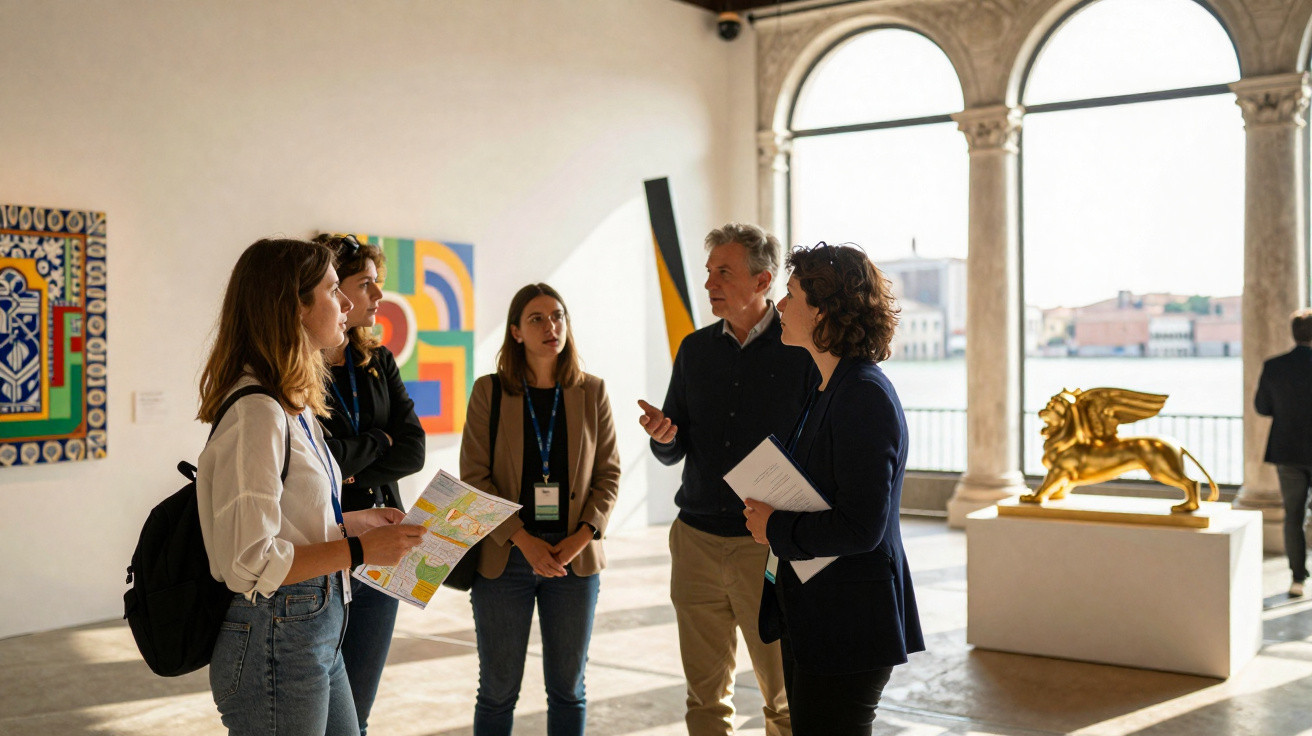
The 61st Venice Art Biennale opens to the public this Saturday, featuring 100 national pavilions, a central exhibition with 111 participants, and a controversy that prompted the resignation of the international jury. The awards will now be determined by visitors.
Under the theme "In Minor Keys" and conceived by chief curator Koyo Kouoh (1967–2025), the Venice Art Biennale will also include 31 parallel events at venues across Venice. These will run until 22 November, when the awards for the global contemporary-art event will be presented, rather than being announced at the opening ceremony as is customary.
61st Venice Art Biennale and the jury dispute
The crisis at the 2026 Venice Art Biennale began on 23 April, when the international jury declared an unprecedented boycott: it would exclude from the awards countries whose leaders had been accused of crimes against humanity by the International Criminal Court.
The decision, which directly affected the Israeli and Russian representations, brought a political dimension to an event traditionally focused on artistic creation.
Chaired by Brazilian curator and cultural manager Solange Oliveira Farkas, the jury’s decision immediately sparked controversy in cultural and diplomatic circles. The Biennale Foundation and the Italian government opposed the criterion, arguing for institutional neutrality and rejecting any form of censorship.
The organisers stressed that the Biennale "must remain a space open to international participation" and dissociated themselves from the jury’s autonomous decision. This created a deadlock that intensified amid political pressure and internal disagreements, including criticism from the Italian government.
Faced with the institutional dispute and the lack of agreement, the jury’s five members resigned together on 30 April, just nine days before the opening. Alongside Farkas, the panel comprised Zoe Butt, Elvira Dyangani Ose, Marta Kuzma and Giovanna Zapperi.
As a result, the presentation of the Golden Lion has been postponed until the exhibition closes. With no jury in place, the organisers have introduced a new participation model, the "Visitors’ Lions", allowing the public to vote for the best pavilions and artists.
In March, the European Commission condemned the Venice Biennale’s decision to permit Russia’s participation, stating that European Union funding could be at risk if the decision remains in force. However, the organisers may still appeal the measure.
Although the organisers have never barred Russia from participating, the country was absent from the Art Biennale in 2022 and 2024. In the first instance, its artists and curators withdrew; in 2024, Russia gave its pavilion to Bolivia.
Russia and Israel at the Venice Art Biennale
This year, Russia’s pavilion presents "The Tree Is Rooted in the Sky", curated by Anastasiia Karneeva. The exhibition brings together around 40 artists, including Lizaveta Anshina, Ekaterina Antonenko, Antonio Buonuario and DJ Diaki.
Israel, meanwhile, will occupy its space in the Arsenale with "Rose of Nothingness". The pavilion is commissioned by Michael Gov, curated by Avital Bar-Shay and Sorin Heller, and features artist Belu-Simion Fainaru.
Portugal at the 61st Venice Art Biennale
Portugal will be represented by the artistic project "RedSkyFalls" by artist Alexandre Estrela. Commissioned by the Directorate-General for the Arts and curated by Ana Baliza and Ricardo Nicolau, it will be shown at Palazzo Fondaco Marcello. Brazil and Timor-Leste will also take part through their national representations from the Portuguese-speaking world.
Since the public presentation of his work, Estrela has spoken out against the participation of Russia and Israel in the event, expressing solidarity "with oppressed peoples".
Estrela is among the 183 signatories of an online open letter promoted by the Art Not Genocide Alliance (ANGA), published in March. In it, participants in the 61st Venice Art Biennale - including artists, curators and workers - call for Israel to be excluded from the event.
The signatories argue that "the Venice Biennale’s complicity in the attempted destruction of Palestinian life must end".
Portuguese artists in parallel events
Portuguese artists are also represented in parallel events, including visual artist Pedro Cabrita Reis’s exhibition "XIV Steps", which opened on Monday. It comprises 14 new large-scale paintings revisiting the Stations of the Cross through a "personal vision" of the Passion of Christ, in dialogue with the history of European painting.
Artist Marita Setas Ferro is also taking part in "Personal Structures – Confluences 2026", organised by the European Cultural Centre Italy. Running in Venice from 9 May to 22 November, the exhibition includes her solo project, "The Echoes of Things from Nature", on seascapes and organic formations.


Comments
No comments yet. Be the first to comment!
Leave a Comment