
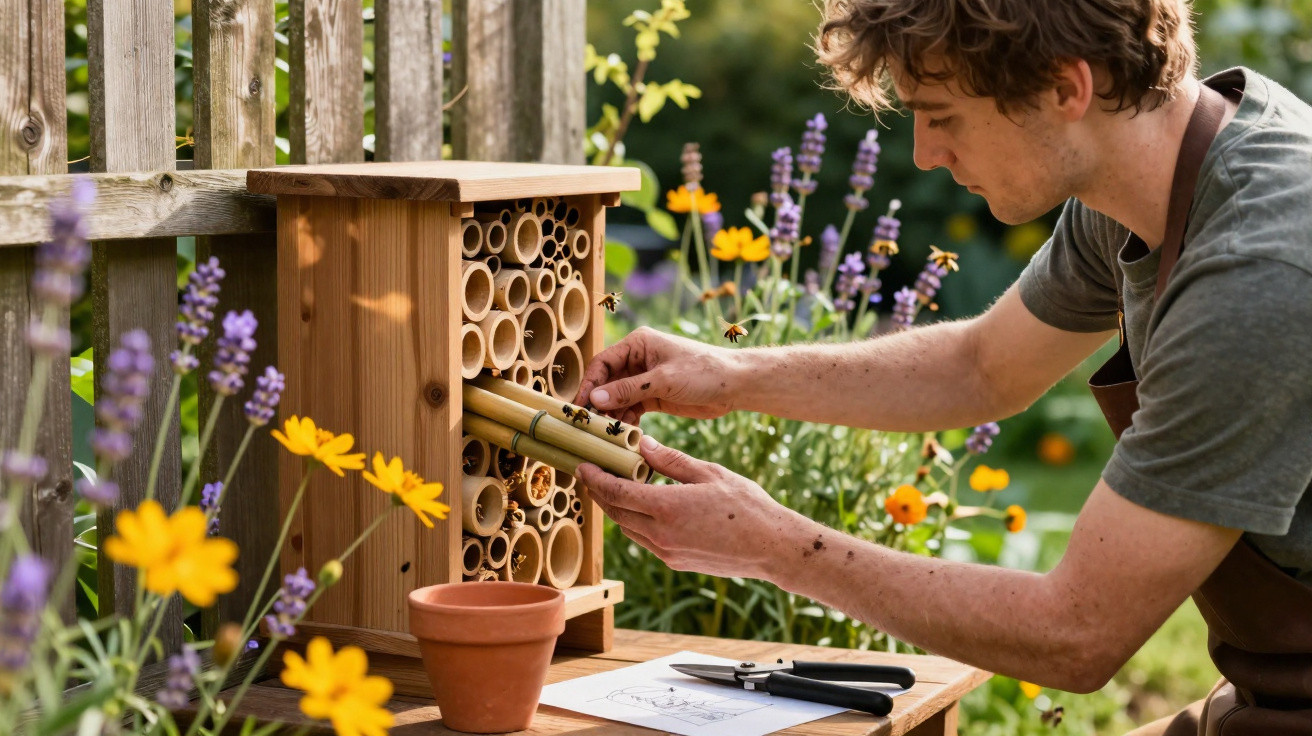
What looked like no more than a bundle of tidy tubes packed into a tin, with a small roof on top, initially struck me as decoration. Then, at midday, the first wild bee darted in and out, its abdomen dusted with pollen. The moment stayed with me because it turned something ordinary into something alive: as quiet as a breath, yet suddenly charged with buzzing purpose. A revolution was taking place there, almost unnoticed.
Why tubes genuinely attract bees
Wild bees are not looking for a palace. They need a tunnel with an opening of the right size: sheltered, dry and warm. Tubes offer a straightforward answer to this ancient need, which awakens wherever sunlight reaches a gap in the garden. A tube insect house precisely recreates nesting places that have become scarce in nature: hollow stems, burrows in dead wood and small cavities in clay.
One late-summer afternoon at the edge of an allotment site, a bundle of reed tubes hung from a fence beside lavender and thyme. Children counted the visits of a reddish-brown mason bee and recorded 27 landings in ten minutes - not a laboratory study, but a clear rhythm of life. This is how a connection forms: in one bee’s comings and goings, you can watch the day’s story unfold.
The biology behind it is straightforward. Tube diameters of 3 to 9 millimetres suit the range of native species, while a depth of roughly 10 to 15 centimetres provides security; smooth inner walls help protect their wings. Give the front some warmth and the rear protection from wind, and an object on a fence becomes a home.
How to make an insect house from tubes
In brief: use a sturdy frame, a close-fitting roof and plenty of clean tubes. Choose reed, bamboo or paper tubes, cut them to 12 to 15 centimetres, and close the back of each tube, either by using natural nodes or sealing them with clay or hot glue. Tie them into bundles or place them in a tin or wooden frame, angle them slightly forwards, position them facing south-east to south, and hang them 1 to 2 metres above the ground.
As the details matter, here are three further steps. Sand the cut edges smooth on the inside, leaving no fibres or splinters. Use a range of diameters - 3–4 mm, 5–6 mm and a few at 7–8 mm - so that more species can find a suitable space. Let’s be honest: nobody does this every day. Even so, one calm afternoon spent with tools and a cup of tea is worthwhile, because its results can last for years.
Some mistakes come from good intentions. If tubes are too short, have walls that are too thin, remain open at the back or are hung in the rain, they will stay empty.
“As smooth as a drinking straw, otherwise the bees will avoid it.”
- South-east is the sweet spot. It is warm early in the day without becoming too hot in the afternoon.
- More nesting tubes mean more offspring. But every individual tube matters.
- A small roof keeps off dripping rain and prevents mould.
What happens next? Life around the tube hotel
Once the first tubes have been sealed, a quiet serial drama begins in the garden. Some caps are made of clay, others of leaf pieces, and others still of fine resin; each one tells the story of a different female builder. Anyone who has seen this understands why a square metre of flowers beside an insect house is far more than decoration, and why pesticides take the life out of the picture. It is this closeness that holds everything together. Before long, a second bundle may be hanging a little further along in the light, and someone may ask you for the instructions. It is contagious, in the best sense.
| Key point | Detail | Benefit for the reader |
|---|---|---|
| Tube diameter | 3–9 mm, mixed for different species | Increases the likelihood of rapid occupation |
| Direction and angle | South-east to south, angled slightly forwards | Drier tubes, more warmth and less mould |
| Material and cut | Reed/bamboo/paper tubes, smooth inside and closed at the rear | Gentler nesting tubes, fewer failures and more offspring |
FAQ
- Which materials are best for the tubes? Reed, bamboo and thick paper tubes work reliably, provided their inner walls are smooth and the rear end is closed.
- Can PVC or metal tubes be used too? They become hot, encourage condensation and are less readily accepted; natural or paper-based tubes are clearly preferable.
- How deep should the tubes be? A depth of 12–15 cm provides enough room for several brood cells and improves the chance of successful emergence.
- When is the best time to hang it up? Late winter to spring is ideal, although a well-made tube house can still be discovered in summer.
- Do the tubes need cleaning or replacing? Do not clean them; after the season, replace individual tubes only if there is visible mould or damage, while the hotel itself stays in place.





Comments
No comments yet. Be the first to comment!
Leave a Comment