
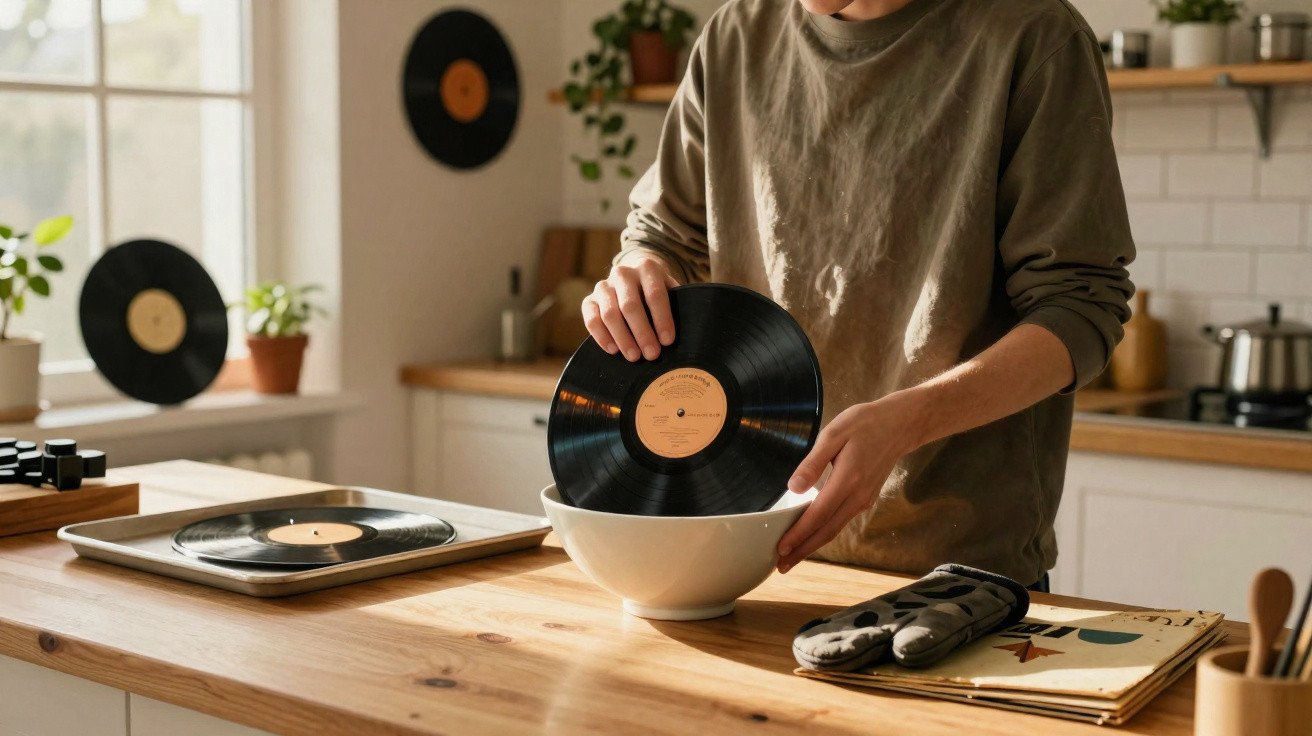
With a straightforward oven trick, old vinyl records can become stylish decorative pieces in minutes.
In many cellars and living rooms, old vinyl records are piled up even though they have long since stopped spinning on a turntable. Scratches, dents and moisture damage can make them beyond saving as music media. Yet these black discs offer more than nostalgia: with a few simple steps, they can be turned into practical statement pieces, with no workshop, specialist tools or expert craft skills required.
Why damaged vinyl records should not go in the bin
Vinyl records are made from PVC, a thermoplastic material. That is exactly what makes them ideal for creative upcycling. Throwing away old scratched records means discarding both a material that can be reshaped and a touch of retro character.
The principle is simple: rather than disposing of vinyl records that can no longer be played, turn them into useful household objects. This reduces waste, conserves resources and adds a highly individual design feature to your home.
"An unusable record can become a striking bowl, decorative item or plant-pot cover in just a few minutes – using an ordinary oven."
For this to work, two things matter above all: the correct temperature and a little care when shaping the record.
The simple science behind the oven trick
PVC is sensitive to heat. At moderate temperatures, the plastic chains in the material become softer and more flexible. The record can then be bent and shaped without immediately melting or splitting.
The temperature range is crucial. A setting of around 100 to 120°C has proved effective. Within this range:
- The record quickly becomes soft and pliable.
- Its shape changes evenly, rather than in isolated areas.
- Once removed from the oven, it hardens again straight away as it cools.
That means three to five minutes in the oven is enough to give the material a completely new shape, provided the preparation is right.
A designer bowl in 5 minutes: step-by-step guide
The classic vinyl craft project is a decorative bowl, which can work as a tray, fruit bowl or display piece. Here is how to make one without the hassle:
Prepare the oven
Preheat the oven to approximately 110°C. This temperature will generally soften the record evenly without making it smell strongly or form bubbles.
Line a baking tray with baking parchment. This protects both the tray and the record from direct residue and prevents sticking.
Choose the right mould
Place a heatproof bowl or dish base, ideally made of glass or ceramic, upside down in the centre of the tray. This item will act as the mould.
Position the vinyl record in the middle on top of the upturned base. It should sit as centrally as possible, so that the edges can bend down evenly.
Put it in the oven and watch carefully
Slide the tray into the oven and stay nearby. After about three minutes, the edges will start to droop and settle around the mould.
"The point at which the record loses its rigidity lasts only a moment – then you need to act quickly and shape it."
Using oven gloves, take the tray out. You can now gently press the softened record at the sides to create waves or give it a smoother shape. The material cools within a few minutes and becomes rigid again.
Leave the new bowl undisturbed for around ten minutes. Its shape will remain permanently stable only once it has cooled completely.
What old vinyl records can be shaped into
A simple bowl is only the starting point. A little willingness to experiment can produce a range of different objects:
- Catch-all tray: Ideal for keys, small items and sunglasses in the hallway.
- Retro fruit bowl: Press the base down more firmly during shaping to create a deeper interior.
- Plant-pot cover: Shape the base slightly, seal the centre hole with cork or epoxy putty, then add a suitably sized inner pot.
- Wall pieces: Shape the record only slightly, then fix it to the wall for a sculptural effect.
Many vinyl records are visually interesting in their own right: coloured vinyl, bold centre labels and unusual edge pressings often stand out even more in their new form.
Safety: essential points to consider
Although the trick is simple, a few rules need to be taken seriously:
- Temperature limit: Do not exceed 120°C, as this can cause significant off-gassing and an unpleasant smell.
- Good ventilation: Open a window slightly or switch on the extractor hood while heating the record.
- Hand protection: The record, tray and mould will all be hot, so always use oven gloves.
- Keep children away: Children should stay at a distance while shaping, as curious fingers can easily get burned.
"After heating, vinyl is not intended for direct contact with food. Anyone wishing to serve fruit or snacks in it should use a separate insert."
For food, use a glass or metal container placed inside the shaped bowl. This retains the look while ensuring food does not touch the plastic directly.
Which vinyl records are suitable – and which are not
Before getting started, it is worth taking a realistic look through your collection. Not every scratched record is automatically worthless.
| Suitable for the oven | Better left on the shelf |
|---|---|
| Heavily scratched, unplayable copies | Rare first editions |
| Mass-produced records with no collector value | Signed records |
| Records damaged by moisture | Sought-after pressings from particular labels or years |
If in doubt, take a quick look at established online marketplaces or databases. A record that appears unremarkable may still be in demand, and putting it in the oven could then be a frustrating mistake.
Alternatives without an oven: clock, frame or collector's item
If heating plastic in an oven does not feel right, there are other ways to give old vinyl records a second life.
- Make a wall clock: A battery-powered clock mechanism fits through the centre hole. Attach the hands, hang it up and it is ready.
- Frame the record: Particularly attractive labels or coloured vinyl can look like artwork behind glass.
- Use it as a decorative base: Suitable as a stand for decorative objects, but not for hot pans.
- Sell or give it away: Playable records may find new owners at car boot sales, second-hand shops or online.
What all these ideas have in common is that they considerably extend the life of the record, even when its original purpose – playing music – is no longer the priority.
How to incorporate the trend into everyday life
Many households have a box of old records tucked away somewhere. Rather than being irritated for years because nobody uses them, a short craft afternoon can solve several problems at once: less clutter, more order and a few new eye-catching features for the home.
Once people have mastered the technique, they often start looking specifically for cheap, damaged records at car boot sales. The shaped bowls work surprisingly well as gifts, especially if the label reflects the musical taste of the recipient.
Technically, this is a clear example of "upcycling". The term means transforming an old or broken item into a new product with greater usefulness or a more attractive appearance. That applies perfectly to a scratched vinyl record: an unusable music carrier becomes a decorative, functional object.
By paying some attention to safety and the material's properties, a dusty stack of vinyl can be transformed into a whole series of one-off pieces in a single afternoon – each bowl slightly different and each record carrying its own history.
Comments
No comments yet. Be the first to comment!
Leave a Comment