
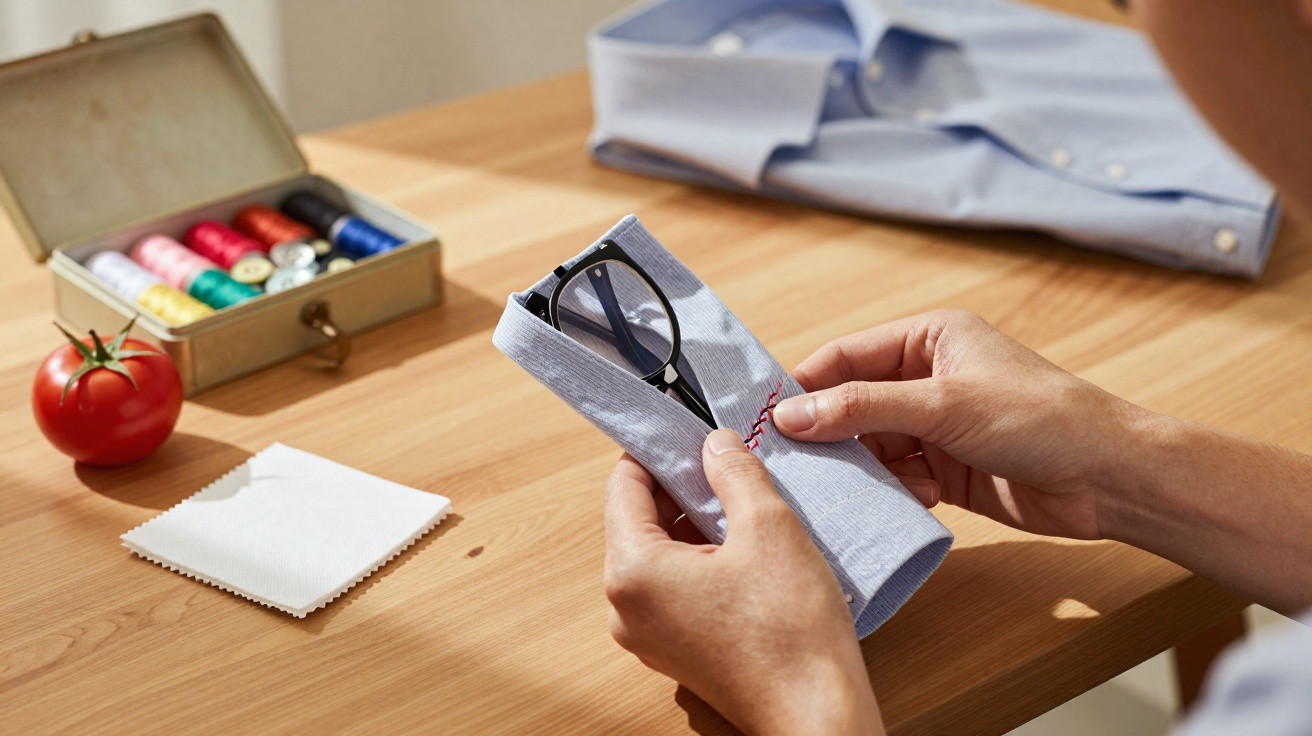
Discarded shirt, full sewing box: with a little-known trick, a single cuff can be transformed into a surprisingly practical accessory.
Many people simply place their glasses loosely in their handbag, then later wonder why the lenses have acquired fine scratches. Yet the answer may already be in the wardrobe: an old shirt cuff contains nearly everything needed for a sturdy, stylish glasses case. A few stitches, a £0 budget and 15 minutes are enough to create an accessory that looks shop-bought.
Turn an old shirt cuff into a glasses case: the basic idea
This trick makes use of a feature found in every well-made shirt: the cuff is reinforced with a special interlining fabric. This unobtrusive layer provides strength, shape and protection, making it ideal for shielding delicate lenses from knocks and scratches.
Rather than buying a new case, this sewing project simply extends the life of an existing garment – fully in keeping with upcycling and the circular economy.
Shirts with worn elbows or frayed collars, in particular, can still provide valuable material. Their cuffs usually remain firm, are neatly finished and even come with a fastening button. This section will later become the opening of the case, complete with an already integrated button-and-buttonhole closure.
Step by step: sew a glasses case in 15 minutes
This project is suitable for sewing beginners too. Anyone who can sew a straight seam is ready to begin. A sewing machine is useful, but a strong hand stitch will do if necessary.
Materials you will need
- 1 used shirt cuff, preferably cotton or poplin
- Scissors, ideally fabric scissors if available
- Needle and thread or a sewing machine
- Optional: a small piece of microfibre cloth for an integrated cleaning surface
- Optional: soft lining fabric for delicate lenses
How to make the case
- Slide your glasses into the sleeve section and roughly measure how much room they need.
- Cut the sleeve straight across around 20 centimetres above the cuff, creating a kind of fabric tube.
- Turn the tube inside out so that the inner side faces outwards.
- Align the freshly cut edges neatly and secure them with pins.
- Sew this edge closed with a straight stitch, either by machine or by hand.
- Finish the seam allowance, for example with a zigzag stitch or overlocker, to prevent fraying.
- Turn everything right side out again: the closed end forms the base of the case, while the cuff at the top becomes its opening.
You can now test the fit by slipping your glasses inside. The cuff button closes the case securely, so there is no need to sew on an extra fastening. If the case is much longer than the glasses, you can trim the fabric tube slightly further if desired.
Handy extra trick: sew a microfibre cloth straight in
Anyone who is always looking for their glasses, with the cleaning cloth in the car, the glasses in the hallway and the frame elsewhere, will appreciate this step: before closing the base permanently, a small piece of microfibre cloth can be sewn into the seam.
With a sewn-in microfibre cloth, you have cleaning and protection in one – nothing will fall out of your handbag or get left in the car.
Cut a square from a soft glasses-cleaning cloth, position one edge along the future base seam and simply catch it in as you sew the pieces together. This leaves a small attached cleaning tab inside the case that cannot come loose or be lost. It is especially useful for sunglasses in summer or children’s glasses.
Why cuffs offer such effective protection for glasses
Anyone who has looked closely at a cuff will notice that it is not only thicker but also holds its shape better than the rest of the fabric. This is because of the built-in interlining material fused to the outer fabric. It creates a firm yet flexible structure.
This combination of strength and light padding cushions small impacts, such as when a handbag knocks against the edge of a chair or the case is packed inside a full laptop bag. At the same time, the cotton outer layer stays soft enough not to leave pressure marks on the lenses.
- Reinforcement in the cuff area protects against pressure and impacts
- Button and buttonhole provide a secure closure without extra components
- The inside offers a soft, breathable environment for glasses
- Like a shirt, the case can be machine-washed without difficulty
With a neatly finished base seam, the construction can easily withstand everyday use in a rucksack, school bag or handbag. If the case becomes dirty over time, simply wash it – ideally in a laundry bag to preserve the button and its shape.
Personalise it: from simple protector to favourite accessory
If you enjoy small details, this straightforward idea can become a truly individual piece. The cuff often already has a pattern, whether stripes, checks or a subtle texture. Interesting graphic effects can be created by deliberately choosing where to position the seam.
Ideas for a personal touch
- Change the button: Sew on a decorative button, mother-of-pearl button or colourful plastic button.
- Add a label: Stitch small woven labels or name tapes onto the side.
- Adjust the width: For very narrow glasses, sew a second lengthways seam inside to make the tube slimmer.
- Add soft lining: Sew in thin lining fabric or a strip of cotton flannel if the shirt fabric feels very stiff.
If you have two matching cuffs, you can sew a set straight away: one for everyday glasses and one for sunglasses. Or make matching cases for a friend who has been carrying around a scratched plastic case for months.
What can you do with the rest of the shirt?
The idea does not end with the cuff. Other small items can be made from the remaining shirt, all fitting the same sustainable approach. A single garment can therefore become a whole collection of useful things.
| Shirt component | Possible new use |
|---|---|
| Front section with button placket | Flat zip pouch or document holder |
| Back section | Cushion cover or laundry bag for travelling |
| Second cuff | Second glasses case or pen holder |
| Collar | Playful pet collar or decorative element |
Anyone who regularly takes on micro-projects like these does more than reduce textile waste. They also gain a better sense of how much work and material go into one garment. Many people say that afterwards, they shop much more consciously.
What to consider when choosing fabric and caring for it
Firm cotton shirts are best suited to this glasses case. Very thin fabric offers less protection, while very thick fabric may feel too stiff inside. If you also want to store a contact lens case or small bottles, choose a slightly wider shape so that nothing gets squashed.
It is also important to consider previous washing habits: if the shirt has been heavily treated with fabric conditioner, it may be sensible to wash the fabric once without conditioner so that no residue reaches the lenses. After washing, pull the case back into shape where possible and leave it to dry flat so that the cuff does not become distorted.
Who will particularly benefit from this sewing project?
This small trick is ideal for several groups:
- Sewing beginners: Hardly any pattern cutting and only one seam – perfect for practising.
- Budget-conscious people: No additional materials are needed, as most items are already at home.
- Parents: Children’s glasses get protection that does not look like a “granny glasses case”.
- Craft enthusiasts: A quick in-between project that also makes a good gift.
It becomes especially interesting when the first person in a friendship group appears with a case like this. The reaction is often the same: a brief, disbelieving look, followed by the question: “Wait, that used to be a shirt?” That is exactly when the charm hidden in seemingly worthless leftovers becomes clear – as does how far you can get with a few minutes, scissors, and needle and thread.



Comments
No comments yet. Be the first to comment!
Leave a Comment