
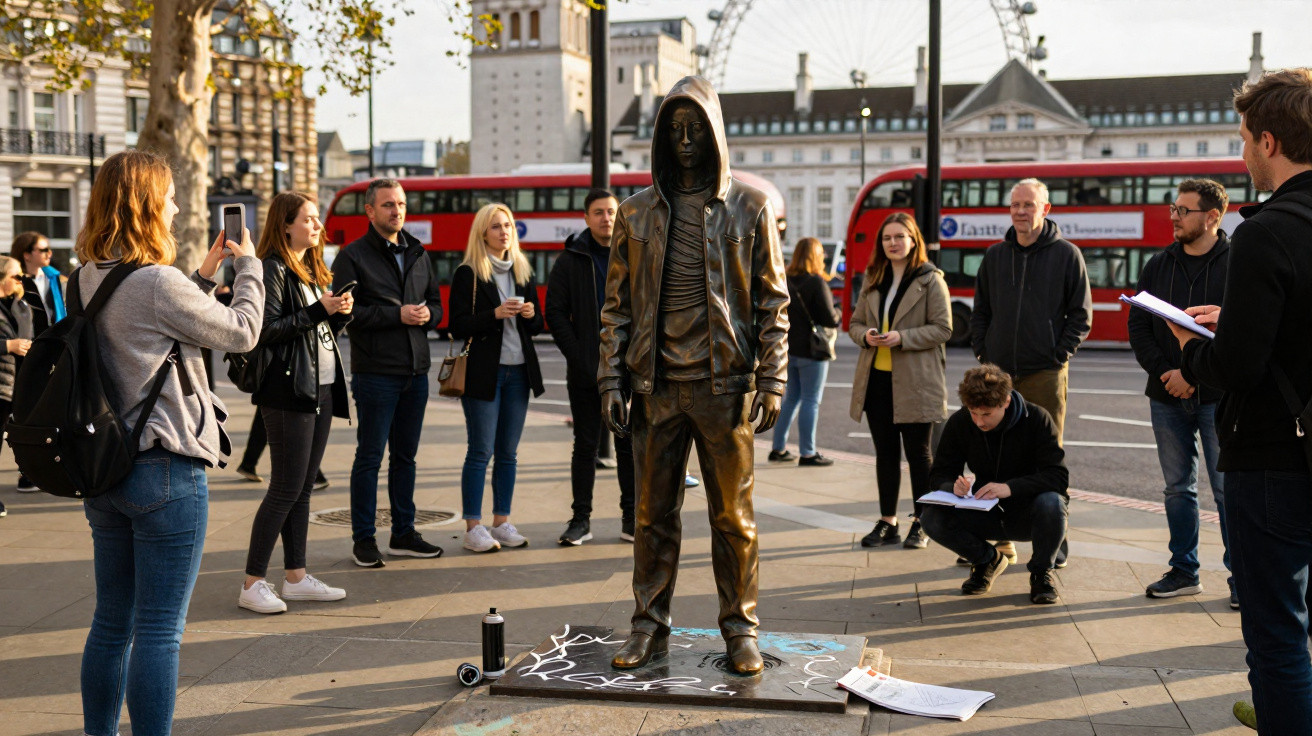
Last Wednesday, 29 April, London woke to find a statue in Waterloo Place, one of the best-known locations in the city centre. It depicts a man in a black suit raising an enormous flag of the same colour, which conceals his face, while one foot hangs beyond the plinth. The unexpected work caused a stir, though its signature came as no surprise to those who follow the work of Banksy, the world’s most famous street artist.
Banksy’s intervention in Waterloo Place
Banksy’s identity has still never been officially confirmed, despite speculation linking him to two members of Massive Attack. His first stencils appeared in Bristol in the early 1990s, amid the wave of graffiti that was beginning to spread through major cities and their outskirts. By the turn of the millennium, he had become an icon of street art.
As well as creating works in cities across the United Kingdom, Banksy gradually extended his talent around the world. New York, Los Angeles, Detroit and New Orleans, as well as Italy, Palestine and Ukraine, Australia, Canada and Spain, have all received his dissenting touch, with metaphor at the heart of his approach. His popularity has grown both because of the originality of work ranging from murals and sculptures to installations and stencils that seem to play hide-and-seek with passers-by, and because of the timeliness with which he intervenes in conflict zones or places facing profound humanitarian crises.
The image of a man in a traditional executive suit striding into emptiness, blinded by the flag he carries, is unsettling. It speaks to the heart of the Western world: where are you heading, dear Europe, once the continent that set the standard for the New World? Aware of the weight carried by the messages in his interventions, the artist used Instagram the following day to confirm that the work was his, posting footage of the plinth and statue being installed. Westminster City Council, which oversees the district where it appeared, has already said that the work will remain accessible to the public.
With the humour so characteristic of his extensive artistic output, Banksy wrote on Instagram that he had placed it there because there was a vacant spot among the famous statues already in Waterloo Place: one of King Edward VII, one of Florence Nightingale and a Crimean War Memorial.
Banksy, Europe and the black flag
The collision between the glories and virtues of the past and today’s darkness is thought-provoking. Europe is held captive by its bureaucracy, its sluggish response to successive waves of immigrants, and a soft-minded view of what political correctness ought to be. Senator Bernie Sanders commented: “When a flag blinds you, you fall off the cliff.” Powerful. German MEP Terry Reintke wrote on X: “Banksy gets it right again. Patriotism without vision is a step towards the abyss.”
My reading is slightly different. If the figure represents Europe - or, for the British, the Old World, in whose development, but also disintegration, Great Britain played a fundamental part - I do not see a message about blind patriotism. Instead, I see a world captured by a black cloud, enveloped by a force that plunges it into darkness, pointing towards the foretold condemnation of the Old Continent, fractured by its complacency in the face of new invaders.
I am reminded of a line from the writer Murakami, whom I hope will one day receive the Nobel Prize, in one of his most beautiful novels, Kafka on the Shore. Colonel Sanders, a character who, curiously, shares the senator’s name, tells another character: “After all, people destroy themselves more often because of their virtues than because of their faults.” The man in the statue is dressed as a leader and walks towards the abyss; that is what makes him tragic.






Comments
No comments yet. Be the first to comment!
Leave a Comment