
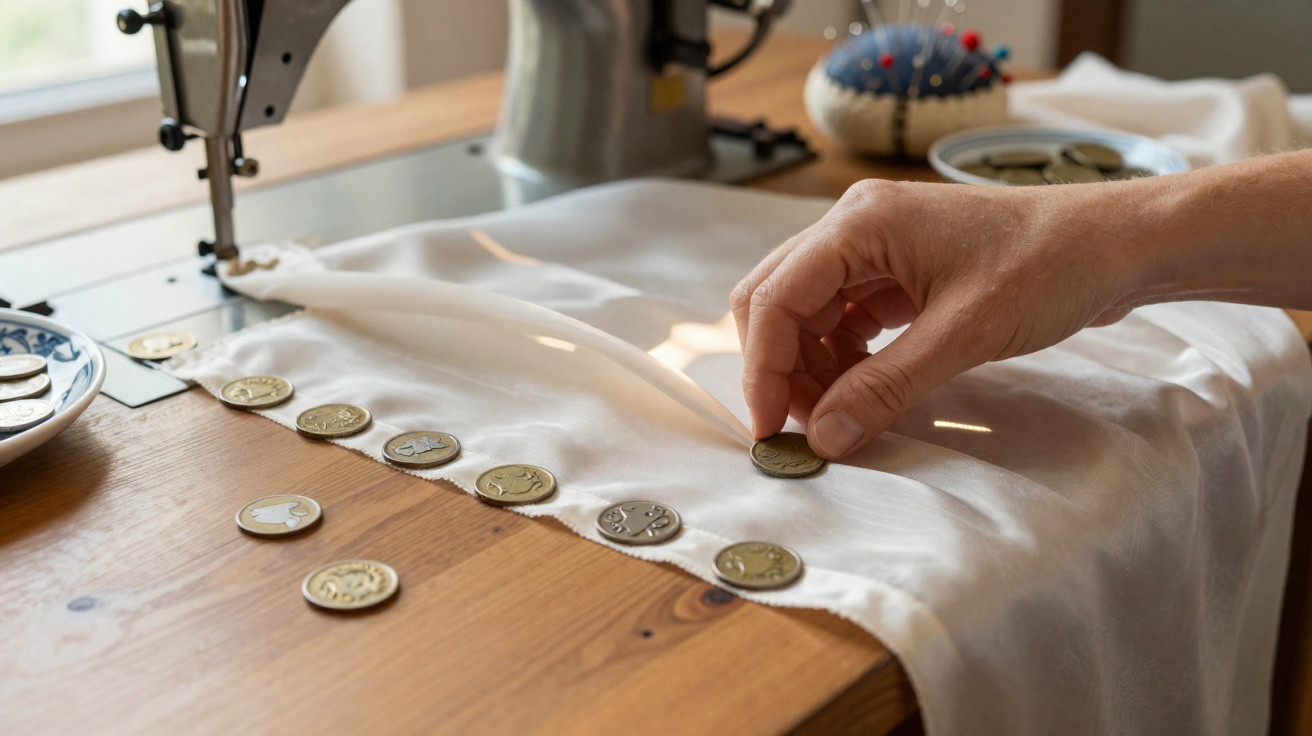
Old coins often sit in a jar for years, then suddenly prove to be a secret weapon in the sewing room – especially when working with tricky fabrics.
Many homes still have drawers packed with coins that are no longer legal tender. Rather than sending them for scrap, experienced home sewers and professionals repurpose these small metal pieces as accurate sewing weights. They hold delicate fabrics in place without making a single hole, which can make all the difference with softshell, silk or leather.
Why coin weights outperform traditional pins
Anyone who has cut costly silk, fine jersey or a rain jacket will know the issue: every pin leaves a mark. Plain cotton is fairly forgiving, but sensitive or coated textiles are a different matter.
“Pins create tiny micro-perforations – in high-tech fabrics, these holes can remain permanently visible or even affect performance.”
Textile technicians and sewing professionals therefore recommend using pins as sparingly as possible with certain materials, including:
- silk, chiffon, organza and other smooth, lightweight woven fabrics
- softshell, performance fabrics and outdoor membranes
- fine jersey and knitted fabrics
- leather, faux leather and coated fabrics
- lacquered or waxed cotton fabrics
Any puncture may become noticeable later on. With rain jackets, every perforation can, in the worst case, become a point where water gets in. Coin weights avoid this issue altogether: the pattern and fabric are simply secured by weight, with no piercing required.
Sort first, sew later: which coins are genuinely useless?
Before old coins make their way into the sewing room, inspect them carefully. A coin withdrawn from circulation is not necessarily worthless. Some may have collector value, or at least an interesting value as metal.
Numismatists often use a so-called rarity index, broadly ranging from 0 to 100. A low score indicates a widely available coin, while a high score denotes a rare collector’s piece. Ordinary common coins are generally made from cupronickel or comparable alloys, making them excellent raw material for sewing weights.
Coins containing silver require more care. For instance, an old silver coin containing around 4 grams of fine silver may have a metal value in the single-digit euro range, depending on the daily price. Such coins should never simply be drilled, bent or sewn permanently into place.
“Basic rule: check first, then recycle. Only genuinely common, low-value coins belong in the sewing room.”
If you are unsure, set aside coins that seem unusually heavy or particularly attractive. Compare them later against common online reference guides or, if in doubt, have them briefly valued locally. For everyday sewing, the typical mass-produced coins found in abundance in old money boxes are perfectly sufficient.
Which weight works best for cutting out fabric?
For effective sewing weights, appearance matters less than precise weight. If they are too light, the pattern shifts; if they are too heavy, thin paper can tear or move unpredictably.
The following ranges are useful as a general guide:
| Weight per sewing weight | Best use |
|---|---|
| 30–40 g | small pattern pieces, narrow facings, thin tissue paper |
| 40–60 g | standard sewing patterns, lightweight to medium-weight fabrics |
| 60–80 g | heavier fabrics, large areas, softshell and coated fabrics |
Once you know the weight of your individual coins, reaching these ranges is straightforward. If one coin weighs 10 grams, for example, a stack of four to six coins produces a sewing weight within the ideal range.
How to make sturdy sewing weights from old coins
Preparation: clean and sort
Start by placing the chosen coins in warm soapy water. Leave them briefly to soak, remove any dirt with a soft brush, then dry them extremely thoroughly. Grease, dust and moisture have no place inside the fabric covers later.
Next, make two simple decisions:
- How many coins should each stack contain? (This depends on the target weight.)
- What shape should the weights take? (Round, “berlingot” shaped, or small cushions.)
Wrapping: preventing slipping and odours
To stop the metal stacks from rubbing together, developing an unpleasant smell or sliding over smooth fabrics, give them a form of inner padding. Suitable options include:
- a strip of felt or a thin felt sheet
- masking tape or another lightweight paper tape
- thin cotton fabric for the first layer of wrapping
Arrange the coins in stacks of four to six and wrap them tightly. This compact bundle forms the core of the sewing weight.
Sewing the cover from fabric offcuts
This is where the creative part begins. Cotton or linen offcuts, preferably in a slightly sturdier quality, work well for the outer cover. Pieces measuring roughly 10 x 10 centimetres per weight will usually be enough.
Method:
- Cut out a square and place the coin stack in the centre.
- Fold the corners and edges over the stack to create a small parcel.
- Close the fabric layers using hand stitches or a sewing machine.
- Stitch all open areas carefully so that no coin can escape.
If this creates a slightly triangular, cushion-like shape, the weights will be particularly easy to pick up and position along pattern edges.
Using coin sewing weights on different fabrics
Softshell and performance fabrics: no holes, no leaks
Every pin in a membrane rain jacket or outdoor trousers can create a potential leak. Place several coin weights along the cutting edge instead, and the fabric stays flat, the paper pattern does not shift, and the protective layer remains fully intact.
One practical tip: along long, straight edges, a gap of 15–20 centimetres between weights is usually enough. Position them more closely at corners or sharply curved sections to prevent anything from lifting.
Silk, chiffon and fine jersey: no ripples, no pulled threads
Fine, draping fabrics respond badly to tension. Pins can lift threads, create unattractive ripples or even tear visible holes. When pattern pieces are held with coin weights, the fabric lies relaxed and smooth on the table. A clean chalk line is all that is needed for accurate cutting afterwards.
With particularly slippery materials, it is useful to place a layer of paper beneath the fabric. The weights then secure both the pattern and the top fabric at once, so nothing slides off the table.
Leather, faux leather and coated cotton: no visible punctures
Anyone who has put pins into leather has seen the result: the hole remains – permanently. This is especially problematic on visible areas such as bag flaps, collars or belts. Coin weights hold the pattern in position here, while the first pin should be used only in seam allowances that will later be hidden.
“Gravity works quietly, gently and with remarkable precision – the ideal helper when cutting delicate materials.”
Extra practical uses for coin sewing weights
Once you have a set of coin weights in the sewing room, you will soon use them for more than just cutting out. A few practical ideas include:
- holding seam allowances in place while pressing
- keeping hems in shape before they are pinned permanently
- temporarily weighing down pattern pieces while marking alterations
- acting as a “third hand” when pressing, folding and aligning at the same time
A firm, non-slip surface is important. On glass or very smooth tables, a thin cutting mat or a large cork or felt mat will help. The fabric covers grip more effectively, keeping the weights where they belong.
If you regularly work with very large pattern pieces, such as those for coats or long dresses, it is best to supplement your coin sewing weights with several heavier versions. Wider stacks or additional metal cores work well, provided they are always wrapped securely so they do not leave pressure marks in the fabric.
Ultimately, this technique combines two things many households already have: old coins and fabric offcuts. With a little time, they become durable, precise tools that protect sensitive fabrics and make work at the cutting table far more relaxed. At the same time, that dusty jar of loose change disappears from the drawer in favour of a tool that is useful every day.



Comments
No comments yet. Be the first to comment!
Leave a Comment