
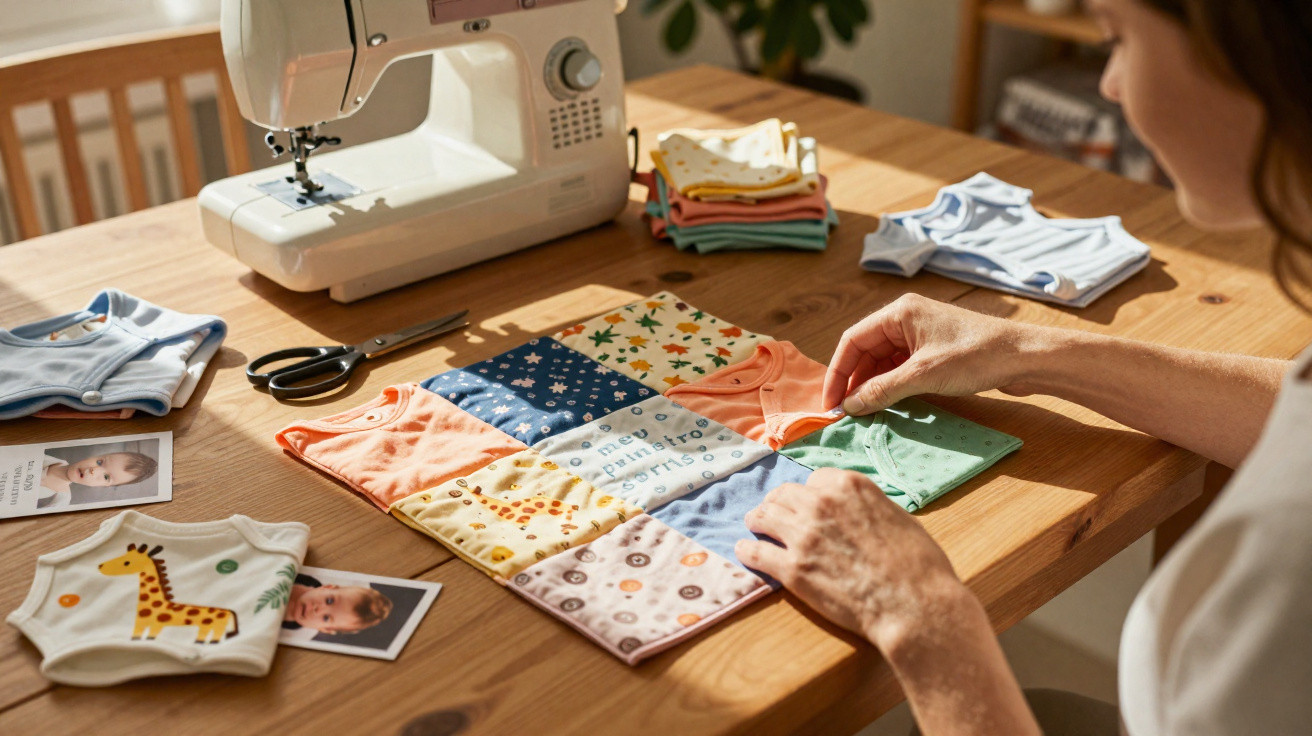
Tiny babygrows are piling up in boxes in the cellar – far too precious to throw away, yet out of sight in everyday life.
Almost every family has boxes filled with baby bodysuits, tiny pyjamas and first miniature outfits. They are kept because they hold so many memories, then tucked away in a wardrobe. One simple sewing project can bring those moments back into the living room, turning them into a piece of family history that is picked up and touched every day.
From a dusty box to a keepsake blanket
During the first year, a baby can easily go through five to seven bodysuits a day. Stains, spit-up and growth spurts soon create a mounting pile of washing. Many parents save the loveliest pieces: the outfit worn home from hospital, the bodysuit from a first Christmas or a gift from a favourite aunt.
These garments may be priceless emotionally, but they have little resale value. That is where the idea of sewing them into a keepsake blanket comes in: a large patchwork made up of countless small moments.
Forgotten bodysuits become a textile photo album that sits on the sofa rather than gathering dust in the cellar.
Rather than storing three boxes in the loft, you create one useful item: a blanket for the living room, nursery or parents' bed. Anyone who picks it up automatically “turns the pages” of that first year, one square at a time.
Memory blanket: how the idea works
The principle is straightforward: cut equal-sized pieces from old baby bodysuits, babygrows and favourite T-shirts, then sew them into a patchwork. The result is a “memory blanket” that works like a fabric photo album:
- Each square represents a particular moment or stage.
- Prints, patterns and motifs tell their own little stories.
- The blanket stays visible in daily life and is handled regularly.
Many families keep the blanket beside a traditional photo album or baby book. Photographs tend to capture what those moments looked like, whereas the blanket brings back sensory memories: the feel of soft jersey, a favourite colour or the familiar print from the “goodnight bodysuit”.
Children especially enjoy it when parents briefly talk through each fabric patch on the sofa or in bed at night: “This is what you were wearing when you ate your first purée,” or “You wore this on the first day of your first holiday.”
The challenge of jersey fabric – and how to solve it
Although the idea is full of emotion, it does involve one small technical difficulty: most baby bodysuits are made from jersey. This knitted, rather than woven, fabric is highly stretchy. It can slip and pull under the sewing machine, distorting the squares and causing seams to pucker.
Without stabilising the fabric, you risk ending up with a blanket that warps at every corner.
The answer is iron-on interfacing applied to the reverse of the fabric. It turns stretchy jersey into a reasonably stable material that is much easier to sew. In brief, the process is as follows:
- Wash every chosen garment and allow it to dry thoroughly.
- Reinforce the reverse of each piece with fusible interfacing.
- Cut the squares only afterwards.
- Sew the squares together, then add a backing panel.
Skipping this stage often leads to crooked corners and misshapen seams later on. With interfacing, the blanket holds its shape, the edges stay neat and the finished result looks considerably more polished.
How many garments you need for a standard blanket
For a typical sofa or nursery size, around 25 to 30 garments are enough. They can be cut into squares measuring roughly 15 x 15 cm. The finished blanket size depends on both the number of pieces and the square size you choose.
A tried-and-tested approach for beginners:
- Choose 25–30 favourite garments, such as bodysuits, pyjamas, tiny trousers and T-shirts.
- Make a 15 x 15 cm paper template.
- Position the template so that central motifs, slogans or patterns sit inside the square.
- Cut every square with approximately 1 cm of seam allowance.
Soft fleece or minky fabric works well for the backing. It makes the blanket cosy while concealing the seams. If you wish, add a thin layer of wadding between the layers to make it warmer and slightly thicker.
Small details that make a big difference
One appealing detail is that bodysuit popper strips do not need to go in the bin. They can be removed and attached to the blanket, for example so it can be fastened to a cot rail or pushchair. This helps the throw stay in place and gives it a practical purpose alongside its role as a keepsake.
Sew it yourself or have it made?
For many parents, the main question is whether to sit down at the sewing machine themselves or commission a professional studio. Both options come with clear benefits and drawbacks.
| Option | Benefits | Challenges |
|---|---|---|
| Sew it yourself | Highly personal, more affordable, and offers an intensive connection with every item | Requires time, a sewing machine, basic skills and uninterrupted hours |
| Have it made | Professional finish, less stress, and freedom over size and design | Higher cost and a waiting period of several weeks |
Many specialist studios work to set sizes, such as 75 x 75 cm for smaller blankets or 135 x 180 cm for large family throws. Depending on the format, they may require anything from around 20 to 120 garments. In most cases, items must be sent in freshly washed and completely dry.
The waiting time is often between four and twelve weeks. For some parents, that is an advantage: anticipation builds, making the completed blanket feel like a gift in its own right – for a second birthday, the start of nursery or as a surprise for grandparents.
Why children often keep these blankets for years
A memory blanket does not stop being meaningful once the baby years are over. Many children later use it as a cuddly blanket in their bedroom, while listening to stories, when travelling or during sleepovers. Toys may come and go, but this blanket often remains in use for a long time because it carries so many stories.
Every small mark and faded print speaks more of a life that has been lived than of wear and tear.
For parents, bringing out the blanket at important transitions can also become an emotional ritual: on a first day at nursery, when moving into a new bedroom or when a sibling is born. At those times, it helps make the older child's own baby days visible again.
Practical tips for planning and choosing garments
Anyone still in the middle of everyday life with a baby can already consider which pieces might eventually go into a blanket. A few ideas:
- Pick motifs that genuinely trigger memories, rather than simply looking “pretty”.
- Combine different colours and patterns to give the blanket a lively appearance.
- Include a few plain or neutral items to calm the overall look.
- Use heavily stained garments only when they are truly important emotionally.
If you are unsure, start by collecting more pieces than you will ultimately need, then sort them by instinct. It is often only when they are arranged on the floor that you see which combination feels moving and which feels more arbitrary.
How emotional value and sustainability come together
Alongside its role as a keepsake, this idea has a clear sustainability benefit. Baby clothes are often worn for only a few weeks before they are too small. Rather than giving every item away or disposing of it, at least some can remain usefully within the household. It saves resources and reduces the feeling that you need to “hold on to” memories by keeping everything.
It also creates a new family ritual: regularly talking about a child's earliest days can strengthen many children's sense of belonging. They can literally see that someone made an effort to preserve those first months of life not only in photographs, but in fabric too.
Those who want to take the idea further can expand it later on. Nursery T-shirts, first football shirts or concert T-shirts from the teenage years can be sewn into similar blankets. In this way, an overlooked pile of clothes becomes a complete, evolving fabric archive of family life – and perhaps the very blanket that is still lying on the sofa in 20 years' time, long after its former wearer has moved out.

Comments
No comments yet. Be the first to comment!
Leave a Comment