
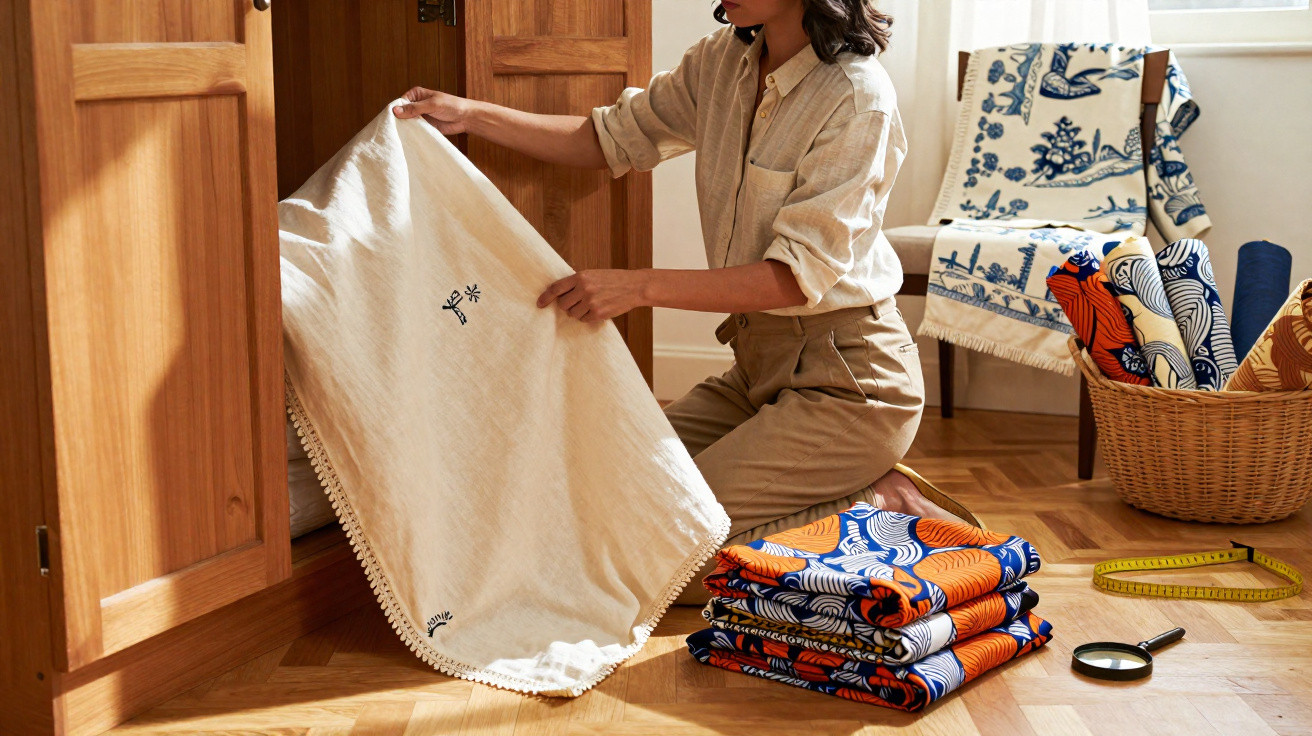
In countless cupboards, old bed sheets and curtains lie unused and long written off – yet some of them are hidden money-makers.
Anyone who simply sighs and puts Grandma’s old linen chests in the cellar may be overlooking a small fortune. The market for historic textiles is growing rapidly, fuelled by collectors and fashion designers seeking qualities that modern industry can scarcely provide. Three types of fabric stand out in particular – and surprisingly often, they are already somewhere in the home.
Why old fabrics are suddenly in demand
Trade in second-hand textiles has become far more professional in recent years. Alongside affordable everyday clothing, attention is increasingly turning to distinctive materials from earlier decades. Fabrics woven before around 1960, in particular, can command high prices.
“On specialist platforms, historic natural-fibre fabrics sell for €50 to €150 per metre – and this is no longer unusual.”
There are sound reasons behind these figures. Specialist institutes point out that the quality of many natural fibres from before mass production is difficult to replicate. At the time, weavers relied on:
- a high thread count, giving the fabric more weight in the hand;
- long-staple linen or cotton with a durable structure;
- traditional dyes, such as madder for red and natural indigo for blue.
Together, these properties create rich colours that do not fade into dullness over the decades, as well as a patinated surface rarely found in modern production. Anyone making high-quality summer dresses, kimonos, cushion covers or characterful curtains today therefore deliberately looks for old stock.
Your first wardrobe check: how to proceed
Before taking anything to a dealer, it is worth taking a methodical look around your own home. Many valuable pieces are tucked away among yellowed fitted sheets or inside forgotten moving boxes.
Which textiles may be worth checking
Bring out anything that appears old or has come down through the family:
- trousseau linens, including large, heavy sheets and duvet covers;
- old tablecloths and fabric napkins;
- curtains and net curtains made from heavier fabrics;
- uncut fabric lengths that were never used.
Your first impression when handling the material matters. Good-quality older fabrics tend to feel dense, cool and “heavy for their size”. Linen and hemp, especially, retain a slightly fresh feel even in summer. Thin, stiff or plastic-like materials are more likely to be newer synthetic goods.
How to identify an interesting quality
Hold the fabric up to the light and inspect its structure. A tightly woven surface without large gaps is a sign of quality. Turn the piece over and examine the reverse of any pattern: if the print remains clearly defined and sharp on the back, it often indicates a more elaborate manufacturing process.
Many collectors and professionals use a simple burn test to tell natural fibres from synthetics. A single thread is enough:
- If the thread burns quickly, smells like burnt paper and leaves fine grey ash, it is usually cotton or linen.
- If the material melts, crackles and forms a hard black bead, it contains synthetic fibre.
This test should always be carried out carefully and outdoors only, ideally on a fireproof surface with water close at hand.
The three leading favourites: where the highest returns are found
Among the many possible discoveries, three fabric categories currently stand out in the market. Anyone with these at home could be in for a substantial windfall.
Heavy linen sheets from trousseau chests
The very large linen sheets once commonly used often date from the late 19th or early 20th century. They can be recognised by:
- embroidered monograms or initials;
- a noticeable weight, often well over 800 grams per sheet;
- a cool, textured feel against the skin.
Designers and bespoke tailors turn these sheets into summer trousers, oversized blouses and minimalist home furnishings. The fabric is hard-wearing, breathable and ages attractively. Well-preserved sets of linen can quickly fetch several hundred euros from collectors and upholsterers.
Historic toile prints in country-house style
Another fabric group prized by collectors consists of large-scale, single-colour pictorial prints on a natural-coloured background. Typical motifs include rural scenes, romantic figures, small châteaux or cottage gardens, usually in red, blue or violet. Such fabrics can be identified by image motifs that appear almost as clearly on the reverse as on the front. This strongly suggests an old, labour-intensive printing method using metal rollers.
Decorators use these intricate patterns for wall coverings, headboard upholstery, cushions and even entire sofas. Continuous lengths in good condition achieve especially high prices because they can be used for interior design projects.
Bright wax prints from the 1970s and 1980s
The third star of this booming sector is the intensely coloured wax-print fabric of the 1970s and 1980s, known for its large-scale graphic patterns. Typical features include:
- exceptionally vivid colours that remain strong even after decades;
- a crisp handle with a slight “waxy” feel;
- manufacturer details and, in some cases, the year printed along the selvedge.
Labels such as Vlisco are particularly sought after in this category. Untouched, complete fabric lengths are considerably more valuable than remnants that have already been cut, as fashion designers may be planning entire dresses or jackets from them.
Pricing factors: what collectors and designers actually pay
Although valuing historic fabrics may initially seem arbitrary, it is based on clear criteria. The most important factors are:
- Condition: Stains, holes, thinning or severe yellowing significantly reduce value.
- Rarity of the design: Unusual scenes, signed prints or rare colourways command more.
- Amount available: Larger, continuous pieces are more useful for professional projects.
- Popularity among creatives: Fabrics that suit current trends are easier to sell.
In ideal circumstances, authentic fabrics fall within the €50 to €150 per metre range. Heavy linen in complete sets – several matching sheets of consistent quality – is particularly sought after by upholsterers, studios and workshops.
“Anyone able to assess the value of their wardrobe finds realistically can negotiate with greater confidence – and will not give away their potential.”
Where selling is worthwhile – and when to wait
Anyone who has found something interesting has several routes to market. Online platforms exist that focus on high-quality vintage textiles. They allow listings to be filtered by fibre type, period, pattern and dimensions, helping attract the right buyers directly.
Other possible channels include:
- online auctions focused on design and crafts;
- flea markets and antiques markets specialising in fashion or fabrics;
- approaching fashion professionals, interior designers or upholstery workshops directly.
Those not under pressure to sell can make use of seasonal demand. Before the summer season, for example, breathable linen fabrics have a better chance of selling. Shortly before autumn, designers are more likely to seek bold wax-print textiles for jackets and coats.
Preparing historic fabrics: a little care can raise the price considerably
Before listing a fabric online or laying it out at a market, some detailed preparation is worthwhile. Tightly woven linen can often tolerate a hot wash to remove yellowing. Many knowledgeable sellers use washing powder with percarbonate-based oxygen bleach, which brightens yellowed fibres without attacking them too harshly.
Prospective buyers need as much information as possible in a meaningful listing. It is advisable to provide:
- photographs of both front and back;
- close-up images of the selvedge, monograms and labels;
- exact width and length in centimetres;
- details of any flaws;
- confirmation of whether a burn test has been carried out and its result.
Patterned fabrics such as historic toile prints or wax prints should not be cut up hastily. Collectors look for complete scenes, continuous repeat sequences and selvedges that are as intact as possible. An undamaged repeat can achieve higher prices than several small pieces with motifs cut off.
What non-specialists often miss – and how to avoid mistakes
Many owners underestimate older textiles because they focus only on stains or loss of colour. Professionals, however, place greater importance on other qualities: dense weaving, authentic dyes, a convincing patina and the most original condition possible. A small, neatly darned tear is often less serious than aggressive treatment with bleaching agents.
Anyone who is unsure should not give everything away immediately, but instead show individual photographs in specialist forums or to specialist dealers. This can provide an initial assessment and reduces the risk of handing a rare piece to the first interested person for only a few euros.
Conversely, disappointment is likely when synthetic fabrics or decorative materials from the 1990s are wrongly assumed to be treasures. Typical warning signs are an almost plastic-like handle, colours that have aged poorly, and shiny, smooth threads within the weave. In these cases, the effort is usually not worthwhile – the fabric is more suitable for craft projects than as an investment.
A careful look through the home quickly develops into an eye for genuine quality. And sometimes, between a yellowed sheet and an old curtain, there is not just dust but a fabric for which collectors are willing to pay handsomely.



Comments
No comments yet. Be the first to comment!
Leave a Comment