
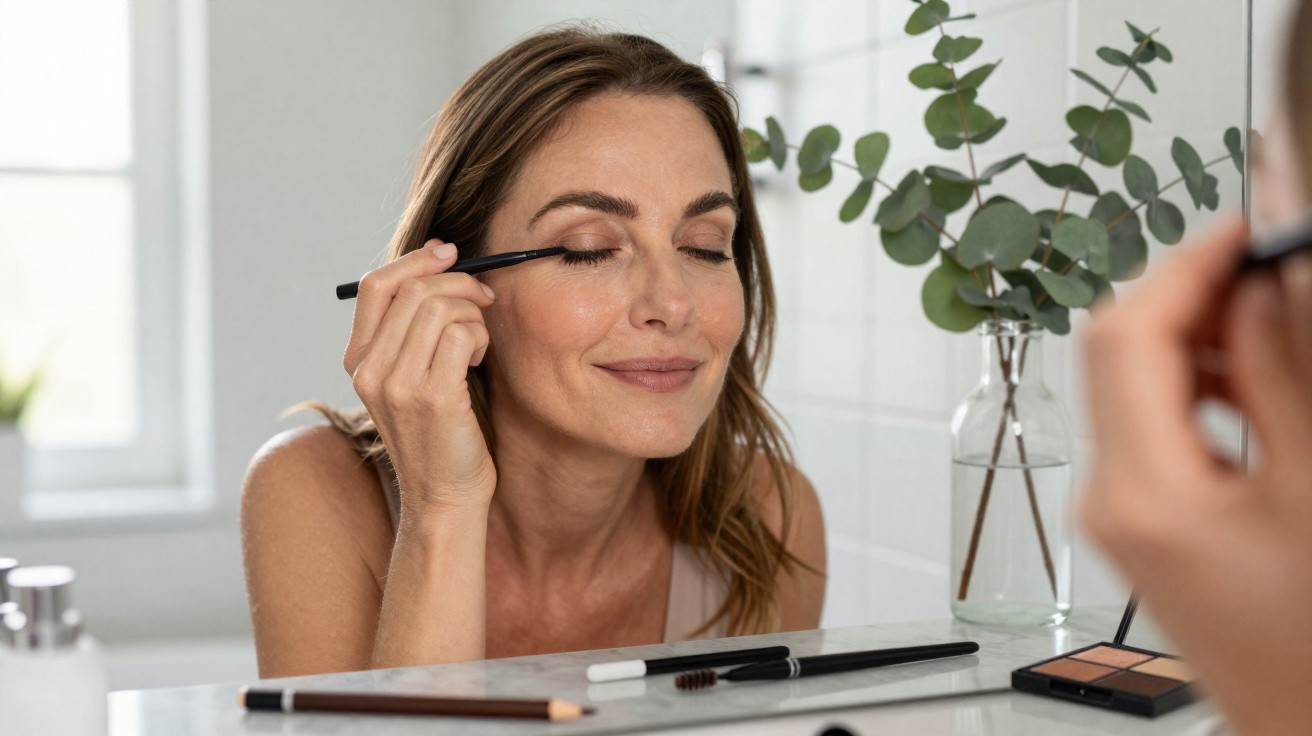
Many people first notice it in photographs or while applying make-up: the upper lids appear heavy, eyeliner disappears into the crease, and eyeshadow settles into fine lines. Yet surgery is not immediately necessary. A few targeted make-up techniques can create a visual lifting effect for the eyes – often far more noticeably than many expect.
Why drooping eyelids are so common after 50
As we age, skin becomes thinner and loses elasticity, while collagen and fatty tissue diminish. This is especially noticeable around the eyes, where the skin is exceptionally delicate. As a result, the mobile lid becomes partly or almost entirely covered by the fixed upper lid.
Anyone affected will recognise the usual make-up difficulties:
- Eyeliner vanishes into the shadow of the crease or looks “broken”.
- Mascara transfers onto the upper lid.
- Eyeshadow gathers in fine lines.
- The eye looks smaller and more tired than it once did.
“With the right technique, a drooping eyelid can be visually lifted without using more product – just using it more intelligently.”
Eyeliner trick 1: Do not pull the skin tight to keep the line straight
Many people's first instinct is to lift the skin with their fingers, smooth the lid and then apply eyeliner. However, this backfires as soon as the skin is released. It returns to its natural position, leaving the line looking distorted or uneven.
Make-up artists therefore recommend one simple but crucial approach:
- Keep the eye in its natural position; do not pull or stretch it.
- First set the lid with a light powder to soften the appearance of fine lines slightly.
- Apply eyeliner in short strokes rather than attempting one long sweep.
This allows the line to follow the true shape of the lid and remain intact when blinking.
Eyeliner trick 2: The invisible extension beneath the crease
A classic wing at the outer corner of the eye often does not work for drooping eyelids. Its tip can end directly in the crease, bend awkwardly and make the eye appear even more tired.
One professional tip may sound unusual, but it has a striking effect:
- Look straight into the mirror and keep the eye naturally open.
- Place a small dot at the outer corner of the eye, slightly below the crease, where the skin is still smooth.
- Draw a short line from that point back towards the lash line.
The tip of the eyeliner is deliberately positioned beneath the crease. Although the wing appears shorter, it creates the illusion of an eye that is subtly lifted upwards. Attention is drawn away from the drooping area towards the diagonally tapered line.
“With mature skin, the perfect eyeliner tip is rarely where it sat in younger years – accepting that automatically makes make-up look better.”
Eyeliner trick 3: Define the lash line instead of drawing a thick band
A wide, dark eyeliner line can quickly look overpowering on drooping eyelids and make the eye seem even smaller. It is much more flattering to concentrate on the lash line instead.
A practical method:
- Press a fine kohl pencil or gel eyeliner directly between the lashes.
- Extend the line only slightly beyond the lashes rather than drawing a large curve.
- Make the line finer towards the centre of the lid so the eyes appear more open.
If desired, carefully line the upper waterline as well. This makes the lashes look fuller without a clearly visible eyeliner line. The result is a more defined gaze, without a heavy strip across the lid.
Trick 4: Style brows correctly – the subtle lifting booster
When dealing with drooping eyelids, many people focus entirely on eyeshadow and eyeliner. Professionals, however, stress that eyebrows make a major contribution to the visual “lifting effect”.
“Well-shaped brows can do more for a fresh-looking gaze than any eyeshadow.”
Create more space beneath the brow
Rather than making brows extremely dense, shape matters most for mature skin. The aim is to leave as much “space” as possible between the brow and the mobile lid.
A fine brow pencil or highly precise powder works well for this:
- Brush the brows down first to reveal the upper outline clearly.
- Gently fill only gaps along the top; do not create a wide, block-like brow.
- Then brush the hairs back upwards to check the lower edge.
- Fill beneath the brow only where there are genuine gaps, rather than colouring in the whole area.
This creates a clearly defined but not overly heavy brow that visually lifts rather than weighs down the eye area.
Choosing colour: too dark looks harsh, too light can look patchy
For a soft, rejuvenating result, many make-up artists choose shades that are no more than one tone darker than the natural hair colour. Particularly with grey or coloured hair, an ashy shade that is not overly warm can make a remarkable difference. Solid black brows can quickly make the face appear harsher.
Eyeshadow for drooping eyelids: softly sculpt rather than cover with colour
Alongside eyeliner and brows, eyeshadow can also visually reshape drooping eyelids – almost like a little contouring technique for the eye.
| Area | Recommended products | Effect |
|---|---|---|
| Mobile lid | Light, softly satin-finish shades | Opens up the gaze and makes the eye appear larger |
| Slightly above the natural crease | Matte, mid-toned brown or taupe shades | Creates a new visual “shadow crease” |
| Outer corner of the eye | A slightly darker matte shade | Gently lifts the eye outwards |
The key point is not to work in the real crease, which is concealed by the drooping lid, but just above it. This makes the crease seem higher – a small technique with a major impact.
Common mistakes that make the eyes look older
Certain habits are particularly unflattering on mature skin:
- Highly shimmery or glittery shades directly in the crease, as they emphasise every uneven area.
- Thick kohl along the lower lash line, which visually pulls the eye downwards.
- Too much concealer on the upper lid, which settles into fine lines and smudges eyeliner.
- Very long lashes brushed downwards, which make the gaze look heavier.
Instead, choose lashes that sweep slightly outwards and upwards, with emphasis mainly on the outer third of the eye to support the lifting effect.
When it is worth seeking medical advice
Make-up can achieve a great deal, but not everything. If the upper lid presses heavily over the eye, or headaches or visual disturbances occur, there may be more involved than age-related skin laxity alone. In these cases, an ophthalmologist should assess whether there are medical causes and whether eyelid surgery could be medically appropriate.
For the vast majority, though, the issue is mainly about appearance and feeling good. Many people find that even small adjustments to their daily make-up routine are enough to see a noticeably more “awake” version of themselves in the mirror.
Less product, more technique: why routine matters more than new palettes
Especially after 50, it becomes clear that the quantity of products is not what matters, but how they are used. Rather than constantly buying new eyeshadow palettes, it is worth adapting your technique.
“Anyone who truly understands their eye shape often needs only three or four products – and a little patience while practising.”
A realistic approach is to set aside a weekend, test different options in bathroom lighting, take photographs on your phone and compare which line placement opens up the eyes most effectively. This is how you develop a personal “lifting routine” that takes only a few minutes each morning.




Comments
No comments yet. Be the first to comment!
Leave a Comment