
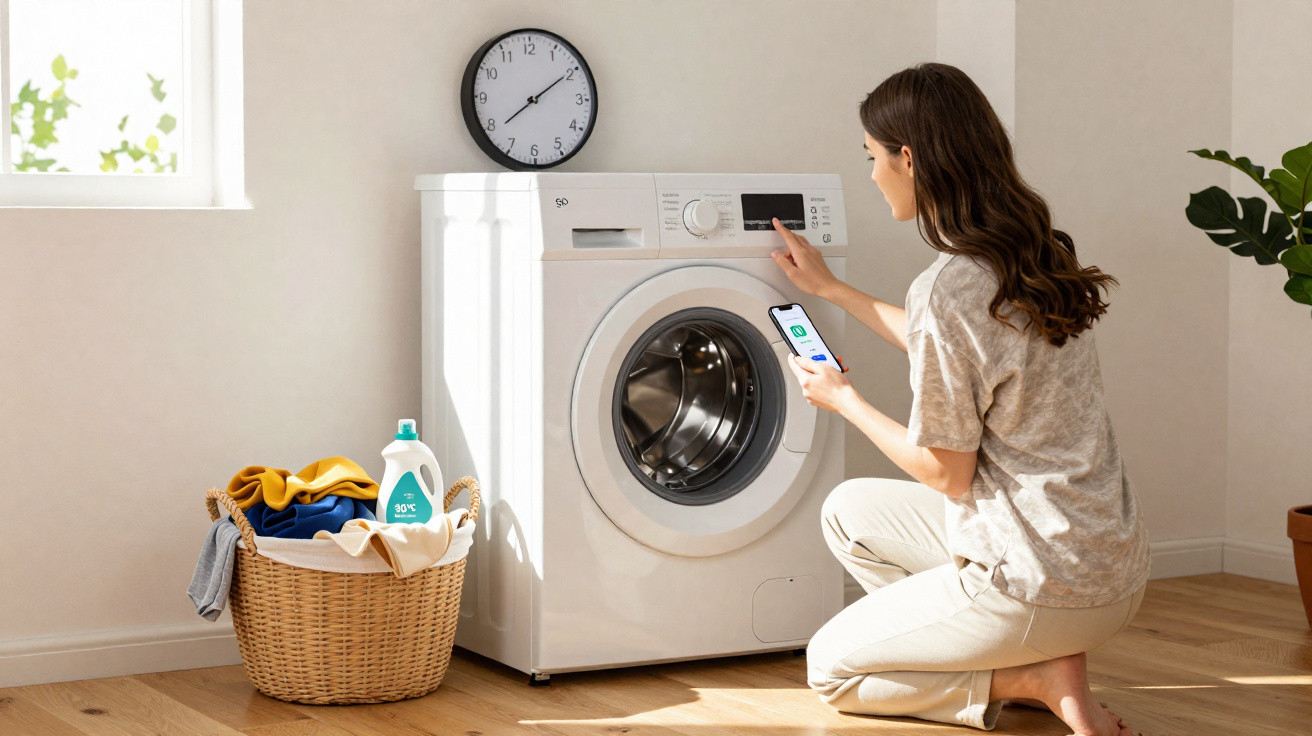
Many households underestimate how much the timing of a wash can affect their electricity bill. Planning when to use your washing machine can save money month after month while also easing pressure on the electricity grid. There is no need to live in darkness or wash everything at 30°C: it is largely a matter of timing and a few straightforward settings.
Why the time you do your washing suddenly matters
Electricity does not cost the same at every hour of the day. With many tariffs, prices vary according to demand on the grid. During the evening, German households often run numerous appliances at once: the cooker, television, lighting, dishwasher and, of course, the washing machine.
“Electricity consumption is at its highest between late afternoon and late evening – so washing at this time often costs the most.”
The reason is that suppliers must provide particularly high capacity during these periods. That is expensive and puts strain on the grid. Ultimately, those additional costs appear on your bill, either directly through higher unit rates or indirectly through rising standing charges.
When it is best not to switch on the washing machine
For most households, the most critical period is early evening. Grid operators and tariff structures show a similar pattern:
- highest demand: broadly from 18:00 to 22:00
- the usual after-work period: cooking, lighting and entertainment devices are used at the same time
- during the heating season, heat pumps or electric heaters are often added to the load
Starting the washing machine at these times means using power when demand is especially high. Electricity is not only often more expensive then; its environmental impact also rises because conventional power stations are more likely to be required to cover peak demand.
In practice, avoid running washes during these key evening hours where possible. Families who wash every day in particular can notice the saving clearly after a few months.
The best times to wash cheaply
Conditions are far easier during lower-demand hours. Many contracts with time-based pricing offer reduced rates at these times.
“Electricity is often cheapest when most people are asleep – during the night and very early morning.”
Typical low-cost periods during the day
Check your supplier’s customer portal or app, as the most worthwhile times depend on the provider and tariff. The following windows are often particularly attractive:
- late evening: from around 22:00
- overnight: roughly 23:00 to 05:00
- early morning: broadly until 06:00
With time-variable tariffs, such as those using a smart meter or dedicated off-peak electricity plans, the difference per kilowatt-hour can be noticeable. Running the washing machine then rather than during the costly evening window can add up to tens or even hundreds of euros over a year.
How to use cheaper times without getting up at night
Nobody wants to set an alarm simply to press “Start” at 02:00. Modern appliances can handle that for you.
- Use the delay-start function: Load the machine in the evening and set it to begin overnight or early in the morning.
- Use a timer plug for older appliances: Older models without a delayed-start feature can often be controlled with a switched timer socket.
- Consider noise levels: In homes with poor sound insulation, choose the early morning instead to avoid risking problems with neighbours.
This matters because blocks of flats may have their own quiet-hours rules. Washing machines in bathrooms or small flats can be clearly audible. In that case, opt for a quieter Eco programme or wash at the edges of the day that still fall outside the costly peak period, such as late morning or the afternoon.
Eco programme: longer washes, lower costs
Almost every modern washing machine has an energy-saving mode or Eco programme. Many people overlook it, or distrust it because it takes longer to complete. Even so, it can reduce costs significantly.
“Eco mode usually saves more energy even though the programme takes longer – the key is the lower temperature.”
Why Eco mode genuinely saves energy
Most of the electricity used in a wash cycle goes towards heating the water. Washing at a lower temperature dramatically reduces energy use. The machine compensates with a longer cycle, but this consumes far less electricity than heating water to a higher temperature.
Typical benefits of the Eco programme include:
- usually washing at 30°C or 40°C rather than 60°C
- substantially lower electricity use for each wash cycle
- gentler treatment of fabrics, helping clothes retain their shape for longer
It is entirely sufficient for everyday clothes that are normally soiled. Truly hot washes are only needed for heavily soiled laundry or specific hygiene requirements, such as illness or baby clothes – and even then, not for every load.
Further ways to reduce washing machine energy use
The time of day is only one factor. Using your washing machine efficiently overall can bring even greater savings.
Choose the right load size and temperature
A quick look inside the drum can help reduce your electricity costs:
- Fill it well: An almost empty drum uses nearly as much electricity as one that is properly loaded. Do not pack it so tightly that nothing can circulate, however.
- Use a lower temperature: Choosing 30°C instead of 40°C, or 40°C instead of 60°C, has a direct impact on consumption.
- Sort laundry beforehand: Wash heavily soiled items separately so that you do not have to clean everything at unnecessarily high temperatures.
Regular maintenance also saves energy
A poorly maintained washing machine needs more resources to operate. Deposits, blocked filters and limescale on heating elements all reduce efficiency.
- Clean the lint filter so water can circulate freely.
- Wipe the door seal to prevent mould and unpleasant odours.
- Every so often, run an empty 60°C cycle with washing machine cleaner or a little vinegar essence to prevent biofilm from developing.
A clean appliance not only washes better; it also operates more closely to the consumption figures stated by its manufacturer.
How much can you realistically save?
A washing machine accounts for a low single-digit percentage of total household electricity use, but this should not be ignored – especially in families or shared homes that run many wash cycles.
| Adjustment | Possible effect per year |
|---|---|
| Using cheaper time windows | depending on the tariff, several tens of euros less in electricity costs |
| Using Eco programmes consistently | substantially lower energy use per wash cycle |
| Optimum load size | fewer wash cycles and lower overall consumption |
The major benefit is that these savings happen in the background. Once you have adjusted your habits, the lower costs continue automatically.
What applies to special tariffs and smart meters
The time you wash becomes even more important with smart meters and dynamic electricity prices. Some suppliers link their prices directly to wholesale markets. With these arrangements, it is worth checking the app before planning your next wash cycle.
Typical approaches with these tariffs include:
- using the washing machine and tumble dryer where possible during hours with low wholesale prices
- postponing washing to another day during very expensive periods, such as winter evenings
- using smart-home systems to start appliances automatically when the price drops below a set threshold
Anyone who also has a solar photovoltaic system often moves washes to sunny midday hours. The washing machine can then run partly on self-generated solar power. In this situation, the public tariff matters less than using as much of your own generated electricity as possible – switch on the washing machine when the roof is producing plenty of power.
More convenience through simple routines
Fixed routines can make this practical in everyday life. For example, do larger loads on the same day each week, load the machine in the evening and set its start time for overnight or an early-morning programme. This keeps the mental load down while ensuring you automatically use better electricity periods.
Anyone who takes a conscious look at their washing habits often finds that small changes do more than reduce the electricity bill. Clothes last longer, the bathroom is less often filled with laundry baskets, and the satisfaction of helping to ease pressure on the grid comes at no extra cost.






Comments
No comments yet. Be the first to comment!
Leave a Comment