
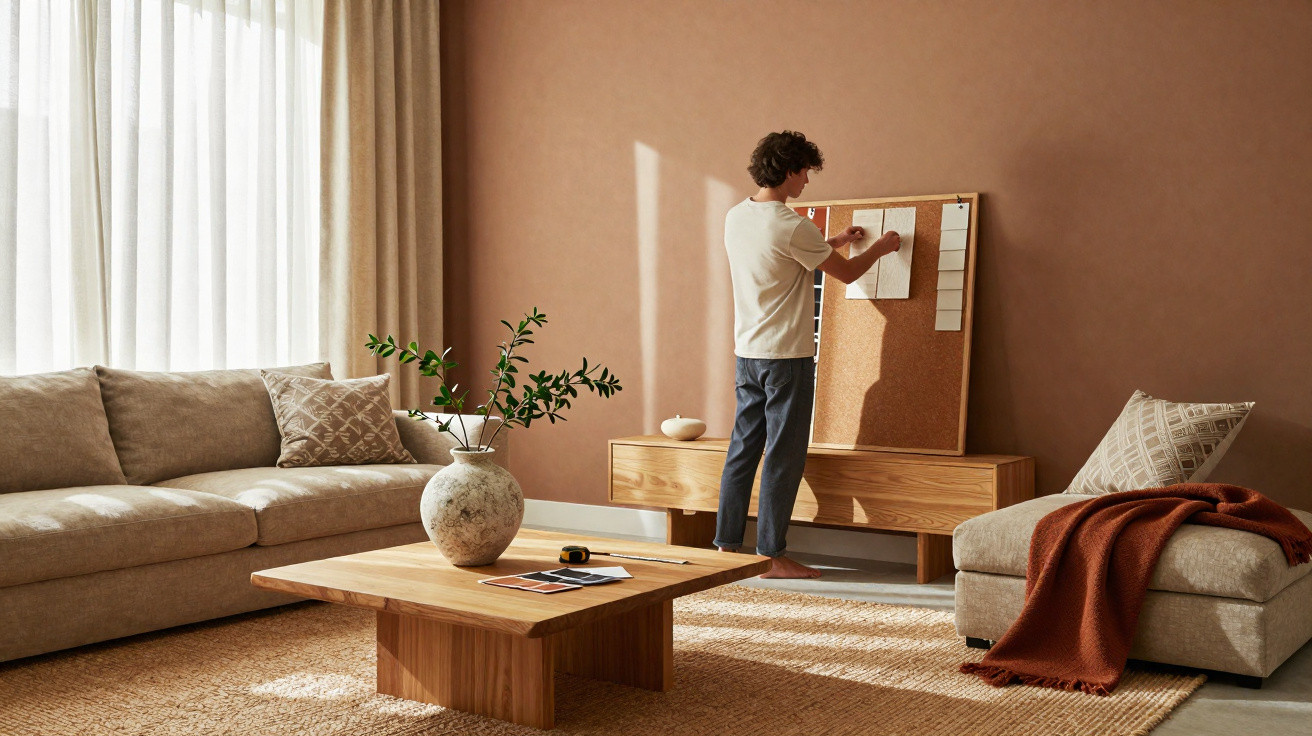
Cosy? Certainly. Calm and balanced? Not entirely.
Throughout Europe and the US, households are discreetly reconsidering their interiors for 2026, turning away from disposable styles and instant updates. The emerging feeling is more unhurried, warmer and much more deliberate, shaped by several major trends that decorators believe will endure for more than a single season.
The new organic minimalism: calm without the cold
Minimalism is not disappearing, although its character is evolving. The stark, gallery-white aesthetic is being replaced by what designers describe as “organic minimalism” – a similarly edited look, but one that feels gentler and more human.
Clean lines stay, but curves, tactility and comfort now matter just as much as empty space.
Picture bean-shaped sofas rather than boxy sectionals, oval or pebble-shaped coffee tables in place of sharp-edged rectangles, and irregular mirrors instead of flawless circles or squares. The intention is to ease a room’s geometry, making it feel less like a display flat and more like somewhere to relax.
This approach also reflects a particular way of thinking: own fewer things, but make them more meaningful. Rather than putting everything you possess on show, the emphasis is on retaining what you use or genuinely adore. It reduces visual clutter while making day-to-day upkeep far simpler.
How to try organic minimalism over one weekend
- Empty one shelving unit, then return only 5–7 objects that genuinely matter to you.
- Replace one angular item – such as a side table, lamp or chair – with a piece that has a curved outline.
- Keep one section of wall entirely empty and notice how much more peaceful the room feels.
A complete renovation is unnecessary. One curved lamp, rounded rug or sculptural vase alone can move a room’s overall mood towards this trend.
Raw, honest materials: wood, stone and linen take over
As forms become softer, 2026 is also placing strong emphasis on the materials used in furniture. Plastics and visibly synthetic surfaces are disappearing from high-end mood boards, with materials that wear openly and naturally taking their place.
Homes are moving from “perfect and new” to “lived in and lasting”, with materials that show time instead of hiding it.
Solid timber – particularly oak, ash and walnut – is once again sought after, whether bought new or second-hand. Natural stone, from limestone through to slate, is featuring beyond kitchens, appearing in side tables, lamp bases and even small trays. Linen, cotton and wool are taking the place of polyester-heavy fabrics for sofas, curtains and bedding.
The appeal is not purely visual. Such materials can frequently be repaired, refinished or resold. They also suit a more restrained, slower approach to consumption: purchase fewer items, pay a little more, and hold on to them for longer.
Warm earthy colours replace cool grey
Colour schemes are changing to complement these unprocessed materials. Cool greys and icy whites, dominant for the past decade, are giving way to sun-warmed tones drawn from clay and earth.
| Old staple | 2026 alternative | Effect in a room |
|---|---|---|
| Cool grey walls | Soft clay or terracotta | Feels warmer and more intimate |
| Bright white textiles | Warm beige or sand | Adds depth without feeling dark |
| Black accents | Dark chocolate or rust | Still graphic, but less harsh |
These shades are especially effective in north-facing rooms and spaces used chiefly after dark, where cool neutrals may appear flat or cold under artificial lighting.
Goodbye visual overload: maximalism loses ground
For much of the 2020s, social media celebrated rooms overflowing with art, plants and personality. By 2026, however, the people living in these spaces every day are increasingly finding them overstimulating.
The new luxury is mental space: walls that are not shouting at you and shelves that are not collapsing under trinkets.
Designers say more clients are requesting “fewer things, bigger impact”. In practice, that means one large artwork rather than a gallery wall, a single statement lamp instead of eight small ones, and fewer yet larger plants. The purpose is to introduce breathing space both visually and psychologically.
Patterns on mute, textures on high
As maximalism recedes, dense geometric and retro prints are also moving into the background. Zigzags, busy chevrons and bold mid-century wallpaper are beginning to seem agitating rather than cheerful.
Decorators are choosing plain colours and tactile, substantial surfaces instead: bouclé, weighty linen, raw silk, wool and clay. One terracotta cushion in a nubby weave contributes more to a restful room than five patterned cushions competing for notice.
- Intricate geometric wallpaper is making way for limewash, plaster finishes and matte paint.
- Neon details are being exchanged for rust, ochre and deep olive.
- Assortments of miniature trinkets are being reduced to one or two larger, more substantial objects.
Seven 2026 decor trends that are built to last
Across current forecasts, seven distinct and lasting directions emerge. Each can be introduced gradually and combined with the others.
- Organic minimalism – reduced clutter, increased curves, and comfort prioritised over show-home perfection.
- Natural materials – wood, stone, ceramic, linen and wool taking over from glossy plastics and thin laminates.
- Earth-tone palettes – terracotta, clay, rust, sand and ochre becoming the new neutrals.
- Statement, not saturation – one or two impactful pieces in each room instead of numerous small decorative objects.
- Soft lighting layers – table lamps, floor lamps and wall lights replacing one harsh set of ceiling spots.
- Second-hand and vintage – blending pre-loved finds with new pieces to add character and sustainability.
- “Slow decor” mindset – decorating in phases and selecting pieces with a five- to ten-year lifespan in mind.
Trends with staying power tend to be grounded in comfort, practicality and materials that age well, not in gimmicks.
Practical examples for a small budget
For renters and anyone working with limited funds, the 2026 change is genuinely encouraging. Many of these updates depend more on editing what you have than on buying more.
A standard one-bedroom flat can look more up to date with only a handful of steps:
- Put half of your decorative objects into bags and store them; rotate them by season instead of showing everything at once.
- Add one large jute or wool rug in a warm neutral shade instead of several smaller rugs.
- Pick terracotta or sand-coloured cushion covers, along with a textured throw, for the sofa.
- Bring in a second-hand wooden sideboard or coffee table to replace a flimsy item.
- Change a bright white lampshade for an off-white or beige linen shade to create gentler light.
These changes root your home in the new aesthetic without extensive renovation, while each one also supports later resale or reuse.
What “slow decor” really means for your home
The term “slow decor” will be heard more regularly this year. Borrowed from the “slow fashion” movement, it means making purchases more carefully and over a longer timescale.
Rather than redoing a whole room annually, you may spread essential purchases over three to five years. Begin with the fundamentals – a solid sofa, a good table and decent lighting – before introducing decorative layers.
Slow decor is less about perfection and more about letting your home evolve with you, not with the algorithm.
This method limits impulse purchases and fatigue with trends. It also usually creates spaces with greater personal character, as items are added over time and selected for genuine needs or memories rather than photographs alone.
Risks and smart combinations to think about
Warm earth tones and natural materials carry one potential risk: using too much can result in a featureless beige room. Contrast is the answer. Combine clay walls with dark timber, for example, or use a black metal lamp or deep green cushion to define the setting.
Over-decluttering presents another problem. Even when furnished beautifully, completely empty rooms may feel sterile. A pile of books, a basket of blankets or a visible ceramic collection preserves personality without tipping the room back into disorder.
For the most convincing, future-proof outcome, trend-watchers recommend bringing together three ingredients: organic forms, earthy colours and unashamedly practical items. When a new piece looks appealing, feels pleasant to touch and has an obvious purpose, it is much more likely to remain in your home for longer than one season.
Comments
No comments yet. Be the first to comment!
Leave a Comment