
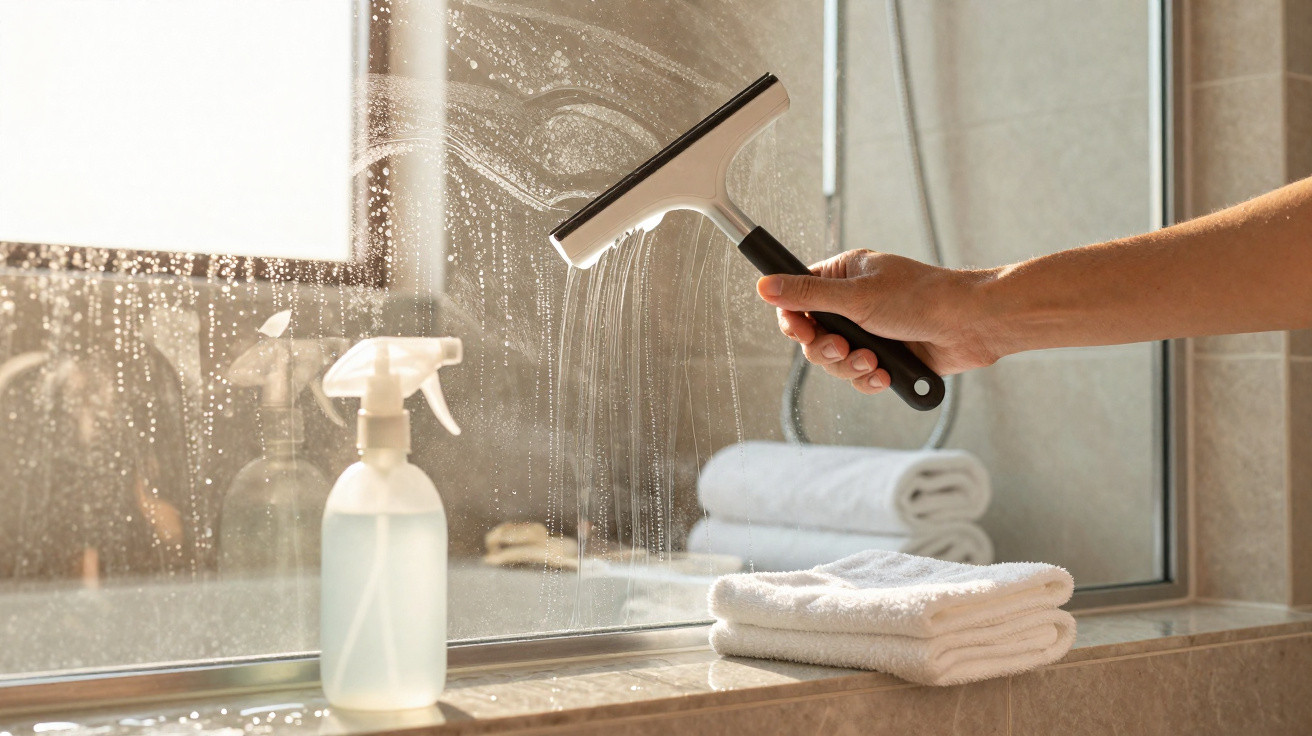
In a hotel, shower screens gleam as though they have just been installed – while at home, the enclosure can soon look dull and stained.
A straightforward professional-cleaning trick can change that.
Anyone who has stood in a well-maintained hotel bathroom will recognise the effect: the glass panel seems almost invisible, with no limescale marks or greasy film. At home, however, these are often precisely the deposits that prove difficult to remove. The flawless appearance is not the result of a secret laboratory, but of a surprisingly simple routine that many hotel room attendants have used for years – and which can easily be adopted in any home bathroom.
Why shower screens quickly become cloudy
Although glass appears hard-wearing, it is a sensitive material in a bathroom. After every shower, tiny droplets of water, soap residue and shampoo particles remain on its surface. Once dry, they settle in place and form the familiar haze.
Cold water, hot steam and cleaning-product residue combine into a coating that becomes increasingly difficult to remove with ordinary cleaning. Harsh products can then attack not only the dirt, but also seals, coatings and sometimes even the glass itself.
The hotel trick addresses exactly this: rather than scrubbing harder, it cleans more intelligently – using a staged process of two or three simple steps.
The clever hotel trick: how professionals clean shower screens
Hotel room attendants often have only a few minutes for each bathroom. They therefore need methods that work quickly without causing damage. The usual sequence is:
- Pre-treating the surface with warm water
- Applying a mild cleaner precisely
- Wiping down the shower screen with a rubber-bladed squeegee
- Buffing it afterwards with a dry cloth or microfibre cloth
From a distance, this may sound basic. What matters are the details: the order, the tools, the contact time and the right combination of water and cleaning product.
Step 1: Warm and moisten the glass
First, run warm – but not overly hot – water over the shower screen. This loosens light soap residue, dust and hair-product deposits. At the same time, the microscopic structure of the glass surface opens slightly more, making deposits easier to lift away.
If you have a hand-held shower head, spray from top to bottom in steady passes. This stops loosened dirt from splashing back upwards later.
Step 2: Use a mild cleaner, not a chemical cocktail
Many hotels rely on a gentle bathroom cleaner or a blend of water with a little vinegar or citric acid where the water is limescale-heavy. This works equally well at home. The important point is to use it sparingly and avoid spraying it directly onto seals or metal fittings.
For a household-friendly option, use a spray bottle containing this simple mixture:
- 200 ml lukewarm water
- 50 ml clear household vinegar or vinegar-based cleaner
- 1 squirt of mild washing-up liquid
Apply the solution lightly to the slightly damp glass, then leave it in place for two to five minutes. During this time, the film of limescale and soap residue breaks down. This is one of the main tricks: professionals do not wipe immediately, but allow the product time to work.
Step 3: Work section by section with the squeegee
Next comes the tool that is standard in many hotels: a shower squeegee with a rubber blade. It replaces vigorous rubbing with a cloth.
The squeegee mechanically removes the dirt-and-water mixture from the glass surface – quickly, with minimal streaking and without harming coatings.
Use this technique:
- Start at the top of the shower screen
- Pull down evenly without stopping
- Wipe the rubber blade with a cloth after every pass
- Begin the next section with a slight overlap
At the end, only a few marks should remain around the edges. Remove these using a dry microfibre cloth. Professionals often use a lint-free cloth designed for windows for this stage.
Hotel routine at home: the daily mini-trick
The real brilliance of the hotel trick becomes clear in everyday use: anyone who quickly uses the squeegee after every shower prevents the familiar grey haze from building up. Thorough cleaning with a vinegar solution or bathroom cleaner is then needed less often.
In many hotels, it is standard practice for staff to squeegee every shower enclosure fully after cleaning. Once it becomes habitual, the process takes hardly a minute.
| Measure | Frequency | Benefit |
|---|---|---|
| Squeegee the shower screen after showering | daily | prevents fresh water marks and limescale |
| Light cleaning with spray solution | 1–2 times per week | keeps glass clear and hygienic |
| More intensive limescale removal | Monthly or as needed | stops stubborn crusting |
What really helps against stubborn limescale
Some shower screens still look spotted despite regular squeegeeing, particularly in areas with very hard water. In that case, targeted limescale treatment is needed, as is common in older hotel bathrooms.
Limescale-removing products based on vinegar or citric acid are suitable. Strong, corrosive hydrochloric-acid cleaners may work quickly, but they pose risks to grout, silicone, metals and skin. Many professionals use them only in exceptional cases and with great care.
A gentle method for home use is:
- Put vinegar cleaner or a diluted citric-acid solution onto a soft cloth
- Dab it specifically onto affected areas, without letting it run over rubber seals
- Leave it briefly, then rinse thoroughly with plenty of water
- Finish with a squeegee and a dry cloth
Common mistakes that leave shower screens looking dull
Many households put in considerable effort but get poor results. This is often due to a few easily avoided pitfalls:
- Too much cleaner: creates smears and attracts dirt
- Unsuitable sponges: rough scouring pads can scratch the glass surface
- Dry-wiping without squeegeeing first: spreads the dirty film instead of removing it
- Hot water plus cold air: encourages condensation marks
The hotel trick is based more on restraint: less product, targeted tools and a clear process.
What does “streak-free” really mean for glass?
The term suggests perfection, but in practice it means something else: from a normal viewing distance, no obvious smears or water trails should be visible. In angled light or sunlight, almost every glass screen will still show fine traces. The same applies to freshly cleaned windows.
Professionals accept this minor remainder and focus on what genuinely detracts from the result: limescale edges, dull marks and sticky soap deposits. Anyone who keeps these under control will automatically make their bathroom look much tidier.
Practical scenario: what a realistic weekly plan looks like
A bathroom used daily by two people can be kept at hotel standard with surprisingly little effort. One possible routine is:
- After every shower: each person spends 20–30 seconds using the squeegee
- Wednesdays: light spray cleaning after showering, followed by the squeegee
- At the weekend: quick check of corners and fittings, with spot limescale treatment if required
Anyone who keeps this up for four weeks will often notice that the old haze disappears and that new deposits do not become visible in the first place. Hotels whose rooms are cleaned several times a week rely on precisely this cumulative effect.
Limits and risks of the hotel trick
Not every shower screen reacts in the same way. Some glass has a special coating designed to resist limescale deposits. Harsh cleaners or abrasive sponges can damage this layer. It is worth checking the manufacturer’s instructions in such cases.
Natural stone in the shower is also sensitive to acid. If vinegar solution drips onto marble or limestone, dull marks can quickly appear. Anyone with these materials in their bathroom is better off using mild specialist cleaners suitable for stone and protecting surrounding surfaces when spraying.
For households with children or pets, there is another consideration: cleaning products should always be kept out of reach, and the glass screen should be rinsed thoroughly after use. Many hotels therefore store their chemicals separately and dispense them in concentrated but controlled amounts.
How the hotel trick can be combined with other household tricks
Using a squeegee after showering fits easily into other routines. For example, anyone who already keeps a microfibre cloth in the bathroom can hang it beside the enclosure and use it to wipe the taps at the end. This makes the entire bathroom appear fresher.
In areas with extremely hard water, a pre-filter fitted to the shower head can be useful. It reduces limescale and lengthens the time between more intensive cleans. Some hotels in older buildings use exactly these aids internally to protect their bathrooms over the long term.
The result is an image many people recognise from travelling: a clear shower screen that barely draws attention to itself. This simple, tried-and-tested trick from hotel practice can bring that impression surprisingly close to everyday life at home – without hours of cleaning effort.


Comments
No comments yet. Be the first to comment!
Leave a Comment