
After returning from a trip, you notice the oven clock flashing, while the kitchen appears entirely normal – perhaps unnervingly so.
The refrigerator is humming, the freezer door is icy to the touch, and nothing looks unusual. But a quiet doubt surrounds every pack of mince and tub of ice cream: did your food remain frozen while you were away, or did an unnoticed power cut briefly turn the freezer into a breeding ground for bacteria?
The unseen danger of a power cut
Freezers give a reassuring impression of security. Food enters rock-solid and can come out weeks or months later looking much the same. However, that apparent reliability conceals a key issue: you usually cannot tell what occurred when nobody was there to check.
A power cut during your working day or a weekend away may allow the freezer to warm up before it refreezes by the time you return. Food can still feel firm on the outside, and its packaging may appear undamaged. Even so, several hours at a milder temperature can give bacteria plenty of opportunity to multiply.
Freezing pauses most microbial growth. Thawing restarts it. Repeated cycles of thaw and refreeze give bacteria a head start you cannot see or smell.
Food safety authorities across Europe and North America issue the same reminder: freezing is not sterilisation. It merely slows or halts the growth of microbes that are already present. When temperatures rise above about 5°C, many bacteria become active once more and can, under suitable conditions, double in number every 20 minutes.
Consider chicken left in a freezer that loses power for several hours. Inside, the temperature can slowly rise to fridge or even room temperature. Any Salmonella or Campylobacter already present can then begin multiplying. When electricity returns and ice crystals form again, the chicken may contain far more bacteria than it did before freezing – with no obvious sign of it.
The coin and ice trick: a basic freezer “black box”
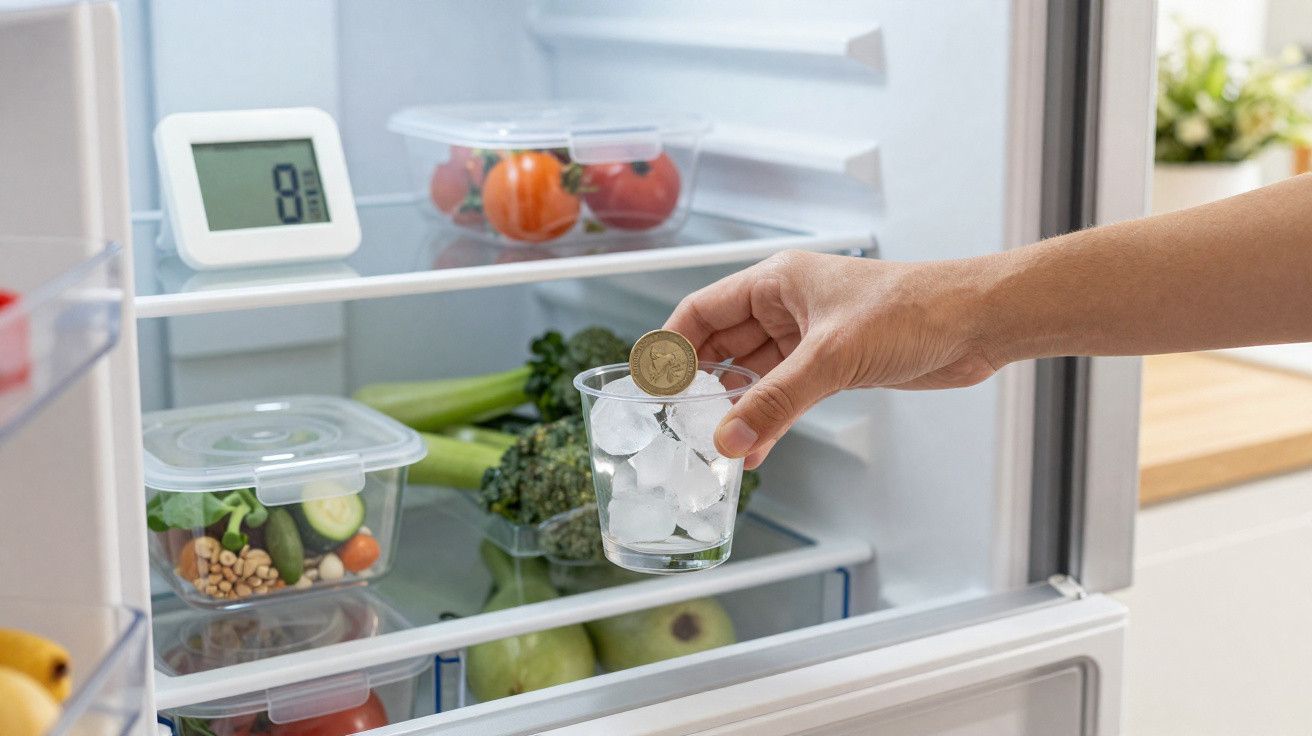
A straightforward household tip has become popular on social media and in food safety campaigns: keep a coin in the freezer on top of a frozen block of water in a small bowl.
A single coin, sitting on frozen water, can act as a crude flight recorder for your freezer, showing how far the temperature rose while you were away.
Setting up the coin and ice trick
- Fill a small bowl, mug or ramekin with tap water.
- Put it on a level, clearly visible freezer shelf.
- Leave it until the water has frozen completely solid.
- Place a coin flat on the ice surface.
- Return the bowl to the freezer and keep it there permanently.
After that, the coin serves as a silent record. Provided the ice does not melt, it will stay on the surface. If a power cut lasts long enough to thaw the ice before the freezer refreezes, the coin will sink into the water and end up trapped lower down when the ice forms again.
Reading the coin after a possible power cut
Where the coin sits can indicate what probably happened inside the freezer while you were absent.
| Coin position | What likely happened | What to do |
|---|---|---|
| Coin still on top of the ice | Ice never melted; freezer stayed cold enough | Food likely safe; still check for odd smells, packaging damage and use-by dates |
| Coin sunk slightly below the surface | Partial melting; temperature rose but probably not for very long | Be cautious with high-risk foods (meat, fish, dairy); consider cooking soon or discarding |
| Coin at the bottom of the bowl | Ice fully melted then refroze; prolonged loss of freezing temperature | Treat contents as potentially unsafe; discard perishable items |
If the coin remains exactly where it was placed, the freezer probably stayed within a safe temperature range. This does not make food safe if it was already old or badly stored, so routine checks remain important: inspect for swollen packaging, surface freezer burn and unusual smells.
If the coin is embedded low in the ice or rests at the bottom after the water has melted, it indicates that the freezer lost its freezing ability for a substantial period. The safest approach then is to regard meat, fish, cooked food, ready meals, seafood, ice cream and dairy desserts as potentially unsafe.
When the coin has clearly dropped, the question is not “can I save this food?” but “do I want to risk days of vomiting for a few pounds’ worth of groceries?”
Why refreezing food may be dangerous
A widespread misunderstanding is that refreezing food somehow neutralises bacteria that grew while it was warm. That is not what happens.
Freezing prevents most bacteria from continuing to grow, but it cannot undo growth that has already occurred. If food warmed up and its bacteria increased a thousandfold, refreezing simply locks in a thousand times as many bacteria. Those microbes are still present when the food is properly thawed and eaten.
Some bacteria can also create toxins that remain active even after the bacteria themselves later die. This helps explain why food can make someone ill despite looking and smelling normal. The concern is not only the microbes, but potentially also the products of their metabolism.
Foods at greatest risk
Certain foods pose greater risks after lengthy or repeated power cuts. Food safety agencies regularly identify:
- Raw meat, minced meat and poultry
- Fish and seafood, particularly shellfish
- Ready-to-eat meals and cooked dishes
- Dairy desserts, ice cream and frozen yoghurt
- Food intended for babies, toddlers, pregnant women, older people or immunocompromised people
From a microbiological perspective, frozen bread, plain fruit and some vegetables are usually lower risk, although thawing and refreezing can worsen their texture and flavour.
Extra checks to use with the coin trick
The coin and ice technique is useful, but it is most effective as one part of broader freezer habits. A few additional measures can greatly reduce the likelihood of food poisoning after a blackout.
- Keep a fridge/freezer thermometer inside and check it regularly.
- Do not open the freezer during a power cut, as each opening accelerates thawing.
- Mark frozen items with both the freezing date and use-by date.
- Keep high-risk foods, including meat, fish and leftovers, together for quicker checking.
- Thaw food gradually in the fridge rather than on the kitchen worktop.
In places where storms or electricity grid issues are common, a small battery-powered temperature logger can offer more accurate information than a coin. For most households, however, a coin remains an inexpensive, maintenance-free indication that something has gone wrong.
What food poisoning can do to your body
Food poisoning is often dismissed as a “dodgy tummy”, yet its effects can be much wider. A mild case may mean a few hours of nausea, stomach cramps and diarrhoea. More severe infections can cause a high temperature, ongoing vomiting, dehydration and, for vulnerable people, hospital admission.
Salmonella, Listeria, Campylobacter and particular strains of E. coli may all be spread through improperly handled frozen food. Symptoms can begin within hours or take several days to emerge, making it difficult to connect them with the questionable lasagne taken from a suspect freezer.
Throwing away a freezer drawer of food is frustrating; spending three days in the bathroom or an A&E ward is worse.
Practical situations: when to be cautious and when to be pragmatic
Imagine two examples. First, you return from a ten-day holiday to find the oven clock blinking and the coin at the bottom of the bowl, completely enclosed in ice. This indicates that the freezer fully warmed and then refroze before your arrival. In this situation, it is sensible to treat every high-risk item as unsafe, however painful the financial loss may feel.
In the second example, you leave home for an afternoon, a storm passes through, and afterwards the coin has dropped only a few millimetres. The ice remains largely solid, while the thermometer reads just below zero once the power returns. You may choose to keep certain items, use them promptly and cook them thoroughly, while discarding anything meant for children, pregnant women or people with weakened immune systems.
Applying stricter rules for the most vulnerable people while being a little more flexible with lower-risk food can help balance health protection against concerns about waste.
Label terms and what they actually mean
Several technical phrases commonly appear when freezers and power cuts are involved:
- “Use by” date: a safety cut-off. Beyond this date, food may be unsafe, even if it has been frozen and thawed.
- “Best before” date: a quality indication. Taste and texture may decline after this date, but safety is not automatically affected.
- “Do not refreeze once thawed”: the manufacturer assumes the item will be handled in a domestic kitchen, where temperature abuse may occur. Disregarding this direction raises the risk.
These terms become still more important when the freezer’s recent temperature history is unclear. A coin in a bowl cannot alter the biology, but it provides a clear visual warning when the narrow boundary between “probably fine” and “definitely risky” may already have been crossed.




Comments
No comments yet. Be the first to comment!
Leave a Comment