
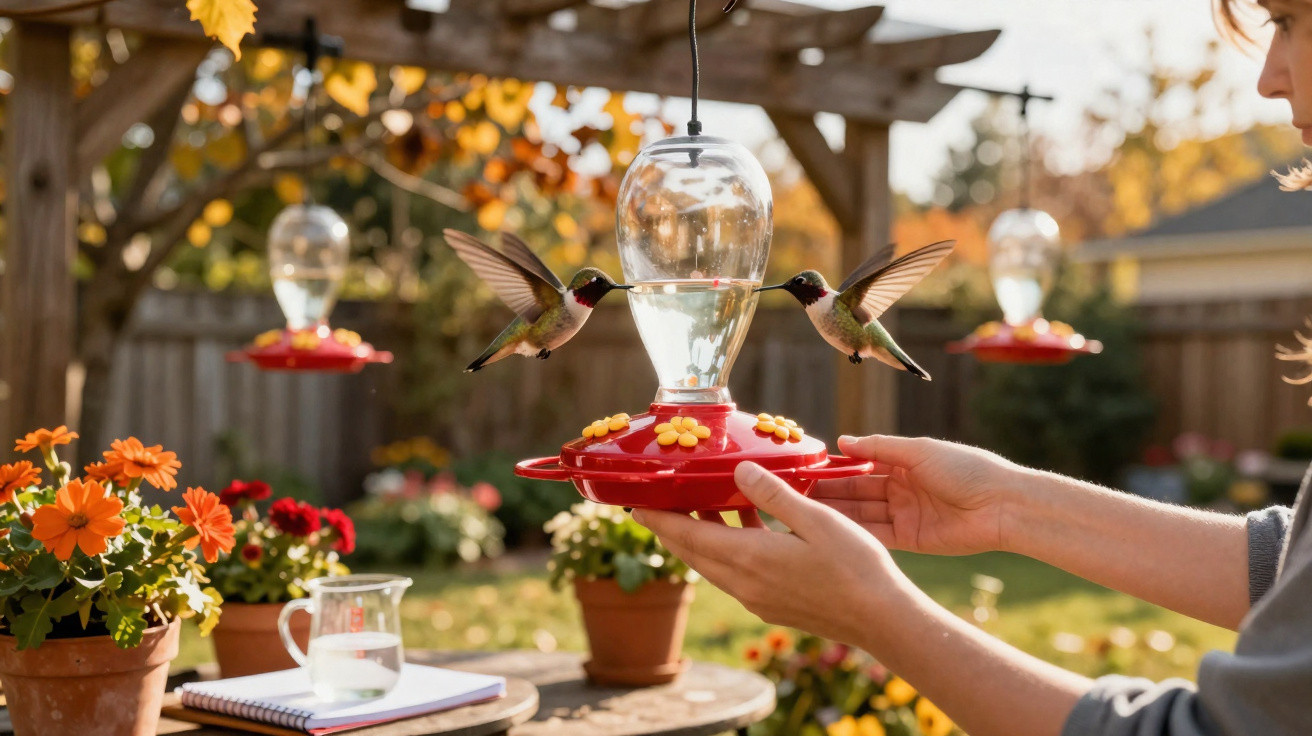
Autumn sunlight takes on a golden hue, the days grow shorter, and the garden suddenly seems more hushed, almost as though the air is listening.
For many people who watch birds in their gardens, that stillness comes as a surprise: the hummingbirds that whirred and chirped throughout summer can appear to disappear overnight. Beneath the quiet, however, is an urgent search for calories, with these tiny migrants moving south and inspecting gardens, balconies and woodland margins for a secure place to refuel. A few considered changes can turn your feeder into one of these potentially life-saving stopovers.
Keep feeders out long enough
When visits begin to tail off, it is tempting to put away the sugar water and consider the season over. Doing so may deprive late-moving birds of vital fuel.
Most hummingbirds begin their southward journey from late August through to October, with timing shaped by latitude and local conditions. Some birds follow weeks after the earliest migrants, particularly youngsters hatched late in summer or adults held back by storms.
Keep feeders up for at least two weeks after you see the last hummingbird, and often until your first hard frost.
Ornithologists point out that an available feeder does not “make” hummingbirds linger for too long. Their migration is governed by daylight hours, hormones and instinct rather than food alone. Offering nectar therefore does not mislead them; it supports stragglers heading towards their wintering areas.
Make the correct nectar for autumn energy needs
As flowers in the wild start to disappear, the sugar strength of feeder nectar matters even more. Migrating birds require a concentrated, dependable source of energy.
The standard recipe is still straightforward:
- 1 part white granulated sugar
- 4 parts clean water
Warm the water, stir in the sugar until it has dissolved completely, allow the mixture to cool, then add it to the feeder. Do not use honey, brown sugar, artificial sweeteners or food colouring. They may ferment more rapidly, encourage fungal growth or provide insufficient calories.
A plain 1:4 sugar solution closely mimics natural flower nectar and gives migrating birds a predictable energy boost.
In cool autumn conditions, some experts permit a marginally stronger mixture, up to 1:3, during cold spells, especially in northern areas. The extra-rich nectar can help birds regulate their body temperature on cold nights. Do not make it stronger than this, as overly concentrated nectar can dehydrate them and put pressure on their kidneys.
Clean feeders more frequently in fluctuating temperatures
Autumn weather can change from warm afternoons to cold mornings within hours. Such shifts speed up nectar spoilage and mould formation within feeders.
Unclean feeders are more than unattractive: they may spread fungal infections that swell birds’ tongues and can stop hummingbirds from feeding altogether.
In autumn, clean feeders every two to three days in mild weather, and even daily during warm, sunny spells.
Clean using hot water and a small bottle brush, taking particular care around the feeding ports and in narrow gaps. Where you see black deposits or cloudy nectar, use a weak solution of white vinegar and water before rinsing extremely well. Avoid powerful detergents or bleach unless the mould is severe, and rinse until every trace of smell has gone.
Set out several feeders to limit bullying
Hummingbirds can weigh less than a £1 coin, but they have remarkably large tempers. When every calorie counts in autumn, disputes over territory may become particularly fierce.
A dominant bird will often defend one feeder and drive away rivals. As a result, some migrants are forced to spend energy avoiding attacks instead of feeding.
Spreading two or three feeders around your space lets more birds eat in peace and reduces aggressive guarding.
Keep feeders outside one another’s direct line of sight: position them on separate sides of the house, at different heights, or close to shrubs. A bully that cannot watch every feeding port gives more timid birds a greater opportunity to slip in for a fast drink.
Think like a hummingbird: cover, perches and protection
In autumn, hummingbirds must follow a demanding routine of feeding, resting and avoiding predators while preserving as much energy as they can. The arrangement of your garden can make this easier.
Provide perches near the feeder, rather than on it
Hummingbirds like to perch between feeding sessions, particularly when the air is cool. Resting places nearby let them remain close without expending energy to hover.
- Narrow branches or twigs positioned about 1 metre from the feeder
- Basic metal or wooden plant supports
- Washing lines or thin wires set at different heights
Do not install perches immediately above feeders, as droppings could contaminate the nectar.
Give cover without concealing predators
Site feeders near natural cover, including shrubs, small trees or tall perennials, but avoid placing them deep within thick vegetation.
Ideal placement gives birds a quick escape route and shaded resting spots, while still keeping cats and other predators visible.
Bird strikes on windows increase during migration. Put feeders either within 0.9 metres of the glass or farther than 3 metres away. At close range, any collision happens at a lower speed; at the greater distance, the window is less likely to attract birds visually.
Use autumn flowers as a natural backup buffet
Feeders are useful, yet they cannot provide every advantage that living plants offer. Flowers blooming in autumn supply hummingbirds with natural nectar as well as insect food, both of which are essential during migration.
| Plant | Flowering period | Notes for hummingbirds |
|---|---|---|
| Salvia (autumn sage, pineapple sage) | Late summer to frost | Tubular red and pink flowers; excellent late-season nectar. |
| Trumpet honeysuckle | Summer to early autumn | Climbing vine; offers both nectar and shelter. |
| Zinnias | Summer into autumn | Attract insects, giving protein along with nectar. |
| Bee balm (monarda) | Mid to late summer | Bridges the gap before many flowers fade. |
In UK gardens, hardy fuchsias, late-flowering penstemons and red hot pokers may fulfil a comparable purpose, especially in milder coastal locations where vagrant hummingbirds occasionally occur in collections or under glass.
Adapt to regional timing and changing weather
No two autumns follow exactly the same pattern. A feeder in Arizona supports a different mix of migrants from one in New England or the Pacific Northwest.
In the southern United States, certain hummingbirds winter there, notably Anna’s hummingbirds and small numbers of rufous and black-chinned hummingbirds. Many residents in these regions now leave at least one feeder out throughout the year. In northern states and much of Canada, eventual frost and snow restrict how regularly nectar can be replaced, making the timing more limited.
Track the first and last hummingbird visits each year; over time, you’ll build a local migration calendar for your own garden.
Climate change is already altering these dates. Bird observatories have recorded earlier spring arrivals and later autumn departures for hummingbirds in certain places. Gardeners prepared to leave feeders out a little longer may see unexpected birds, particularly juveniles travelling on schedules that differ slightly from those of adults.
Look for stress signals and know when to stop
There is a balance to strike between offering help and recognising when the weather has become too severe. Several signs can guide your decision:
- Ice repeatedly forms in the feeder and rapidly freezes again after thawing.
- You have had no sightings for several weeks despite checking regularly.
- Nectar ferments or turns cloudy soon after filling because of extreme temperature changes.
Once these conditions persist, it is safe to bring feeders indoors, wash them and store them dry. Many birdwatchers retain one small feeder ready for an unexpected mild spell or a surprise migrant trailing behind the main movement.
Extra context: how tiny bodies complete epic journeys
A little knowledge of hummingbird physiology can alter the way you view that hovering flash beyond the window. A typical ruby-throated hummingbird weighs roughly the same as a British 2p coin, yet it migrates by flying non-stop across the Gulf of Mexico. To achieve this, birds nearly double their body weight in fat during late summer and early autumn.
Each sip at your feeder is part of an intricate energy budget that can mean the difference between survival and exhaustion.
At night, hummingbirds may enter torpor, a form of mini-hibernation in which their body temperature and heart rate fall dramatically. This enables them to save fuel between feeds. Autumn feeders positioned well can give them an immediate energy supply at the start of the day, reducing the time they remain in this vulnerable, low-energy condition.
Practical options for busy gardeners
If you travel regularly or work long hours, helping migrants can seem difficult. A manageable approach includes:
- Choose slightly smaller feeders, reducing wasted nectar when frequent cleaning is needed.
- Arrange for a neighbour to top up and rinse feeders if you will be away for more than three days during peak migration.
- Pair one or two feeders with robust late-flowering plants that continue to perform if maintenance is delayed.
The danger of neglect is genuine: a badly maintained feeder may cause more harm than benefit. If a busy period means you cannot follow the cleaning routine, reduce the number of feeders temporarily instead of leaving them filled with stale nectar.
When managed carefully, an autumn feeder arrangement becomes more than a chance for photographs. It can make an ordinary garden into a small refuelling point on a journey measured not in miles, but in wingbeats and heartbeats each second.






Comments
No comments yet. Be the first to comment!
Leave a Comment