
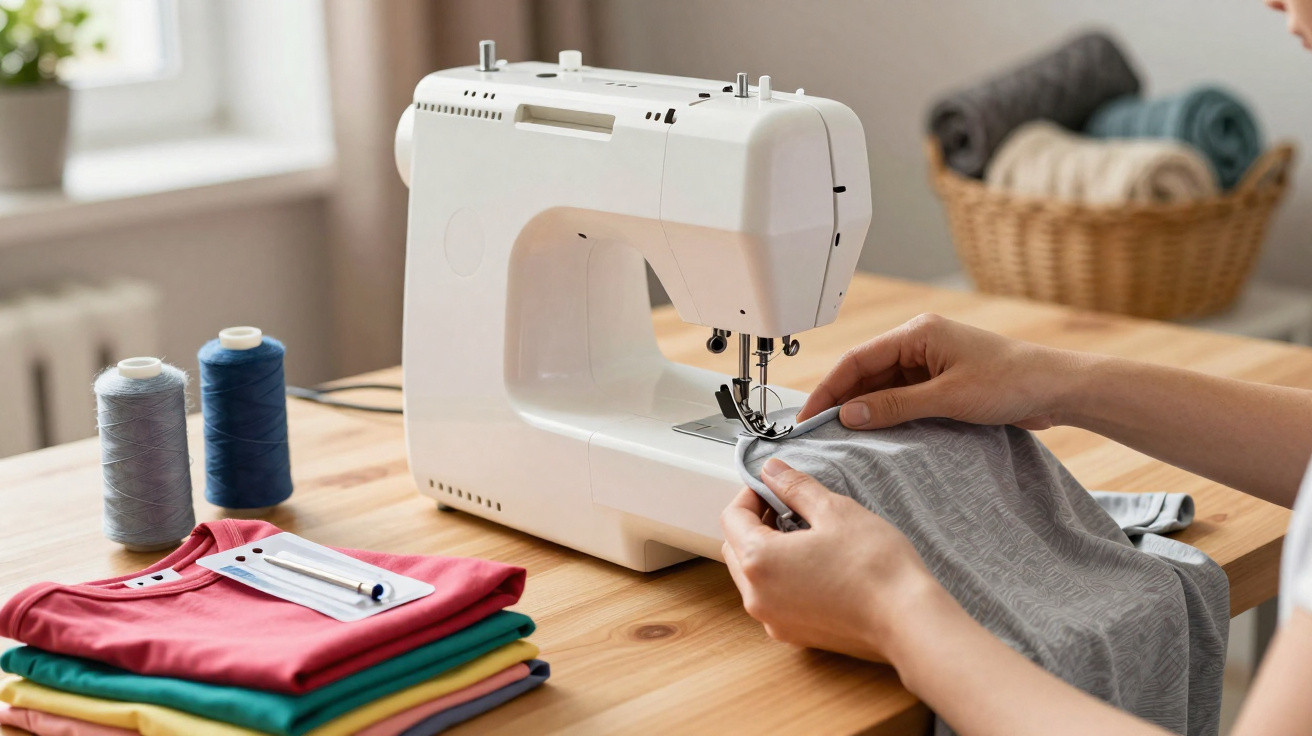
Anyone who shortens or makes T-shirts knows the issue: everything looks neat after pressing, yet the hem ripples when the garment is tried on, or the seam snaps the first time it is pulled over the head. It is easy to think, “I simply cannot do it like the industry.” In reality, the difference is often less about skill than a feature fitted as standard to most domestic sewing machines – one that hardly anyone uses.
Why T-shirt hems often fail at home
A quick look in the wardrobe shows the difference: shop-bought T-shirts usually have two neat, flat parallel rows of stitching at the hem, while the fabric stays flexible. In garment production, this is generally done with a dedicated coverlock machine. Few home sewers own such costly specialist equipment, so they understandably turn to the standard straight stitch on an ordinary sewing machine.
That is precisely where the difficulty starts. Jersey and other stretch fabrics are constantly pulled during wear and washing, whereas a conventional straight stitch has very little give. As a result, the thread can break, the seam may distort, and the hem can ripple or curl outwards.
The professional appearance of ready-to-wear clothing can often be recreated on a standard domestic sewing machine – provided you use a small accessory that is frequently left untouched in its compartment.
The overlooked accessory: sewing a double seam instead of a single straight stitch
Nearly all modern domestic machines from brands such as Singer, Brother and Pfaff include a function that many people know only from the manual – and often skim past there: sewing with a twin needle, commonly called a “double seam”. It is technically straightforward, but it can be a genuine game-changer for T-shirt hems.
How the twin needle works
This method uses two upper threads together with one bobbin thread. From the right side, the finished result shows two parallel lines of stitching, usually spaced 2 to 4 millimetres apart. On the reverse, the bobbin thread runs in a zigzag between the two upper threads.
- top: two straight lines, visually similar to shop-bought T-shirts
- underside: a zigzag connection formed by the bobbin thread
- effect: considerably more stretch than a standard straight stitch
This construction allows the hem to stretch much further without the thread breaking. On cotton jersey, it noticeably improves elasticity compared with a single straight stitch – in practice, this is enough to stop the hem from snapping when the T-shirt is put on.
Where the accessory is hidden
People wanting to use this feature often get stuck at the very beginning: “My machine only has one spool holder.” In many cases, that simply is not true. A second spool holder is usually tucked away unobtrusively:
- in the accessory compartment with the presser feet
- beneath the top cover beside the bobbins
- or as a small loose pin in the bag containing needles and screwdrivers
Simply insert this pin into the designated opening on the machine, and two spools can be mounted side by side. Even basic domestic machines are prepared for double-seam sewing in this way – but many owners never make use of it.
How to set up a double seam for jersey correctly
Two spools of thread alone are not enough to produce a successful T-shirt hem. Several settings determine whether the finish is flat and stretchy or puckered into an untidy tunnel.
Choosing the right twin needle
For most T-shirts made from cotton jersey or lightweight sweatshirt fabric, twin needles in sizes 80 or 90 are suitable. The spacing between the two needles is important:
| Needle spacing | Visual effect | Typical use |
|---|---|---|
| 2.5 mm | subtle double seam | fine T-shirts, children’s shirts, lightweight jersey |
| 4 mm | pronounced sportswear look | casual shirts, sportswear, heavier fabrics |
The needle is fitted in the same way as an ordinary needle, except that its shank has two points. Important: use straight stitch only, and check first that the machine can accommodate this width so that the needle does not strike the needle plate.
Threading correctly and adjusting tension
Double-seam sewing requires two thread spools. Both threads initially pass together through the tension discs, then separate at the final thread guide before each is threaded through its own needle eye. Many sewing professionals swear by the following settings:
- Stitch type: straight stitch
- Stitch length: slightly increased, around 3.0
- Upper-thread tension: slightly looser than usual, for example 3 instead of 4
The lower upper-thread tension helps prevent a ridge or “tunnel” from forming between the two rows of stitching. Before sewing the actual hem, it is worth making a test piece: use an offcut of the same fabric, pressed and folded in exactly the same way.
Those who do not economise on the test piece will avoid unpicking an entire hem later.
When the double seam excels – and when another stitch is better
T-shirts, leggings, sports tops and children’s clothing: wherever stretchy knitted fabric is involved, the double seam plays to its strengths. The hem remains flat, gives when stretched and looks remarkably professional from the outside.
The situation differs somewhat with trousers, skirts made from woven fabric and elegant materials. Here, invisibility matters more than stretch. Many machines provide a dedicated blind hem stitch for this purpose, often marked with symbols such as “B” or “V”.
Blind hem versus double seam: a quick guide
- Jersey, sweatshirt fabric, stretch fabrics: double seam with a twin needle for a visible, elastic hemline
- Jeans, chinos, skirts in woven fabric: blind hem stitch so the hem remains almost invisible from the outside
- Fine blouse fabrics: a narrow blind hem stitch, set very subtly
A blind hem stitch is often supported by a special presser foot with a central guide bar. The machine sews a sequence of straight stitches combined with a small sideways zigzag that catches only a tiny amount of the outer fabric. This leaves just a row of minute vertical dots on the outside, which are barely noticeable at first glance.
More tips for genuinely neat T-shirt hems
Even a good stitch programme cannot rescue a poorly prepared hem. Anyone seeking professional results should also pay attention to a few further factors:
- Measure and press the hem precisely before sewing.
- Do not pull the fabric while sewing; guide it only lightly.
- Use jersey needles or stretch needles to prevent runs in the fabric.
- For highly stretchy fabrics, use a stretch stabiliser for jersey hems.
For especially fine or extremely stretchy fabrics, the bobbin thread can be replaced with bulky or mousse thread. This thread fills the zigzag on the reverse more effectively, makes the seam softer against the skin and reduces rippling after washing.
Why using a twin needle is genuinely worthwhile
Anyone who compares a T-shirt hem sewn with and without a twin needle will quickly understand why the industry uses similar constructions for sportswear and casual clothing. The double seam moves more easily with the garment, remains visually stable and looks “bought” rather than “homemade” from the outside.
This technique can be particularly helpful for beginners by preventing frustrating experiences. Rather than abandoning the project after the third rippled seam, the machine suddenly produces results that can compete with shop-bought garments. The barrier is low: an inexpensive packet of twin needles, a look in the accessory compartment, and a tool that many people had not even considered is ready to use.
Anyone who regularly sews for children or sporty family members benefits twice over. Stretchy, durable hems extend the life of clothing and cope far better with daily play, changing and washing. Combined with suitable thread, careful preparation and a short trial run on fabric offcuts, this gradually creates a result that no longer looks like a “hobby” project, but like confident routine at the sewing machine.




Comments
No comments yet. Be the first to comment!
Leave a Comment