
Friday night: the mirror light is a touch too yellow, and your hairbrush is teetering on the sink’s edge. You are not late yet, but it is getting uncomfortably close. Your curtain bangs are misbehaving again: flawless on the right and forming a strange little ledge on the left. You reach for the round brush, switch on the hairdryer and attempt that salon-style swoosh. Three minutes later, your forehead is sweaty and your fringe looks as though it belongs to a different decade.
TikTok users have already had enough. The glossy, swooping bang is quietly giving way to something lighter, messier and almost deliberately broken-looking.
They are calling it the “shattered fringe.”
What is a shattered fringe – and why is everyone asking for it?
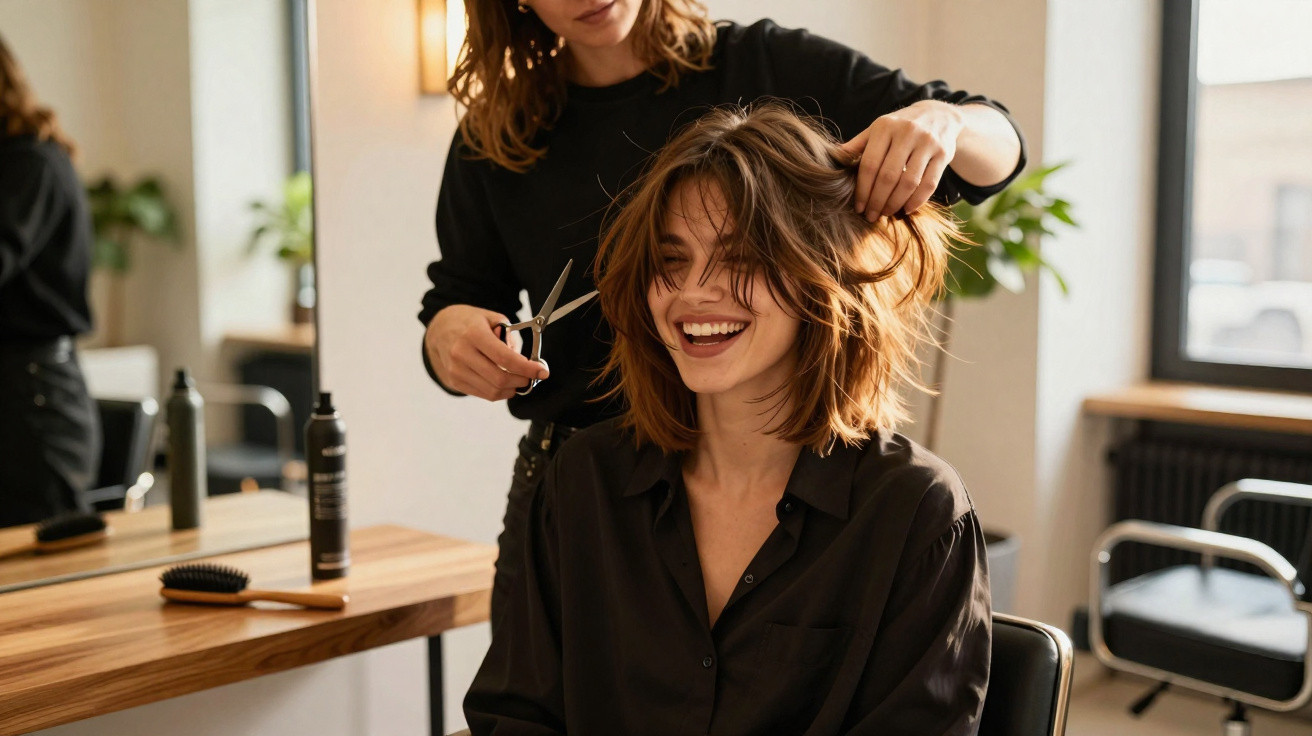
At first look, a shattered fringe appears as though your bangs have finally relaxed. Its outline is soft, the ends are feathered and there is no clear curtain shape or solid strip of hair cutting across the face. It is piecey and slightly undone, with small gaps that reveal flashes of skin and brows.
Think of it as the anti-helmet fringe. It shifts as you move, parts in the breeze and settles differently every time you sweep it back with your fingers. That unpredictability is precisely its appeal.
Scroll through beauty accounts at the moment and a clear pattern emerges. The images being saved repeatedly are no longer of pin-straight curtain bangs, but of airy, shattered ends sitting just below the brows and blending into the rest of the haircut.
In salons, stylists are hearing a familiar request: “I want bangs, but not… bangs-bangs.” A Paris stylist I spoke with called it “the fringe for people who hate committing.” Over the past six months, she says roughly four out of ten new clients have requested a version of this softer, choppier front section. It is a subtle but unmistakable change.
There is a straightforward reason the trend has staying power. Curtain bangs required commitment: round-brush styling, carefully placed oil and frequent trims to maintain their curve. The shattered fringe takes the opposite approach, embracing lived-in texture and understated imperfection.
We are in a moment when hair can look as though it belongs to an actual person rather than a blow-dry bar mannequin. Like the filters on your phone, a shattered fringe frames the face by softening edges, blurring features and drawing attention to the eyes without making a fuss. After years of glossy, TikTok-perfect styling, it feels like a natural next move.
How to ask for – and actually style – a shattered fringe in real life
The first stage comes before you even sit in the salon chair. Screenshots are invaluable, but they need to be realistic. Pick images of people with hair texture and a face shape similar to yours, rather than simply choosing the influencer you would like to resemble at 8 a.m. on a Monday.
At the salon, keep your wording clear: “soft, piecey fringe”, “no straight line”, “feathered ends” and “lots of movement”. Ask your stylist to leave the centre slightly shorter, with the sides merging into your layers or the overall length of your cut. The aim is a fringe you can push aside, wear down or nearly hide when it is tucked back.
The cut itself is not the difficult bit. The challenge is avoiding the temptation to over-style it when you are back at home. We have all had that moment when trying to “fix” one strand turns into redoing the entire head.
Stylists repeat one rule in particular: start by drying your shattered fringe with your fingers. Skip the round brush and do not use a straightener at its hottest setting. Rough-dry it forwards, moving slightly from side to side, then pinch out a few sections with the smallest amount of texture spray or lightweight wax. Honestly, nobody follows this routine every single day. That is another reason this cut succeeds: it still looks good when you have not made much effort.
One London hairstylist put it perfectly:
“Curtain bangs are a style. A shattered fringe is a feeling. You don’t see the cut first, you see the person.”
To maintain that effect, concentrate on a handful of simple steps:
- Request soft, razor-like texturising through the ends instead of a blunt cut.
- Keep the length from the middle of the forehead to just below the brows, depending on what feels comfortable for you.
- Choose a dry texture spray or styling powder rather than weighty serums that stick the strands together.
- Schedule micro-trims every 6–8 weeks to revive the shape without beginning again from scratch.
- On “bad hair” mornings, work with the chaos: a messy clip or low bun with the fringe left out looks deliberate with this cut.
Why the shattered fringe might finally be the bang you don’t regret
There is something about this fringe that fits where many of us are now. We still want the face-framing effect bangs can create, but we are tired of looking as though we have stepped out of a tutorial every time we leave the house. The shattered fringe holds both ideas together: styled without being overdone, noticeable without demanding attention.
It adapts quietly to your day. With full makeup, it appears to be part of the finished look. When you put on a hoodie and call that enough for the morning, it simply makes your features look a little softer and kinder in the mirror. It’s the kind of detail that changes how you feel about your whole reflection, without anyone really knowing why.
| Key point | Detail | Value for the reader |
|---|---|---|
| Shattered fringe is softer than curtain bangs | Feathered, piecey, with no hard line across the forehead | Looks modern and effortless, less risk of looking “over-styled” |
| Low-maintenance styling | Finger-drying, light texture products, works with natural movement | Saves time and stress on busy mornings while still looking put-together |
| Highly adaptable | Can be worn centre, off-centre, blended into layers or tucked back | One cut that suits different moods, outfits, and makeup levels |
FAQ:
- Question 1 Will a shattered fringe work on naturally wavy or curly hair?
- Answer 1 Yes, and it can look incredible. Ask your stylist to cut it dry, or at least assess the shape when dry, so they can see your curl pattern. The fringe will sit more loosely and romantically, creating soft tendrils rather than strict sections.
- Question 2 Is a shattered fringe suitable if I have a small forehead?
- Answer 2 It can be, as long as the length is customised. Choose a slightly shorter, lighter version with more gaps so skin is visible. Steer clear of heavy, thick sections; think a whisper of fringe rather than full coverage.
- Question 3 How do I explain “shattered fringe” to a stylist who has not heard the term?
- Answer 3 Call it a soft, textured, piecey fringe without a blunt line, and show two or three reference images. Explain that you want movement, feathered ends and the ability to sweep it to the sides.
- Question 4 Do I need special products to style it?
- Answer 4 Not necessarily. A lightweight texture spray, a little mousse or a dry styling cream will usually do the job. The priority is keeping the hair light and touchable rather than stiff with hairspray.
- Question 5 What if I regret it and want to grow it out?
- Answer 5 Since the shattered fringe is already soft and blended, it grows out more elegantly than blunt bangs. Your stylist can continue blending the ends into face-framing layers until it simply becomes part of your haircut.


Comments
No comments yet. Be the first to comment!
Leave a Comment