
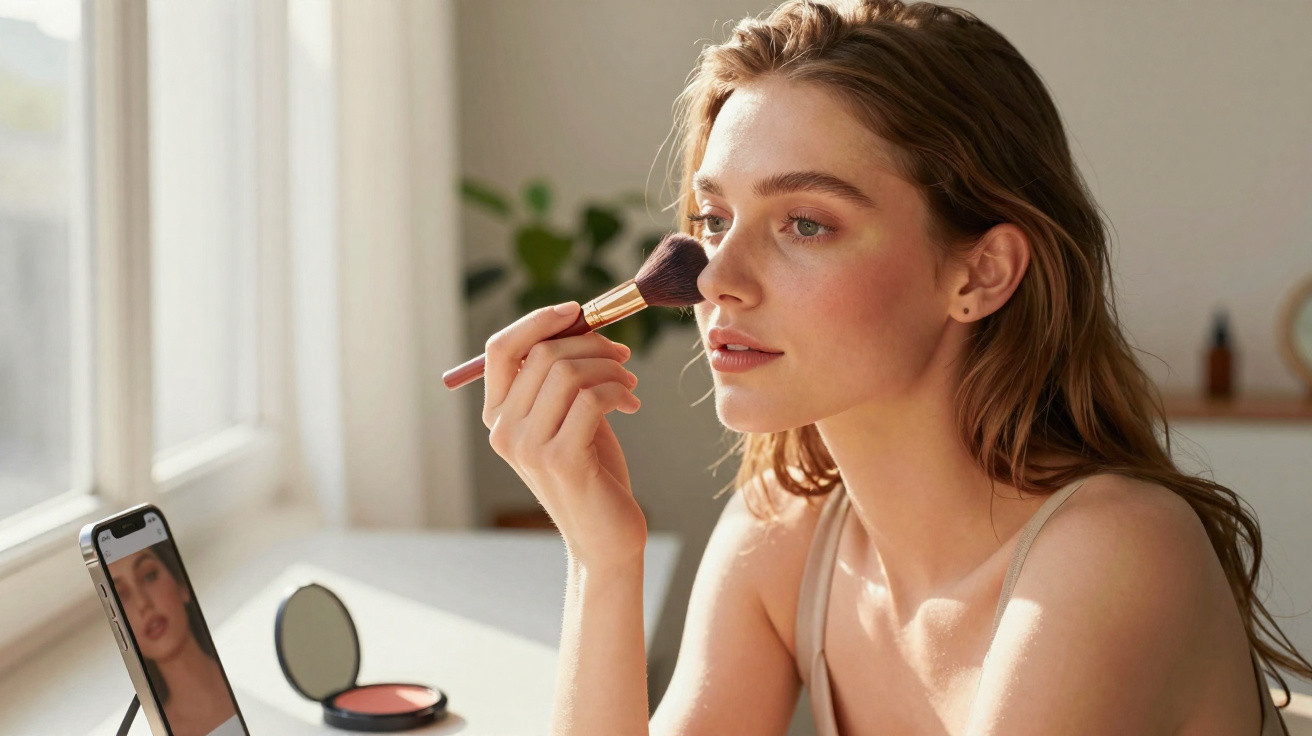
The woman in the café appeared impeccable from a distance.
Her brows were perfectly shaped, her eyeliner precise and her lips glossy. But when she moved nearer to the window, something seemed… wrong. A dense sweep of flush sat beside her nose, as though she had raced up three flights of stairs. The makeup was not poorly done. Its positioning was.
You have probably noticed the same thing while scrolling through TikTok or passing people in the street: blush that sits just a touch too far inward, making features seem smaller and drawing everything towards the centre of the face. It can be so subtle that it barely registers in a bathroom mirror. In daylight or on camera, though, it alters the face’s entire balance.
That small 2-centimetre difference between a “fresh glow” and “why does my face look crowded?” is not merely a matter of taste. It is geometry.
Why blush placement near the nose changes the whole face
When blush travels too near the nose, the face may instantly appear tighter and narrower. The centre becomes the focal point, while the eyes, jawline and cheekbones recede into the background.
Rather than creating lift, the shade draws the eye inwards. The outer edges of the face can look almost lost. Blush that sits close to the nostrils may also amplify natural redness around the nose, leaving skin looking tired rather than luminous.
From further away, the result can appear “puffy” or “crowded”, rather than gentle and romantic. Colour intended to sculpt can end up compressing the face instead.
Look through selfies shot under unforgiving office lights and it becomes easy to spot. The person still looks like themselves, but the proportions seem faintly off. Their nose appears more noticeable, the middle of the face looks overworked and the outer cheeks seem unusually pale.
On camera, blush near the nose can visually merge with any natural redness around the nostrils. Your front camera’s algorithm is unforgiving: by increasing contrast and shadow, it turns that blush sweep into a solid block of colour rather than a diffused halo.
Some television makeup artists refer to the area around the nose as “the danger zone”: apply too much colour there and the face can look smaller and more fatigued, particularly beneath artificial lighting. This is why red-carpet blush is generally placed a little higher and further out.
The explanation is straightforward. Your face is not a flat canvas; it is an arrangement of horizontal and vertical lines, and blush influences how those lines are perceived. If colour sits extremely close to the nose, the vertical line running from forehead to chin can seem shorter and more compact.
Move the same shade slightly upwards and outwards, however, and the cheekbones’ horizontal line opens up. The face appears more relaxed and lifted, while the eyes can look larger. Your features have not changed; only the point where the viewer’s eye lands first has.
Makeup artists call this “visual weight”. Blush carries a great deal of attention. Place that weight towards the centre and the face can look narrower; shift it towards the outer face and it gains room and definition. It is a tiny adjustment with an outsized impact.
How to place blush so it flatters, not crowds, your features
Begin with one easy reference point: imagine a vertical line running down from the centre of your eye. This is your inner boundary. Your blush should not pass that invisible line in the direction of your nose.
Set your brush on the area of the cheek that naturally becomes rounder when you give a half-smile - not a wide, forced grin, just a slight lift. Apply the colour there, then blend it out towards the top of the ear in a soft comma-like shape.
Build colour in light layers. Creating a convincing flush is much easier than removing a patch that has strayed into the nose zone. If you are unsure, maintain a narrow section of “clean” skin between the side of the nose and where your blush begins.
Many people sweep blush inwards because tutorials tell them to “hit the apples of the cheeks”, and they take the instruction too literally. During a hurried morning routine, the brush lands too near the nostril and the placement becomes a habit.
For rounder or softer faces, this may make cheeks appear fuller rather than raised. On highly angular faces, it can make the centre look harsher and distract from naturally striking cheekbones. Where skin has texture, colour near the nose often catches on pores and fine lines.
We have all had that moment of seeing ourselves at 3 p.m. and wondering, why do I look out of breath? Often, it is not how much blush you used - it is where it ended up. Moving it slightly outwards can transform every photograph you take that day.
“Blush should frame your features, not fight them,” says a London-based makeup artist who regularly repositions blush on clients who wonder why they “look tired” despite full glam.
Use this simple mental checklist to keep blush away from the nose without making it look unnatural:
- Leave at least one finger-width of bare skin between your nose and blush.
- Hold the brush at a slight upward angle rather than sweeping straight across the face.
- Tap off excess product before the brush meets your skin.
- Blend the outer edge more thoroughly than the inner edge.
- Move one arm’s length away from the mirror to assess your face.
Let’s be honest: nobody blends blush for ten minutes every day. That is why clear visual cues - the centre-of-eye line and the one-finger gap - are more useful than complicated contour diagrams. They work whether you are half-awake before work with a £6 cream stick or a luxury compact.
Finding your own balance, not Instagram’s
There is no one “correct” blush placement, only the effects you decide to create. Bringing blush slightly closer to the nose can suit some faces, giving a cute, youthful cold-girl flush. Taken too far, though, it moves from editorial to uneven.
Every face is different, as is each person’s comfort level with noticeable colour. Some enjoy a bold, central blush that feels playful and inspired by K-beauty. Others favour the lightest wash high on the cheekbone, almost like a soft-focus filter. The key is understanding how every placement affects balance, then choosing deliberately rather than repeating a habit.
When you next apply blush, try a quick comparison: use your normal placement on one side, perhaps a little nearer the nose, then place the other side slightly higher and further out. Stand back, take a fast photograph in daylight and examine it properly.
Which side makes your eyes stand out? On which side does your nose settle softly into the structure of your face rather than becoming the main focus? Which one feels more like you, rather than the latest tutorial you watched at midnight?
Showing those before-and-after photos to a friend can reveal more than you expect. This is not about criticising your face. It is about learning how colour redirects attention. The more you experiment, the more you see that your face is not a problem to solve, but a composition to arrange.
Blush near the nose is only one small stroke within that composition, yet it speaks loudly. Once you understand that, you can increase or reduce its impact whenever you wish - not to conceal anything, but to choose what you want others to notice first.
| Key point | Detail | Benefit for the reader |
|---|---|---|
| Distance from the nose | Keep a slim strip of bare skin between the nose and blush | Avoids a “crowded” centre and maintains balanced features |
| Placement guide | Do not cross the vertical line beneath the centre of the eye | Helps blush create lift instead of looking heavy or puffy |
| Blending direction | Blend outwards and slightly upwards towards the ear | Opens up the face, defines cheekbones and flatters in photographs |
FAQ:
- Why does my blush make my nose look bigger? When colour sits too close to the sides of the nose, it visually widens and draws attention to that area, especially if you also have natural redness there.
- Is it ever okay to put blush near the nose? Yes, in a light application for a “sunburn” or cold-girl effect, but keep it sheer and avoid a solid stripe that blends into nostril redness.
- Where should I start my brush on the cheek? Begin at the roundest area of the cheek when you make a small half-smile, then blend outwards and upwards, never inwards.
- Does cream blush behave differently from powder near the nose? Cream blush can settle into pores and become patchy around the nose if skin is oily, whereas powder may cling to dry patches, so prepare the area and apply less product there.
- How can I fix blush that’s too close to my nose? Soften the inner edge with a clean sponge or brush, then pat a little foundation or concealer over the area to restore that strip of bare skin.




Comments
No comments yet. Be the first to comment!
Leave a Comment