
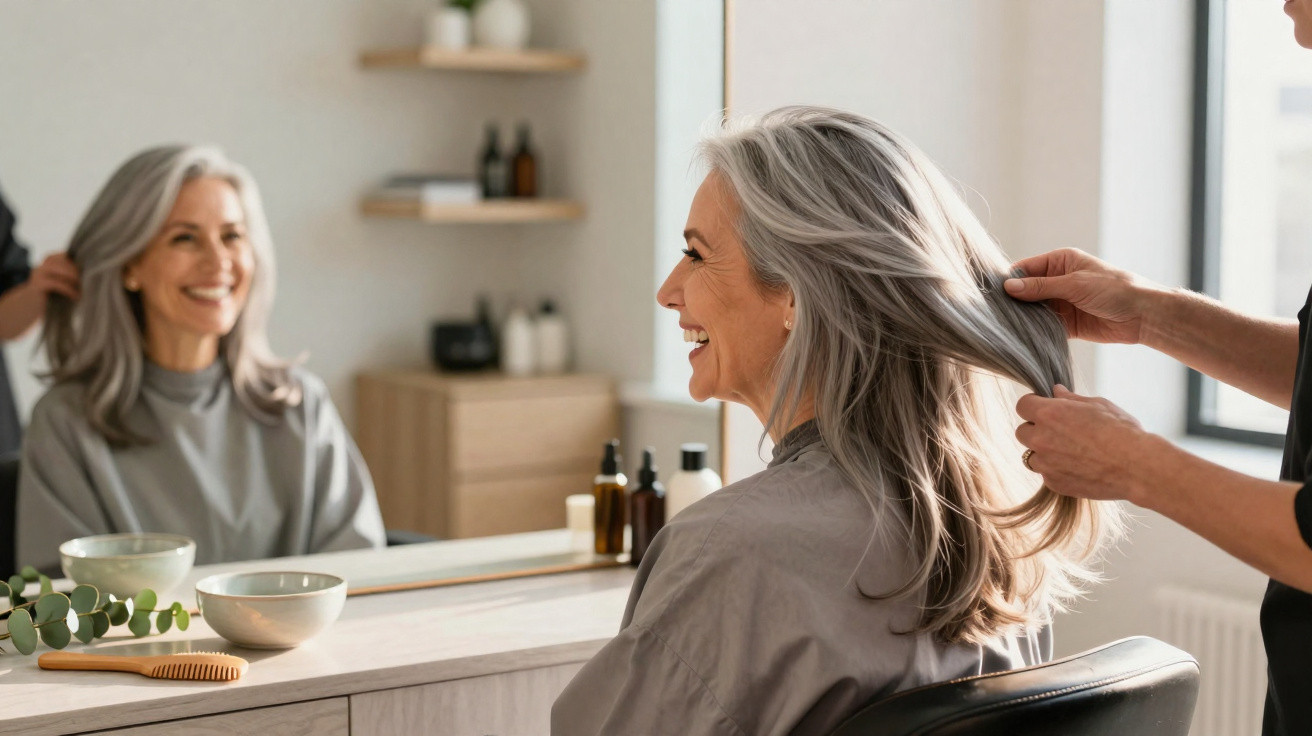
Her stylist proposes “just a little warm brown” to disguise the silver glinting at her temples. She studies her reflection, uncertain, brushing her fingertips over the fresh white strands that seem to have arrived overnight. On the chair beside her is an Instagram screenshot: a woman of a similar age with hair threaded through with gentle grey ribbons, somehow radiant rather than old.
Elsewhere in the salon, a second client is having a different service. A fine technique is being used to blend, soften and reframe her grey instead of smothering it beneath a uniform, opaque colour. The effect is understated. Brighter. It feels less like resistance and more like change. When the stylist steps away, she smiles - and the client, slightly surprised, smiles too.
The question now is no longer “How do I erase my greys?”
From concealing to harmonising: why grey hair is being reimagined
Grey hair once felt like a dividing line. You would spot the first silver strands one morning and face an apparent choice: colour it or “let yourself go”. That outdated story is unravelling. From New York to Berlin, salon colourists say clients increasingly want an option that is gentler, more considered and easier to live with than complete coverage.
They are no longer after a solid helmet of colour that demands a touch-up every three weeks. They want hair with movement, shine and a recognisable sense of themselves - only… less exhausted-looking. The point is not to pass for 25. It is to appear rested, polished and current at 45, 55 or 65. Grey can remain; it simply needs refining.
On a wet Thursday in London, colourist Mia says that half of her new clients arrive carrying screenshots marked “anti-grey but not fake”. A banker in her 40s shows her a Pinterest board of women whose grey has been integrated into delicate highlights. “I’m not hiding my age,” she says, “I just don’t want my roots screaming about it in Zoom meetings.”
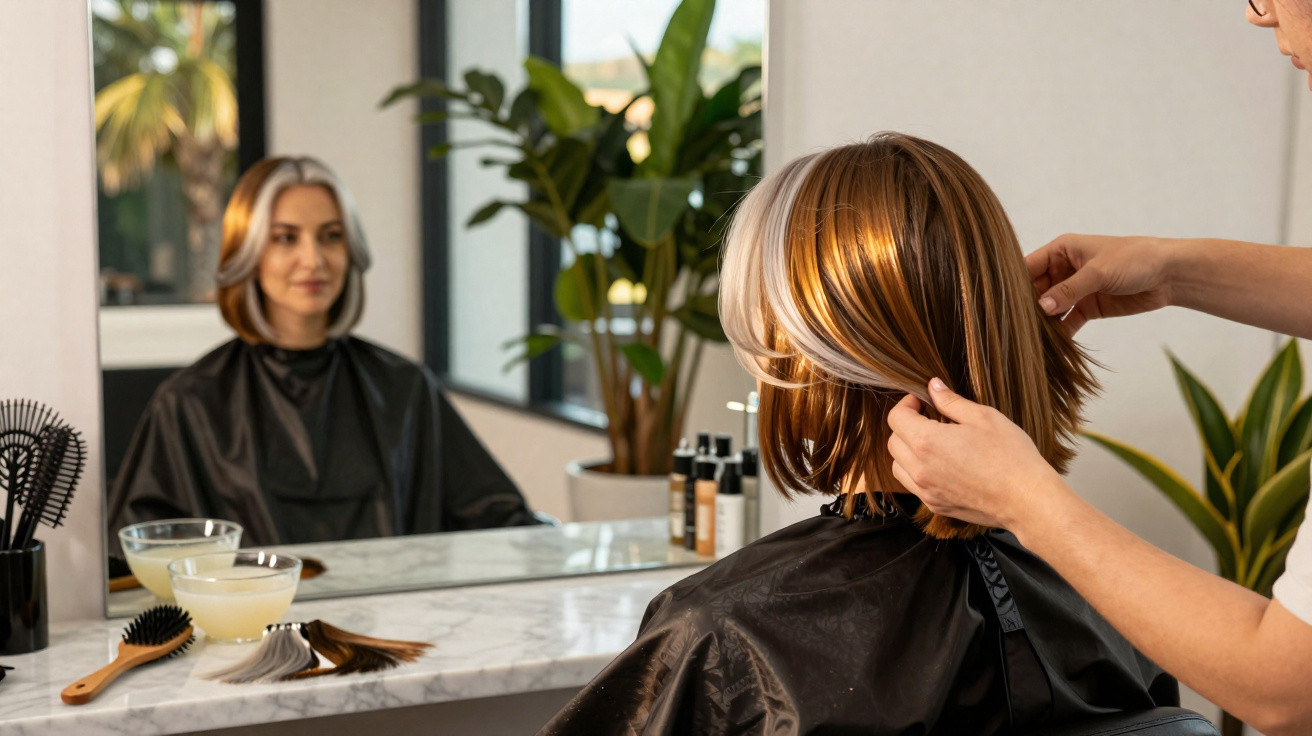
Mia uses a method known as “grey blending”, placing exceptionally fine highlights and lowlights around the face and along the parting. The grey hairs remain, but their contrast is reduced. By the end, her client’s hair resembles expensive summer light rather than a reluctant deal with ageing. There is no stark regrowth line as she leaves, just a softer, cooler-looking version of herself.
The figures point in the same direction. In 2023, searches in English-speaking countries for “grey blending” and “transition to natural grey” surged on Google, while searches for “permanent hair dye every 3 weeks” quietly levelled off. On TikTok, #grombre - grey + ombre - has become a communal project, as women record the uncomfortable months between dyed lengths and natural growth, sharing ways to remain stylish during the transition.
What is behind the change? In part, it is weariness: people are fed up with the expense, the odour and salon bookings dictating their diaries. Health is another concern, with fewer people wanting ammonia-heavy dyes sitting on their scalp throughout the year. Yet there is a wider cultural shift too. The generation that turned away from crash diets is also questioning routine root touch-ups. The definition of “well-groomed” is broadening. Grey hair is no longer seen as a maintenance failure, but as material to work with. That alters the whole conversation.
How to conceal grey and look fresher – without committing to full dye
This newer approach is not about becoming completely silver overnight. It is about selective camouflage. Rather than treating grey hair as a defect, view it as a pattern of light and dark. The key is to soften the areas people notice first: the hairline, the parting and the front sections. This is exactly where focused blending can be so effective.
Ask your colourist for ultra-fine “baby lights” that are only marginally lighter than your natural shade. These slender pieces of colour soften the divide between brown and grey, transforming severe contrast into something like a soft-focus filter. A small number of lowlights - deeper strands - can then ground the overall look and prevent the hair appearing washed out.
You do not have to become tied to a rigid salon timetable. In between appointments, root touch-up sprays or powders can discreetly disguise the most visible silver at the parting, particularly before a significant meeting, date or family occasion. It is about having control rather than becoming dependent. The grey has not vanished; it is simply turned down.
At home, it can be tempting to buy a box dye and “fix everything” on a Sunday evening. This is often where the problems begin. Full-coverage colour produces one dense block that may look fine for a fortnight, before revealing an unforgiving divide between silver roots and darkened lengths. It is that harsh line at the scalp, rather than the grey itself, that can make people feel older.
A less demanding option is a semi-permanent gloss in a cool or neutral shade. It will not entirely cover grey; instead, it lightly veils it. Glosses bring shine, mute yellow or brassy notes and make natural colour appear deliberate rather than lacklustre. Using a purple or blue shampoo once a week can also keep grey sections bright, rather than dull or nicotine-yellow. Let’s be honest: nobody really does that every day.
Styling plays a part that is rarely discussed. Grey strands are often drier and more wiry. If they spring out in every direction, people see “messy” before they see “silver goddess”. A lightweight smoothing cream or leave-in conditioner settles that halo, making every colour decision look more purposeful. Once the texture is under control, attention stops landing on every individual white strand.
“People come in asking me to erase their grey and leave saying they want to show it off,” laughs Paris-based colourist Diane, lifting a section of hair that changes from pearl to ash to smoke in the light.
“The trick isn’t to fight grey,” she says. “It’s to give it context so it looks like a designer shade, not a random accident.”
That “designer shade” result comes from modest, practical adjustments that build over time. Here is a quick cheat sheet to screenshot before your next salon appointment:
- Ask for “grey blending”, not “covering” - this makes clear that you want nuanced work rather than a flat mask.
- Focus on the hairline and parting first - these limited areas account for 80% of what others tend to notice.
- Choose cooler, smoky tones over warm, reddish ones - they blend more naturally with silver and avoid the effect of an “old dye job”.
Beyond colour: styling tricks that make grey hair look like a choice, not a defeat
Colour tells only half the story. A cut and styling approach can either announce “I gave up” or quietly suggest “I know what I’m doing”. The exact same amount of grey can look entirely different depending on the haircut’s shape, its movement and the way it frames the face.
Short, tailored cuts can make grey look striking and graphic, particularly at the temples. Longer styles with layers allow it to become soft bands of light. A fringe may conceal a streaked hairline or draw attention to a dramatic grey section. That is why five minutes spent speaking to a hairdresser who genuinely listens can be more valuable than Instagram’s most fashionable dye.
Consider grey your own built-in highlighting. Gentle layers around the face can bring lighter strands forward, where they work like natural contouring. Creating a little height at the crown with a round brush or a quick burst from a hairdryer stops hair falling flat and looking “tired” - a concern many people privately associate with going grey. Volume communicates vitality; flatness suggests fatigue.
Most of us have experienced that bathroom-mirror moment, under unkind lighting, when every white hair seems ten times more obvious and the impulse to panic-dye feels overwhelming. Today’s movement is, in some ways, a refusal of that panic. Social media is full of before-and-after images where the only changes are a good cut, a cooler tone and a light-reflecting styling cream, yet the person suddenly appears sharper, more defined and more like themselves.
Psychologists studying body image refer to “cognitive load”: the mental effort devoted to worrying about something you regard as a flaw. Relentlessly pursuing root regrowth has a high mental cost. Once grey becomes something to manage rather than conceal, that burden becomes lighter. You stop inspecting your scalp in every lift mirror and get on with living.
When handled thoughtfully, grey hair can even form part of a personal brand. Executives who once worried it might undermine their authority now find that it can lend gravitas, provided the cut is neat and the styling is intentional. Artists and creative people experiment with placement and pattern, allowing silver stripes to move through curls and waves. There is a restrained confidence in communicating through your appearance: “Yes, I age. I also edit.”
Ultimately, the move away from strict hair dye is not really about pigment. It is about freedom: the freedom to visit the salon because you want to refresh your style, not because your roots embarrass you. The freedom to share a selfie on an off day without cropping out the hairline. The freedom to age publicly without apologising through a bottle of dye.
The next time grey catches the light in the mirror, you may still recoil briefly. Habits change slowly. But rather than immediately reaching for the darkest dye on the shelf, perhaps you will pause and ask how that silver could be rearranged to suit you. You may begin to notice people in the street whose hair tells a richer story - neither young nor old, simply present in the moment they occupy.
At its best, hair is not a disguise. It is a conversation between who you were, who you are and who you are becoming. Grey is merely another shade in that language. What happens next is completely your choice.
| Key point | Detail | Benefit for the reader |
|---|---|---|
| Grey blending instead of full coverage | Uses fine highlights and lowlights to soften contrast with grey | Creates a fresher appearance, with less severe regrowth and fewer salon appointments |
| Texture and cut matter as much as colour | Structured cuts, layers and smoothing products control wiry greys | Helps grey appear deliberate and stylish rather than neglected |
| Partial, strategic camouflage | Concentrates on the hairline, parting and face-framing sections | Delivers maximum results with minimal effort while keeping the look natural and modern |
FAQ:
- How can I start transitioning away from full hair dye without a drastic change? Begin by asking your colourist for subtle grey blending around the hairline and parting, and switch from permanent box dye to semi-permanent glosses that fade softly.
- Will grey blending make my hair look patchy or uneven? Done well, it does the opposite: it breaks up harsh lines and makes everything look more seamless, like natural sun-kissed variation rather than patchiness.
- Can I still look “professional” if I let some grey show? Yes - what reads as professional is usually a clean cut, healthy texture and intentional styling, not the absence of grey itself.
- How often do I need to go to the salon with this approach? Many people stretch visits to every 8–12 weeks, topping up with root powders or sprays only when they have key events or feel like extra polish.
- What if I try this and hate seeing my greys? You can always step back to more coverage; starting with blending is a low-risk experiment that lets you test how you feel before committing either way.




Comments
No comments yet. Be the first to comment!
Leave a Comment