
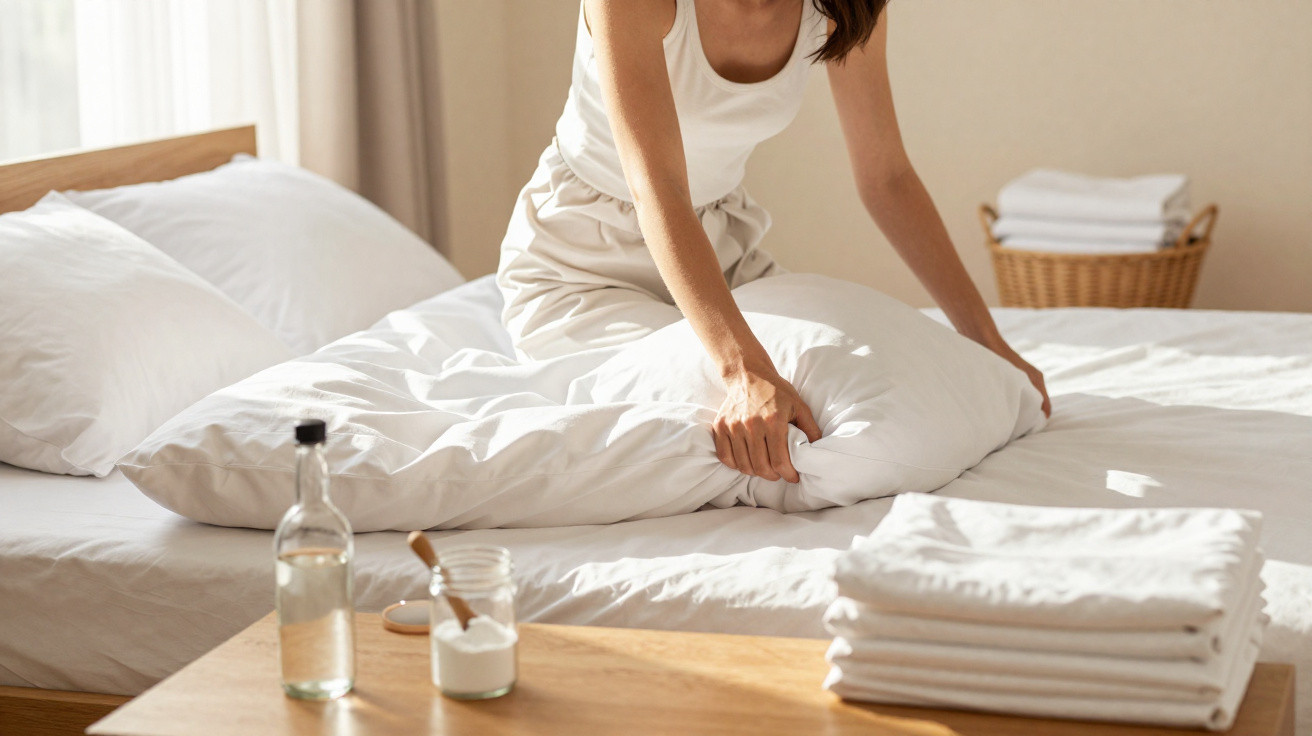
It is always the bed. You put down your suitcase, turn back the duvet and brush your hand across the sheets. They are cool, substantial and wonderfully almost crackly. You lie down “just for a second”, only to realise that your bed at home now seems sadly limp by comparison.
Then you return to your own bedroom and wash the bedding with your normal detergent, perhaps some fabric conditioner and a quick tumble-dry. It smells pleasant and it is clean, but the hotel “snap” has vanished. There is no weight, no crisp rustle-only softness and… a slightly underwhelming feel.
Between the commercial laundry and your washing machine at home lies an understated secret. It has much to do with vinegar, baking soda and the things hotels avoid doing to their sheets.
Why hotel sheets feel so unusually crisp and perfect
The moment you sit on a hotel bed, the sheets give a distinctive sensation. There is a little resistance as you pull them, as though they are filled tightly with invisible air. They are not fluffy; they are firm. When you move, your elbow creates a faint sound: a tiny whoosh of one layer of fabric against another.
That finish is no accident. Hotels buy hard-wearing, closely woven cotton or cotton-rich sheets, usually white, then process them in the same manner time after time. They are hot-washed, dried in industrial machines, firmly pressed and stacked almost like armour. That routine, combined with the weave, creates the sensation of wearing a freshly ironed shirt across your entire body.
Hotels also make use of psychology, naturally. Crisp bedding communicates cleanliness and attention to detail. It looks smart in photographs, folds neatly and creases less than you might expect. The aim is not a soft, cloud-like cocoon. Instead, hotels want you to feel that the space is clean, orderly and slightly luxurious.
In the background, commercial laundries handle sheets like athletes rather than delicate possessions. They use high temperatures and longer programmes, with powerful yet carefully dosed detergents. Fabric conditioner is generally left out because it can coat the fibres. Softener makes sheets feel smooth, but it also makes them a bit dead.
Next comes intensive pressing. Flatwork ironers draw damp sheets through enormous heated rollers, pressing and drying the cotton simultaneously. This is what produces the crisp texture and slight lustre. The fibres become aligned, the surface is flattened and the sheet feels dense as well as cool against the skin.
Thread count matters, though not in the way marketing often suggests. Hotel sheets commonly fall within the 250–400 thread count range, while relying on quality cotton and a percale weave. Percale uses a straightforward “one over, one under” construction, producing a matt, crisp result, whereas sateen feels silkier and drapes more heavily. A lower thread count, superior yarn and a firm weave make the combination you notice at 11 p.m. in an anonymous ninth-floor room.
How to recreate hotel-sheet crispness at home with vinegar and baking soda
Achieving that hotel texture at home begins well before bedtime. It starts in the washing machine. Rather than saturating your sheets with products, the aim is to remove build-up. Think “reset”, not “spa day”. The unexpectedly useful ingredients are ordinary white vinegar and baking soda.
On laundry day, leave out the fabric conditioner completely. Put the sheets in loosely rather than cramming them into the drum. Add your usual detergent, followed by ½ cup of baking soda straight into the drum. This can clean gently, neutralise odours and lessen the hold minerals have on the fibres. For the rinse, add ½ cup of white vinegar to the fabric-conditioner drawer. It works as a natural rinse aid that breaks down residue.
Your sheets will not retain a vinegar smell once the programme has finished. The aroma disappears as the bedding dries. In its place, you get uncoated cotton without the invisible layer that leaves sheets feeling limp. That stripped-back base is precisely what you need to have any hope of achieving hotel-level snap.
This is where everyday life gets in the way. On a Tuesday evening, after work, children and a partly forgotten dinner, no one wants to run two specialist washes, measure white vinegar as if working in a laboratory, then iron a king-size flat sheet. Let’s be honest: nobody really does that every day.
So approach it as a ritual rather than an exercise in perfection. You might plan one “hotel night” every fortnight. That is when you use the vinegar and baking soda combination, select a slightly longer programme and dry the sheets until they are only just damp. At that point, either hang them very flat or iron just the upper section that touches your face and shoulders.
A frequent mistake is using excess detergent. It may seem that more detergent means cleaner sheets, but it commonly creates more residue instead. Overfilling the machine is another problem: sheets knot into a dense bundle and fail to rinse properly. Leave them room to move, use a sensible detergent dose and allow the vinegar to quietly dissolve the remains left by your other products.
Once the underlying texture is cleaner, small adjustments make a rapid difference. A warmer wash, within the limits stated on the care label, a slightly cooler dry and removing the sheets as soon as the machine finishes all help retain that crisp feel. If possible, finish them on a washing line or clothes airer for an hour, pulled taut, so gravity can smooth them a little for you.
“The game‑changer wasn’t buying expensive sheets,” says a London housekeeper who’s worked in four‑ and five‑star hotels. “It was when I stopped using softener at home and started adding vinegar. Suddenly my cheap percale set felt 80% like the hotel ones.”
You can save a simple routine on your phone or tape it inside a cupboard door, so laundry day does not require too much thought:
- Choose percale or cotton-rich sheets rather than microfibre if you want genuine crispness.
- Wash using a modest amount of detergent + ½ cup of baking soda in the drum.
- Put ½ cup of white vinegar in the fabric-conditioner compartment for the rinse.
- Dry until only just dry, not overbaked, then hang or lightly iron for a hotel-style finish.
The understated joy of slipping into truly crisp sheets at home
Climbing into a bed made with genuinely crisp sheets produces a particular sound. The material settles in folds and layers instead of simply collapsing. Your legs meet something cool with a slight resistance. It feels deliberate, almost ceremonial, rather than as though “these sheets have just survived another random wash”.
We do not often acknowledge how strongly such small tactile details influence our mood: the duvet’s weight, the temperature of the pillowcase and the way the sheet clings just enough to your skin. During a difficult week, that first slide into a freshly made hotel-style bed can act like a reset button. It is not showy or Instagrammable, merely quietly grounding.
At a deeper level, bringing hotel-like sheets into your home is about having control over your surroundings. You cannot prevent your inbox from overflowing, but you can make a pocket of order in which everything is taut, smooth and faintly clean-smelling rather than heavily perfumed. This partly explains why the vinegar and baking soda method is so satisfying: it removes artificial softness and returns you to something more honest.
Once you have noticed the difference, it is difficult to ignore it. You begin to spot when your normal wash leaves the fabric slightly gummy. You notice how skipping fabric conditioner can paradoxically make sheets feel fresher. You start scheduling laundry so that “hotel night” coincides with the evening when you need it most. On an ordinary Wednesday, after a long and noisy day, that rustle of cotton can suddenly matter more than you would expect.
| Key point | Detail | Benefit for the reader |
|---|---|---|
| Vinegar in the rinse | ½ cup in the fabric-conditioner compartment to dissolve residue | Creates cleaner, fresher fibres without a heavy scent |
| Baking soda in the wash | ½ cup placed directly in the drum with detergent | Improves cleaning while reducing odours and the effects of hard water |
| Fabric and drying | Choose percale/cotton, dry fully without excessive heat, and remove immediately | Recreates the tension and “snap” associated with hotel sheets |
FAQ:
- Can I use vinegar and baking soda together in the same wash? Not in the same compartment at the same moment, or they mainly neutralise each other. Use baking soda with the detergent in the main wash, and vinegar only in the rinse cycle.
- Will my sheets smell like vinegar after washing? No, the smell fades as they dry. If you’re sensitive, use slightly less vinegar and dry them fully in fresh air or a well‑ventilated room.
- Does this method work with microfiber sheets? It can improve freshness, but microfiber won’t feel truly crisp like cotton percale. The weave and fiber matter as much as the washing routine.
- How often should I do the “hotel treatment” wash? Once every few washes is enough to reset residue. You can keep a lighter, regular routine in between and save the full treatment for your “hotel nights”.
- Is ironing absolutely necessary to get that hotel feel? Not absolutely, but lightly ironing at least the top part of the sheet gives a big boost in crispness. If you hate ironing, drying flat and folding quickly while warm is a decent compromise.





Comments
No comments yet. Be the first to comment!
Leave a Comment